

Unsupervised Semantic Segmentation by Distilling Feature Correspondences
Authors
Mark Hamilton, Zhoutong Zhang, Bharath Hariharan, Noah Snavely, William T. Freeman
Abstract
Unsupervised semantic segmentation aims to discover and localize semantically meaningful categories within image corpora without any form of annotation. To solve this task, algorithms must produce features for every pixel that are both semantically meaningful and compact enough to form distinct clusters. Unlike previous works which achieve this with a single end-to-end framework, we propose to separate feature learning from cluster compactification. Empirically, we show that current unsupervised feature learning frameworks already generate dense features whose correlations are semantically consistent. This observation motivates us to design STEGO ($\textbf{S}$elf-supervised $\textbf{T}$ransformer with $\textbf{E}$nergy-based $\textbf{G}$raph $\textbf{O}$ptimization), a novel framework that distills unsupervised features into high-quality discrete semantic labels. At the core of STEGO is a novel contrastive loss function that encourages features to form compact clusters while preserving their relationships across the corpora. STEGO yields a significant improvement over the prior state of the art, on both the CocoStuff ($\textbf{+14 mIoU}$) and Cityscapes ($\textbf{+9 mIoU}$) semantic segmentation challenges.
Concepts
The Big Picture
Imagine hiring someone to sort thousands of family photos into albums, but they’ve never met your family, seen your home, or been told what a “birthday” or “vacation” even means. They must figure out, purely from patterns in the images, which clusters of pixels belong together: sky with sky, faces with faces. Unsupervised semantic segmentation asks a computer to do exactly this, dividing an image into meaningful regions and assigning labels without any examples of what those labels should be. Machines have been terrible at it.
The problem has real stakes. Annotating a single image for semantic segmentation can take orders of magnitude longer than classifying it. In specialized domains like medicine or astrophysics, the “correct” labels may not even exist yet. Experts are still arguing about the right categories.
A system that discovers visual categories on its own would cut enormous annotation costs. A team from MIT, Cornell, and Google has built one. STEGO far outperforms previous unsupervised methods, not by designing a more complex end-to-end model, but by separating the job of understanding images from the job of labeling them.
Key Insight: Modern self-supervised visual features already “know” which pixels belong together. They just need a targeted distillation step to sharpen that knowledge into crisp, discrete segment labels.
How It Works
STEGO starts from an almost embarrassingly simple observation. Recent self-supervised learning frameworks (systems that learn from raw images without human labels, by exploiting internal patterns) produce a compact numerical descriptor for every small patch in an image. When the researchers looked at correlations between these descriptors, the structure was already semantically meaningful. Pixels belonging to “sky” correlated strongly with other sky pixels, and “person” features clustered with “person” features, even across different images.
The backbone is DINO, a Vision Transformer (ViT) trained without labels using self-distillation. A ViT processes an image as a grid of tiles and learns relationships between them, much like a language model processes word sequences.
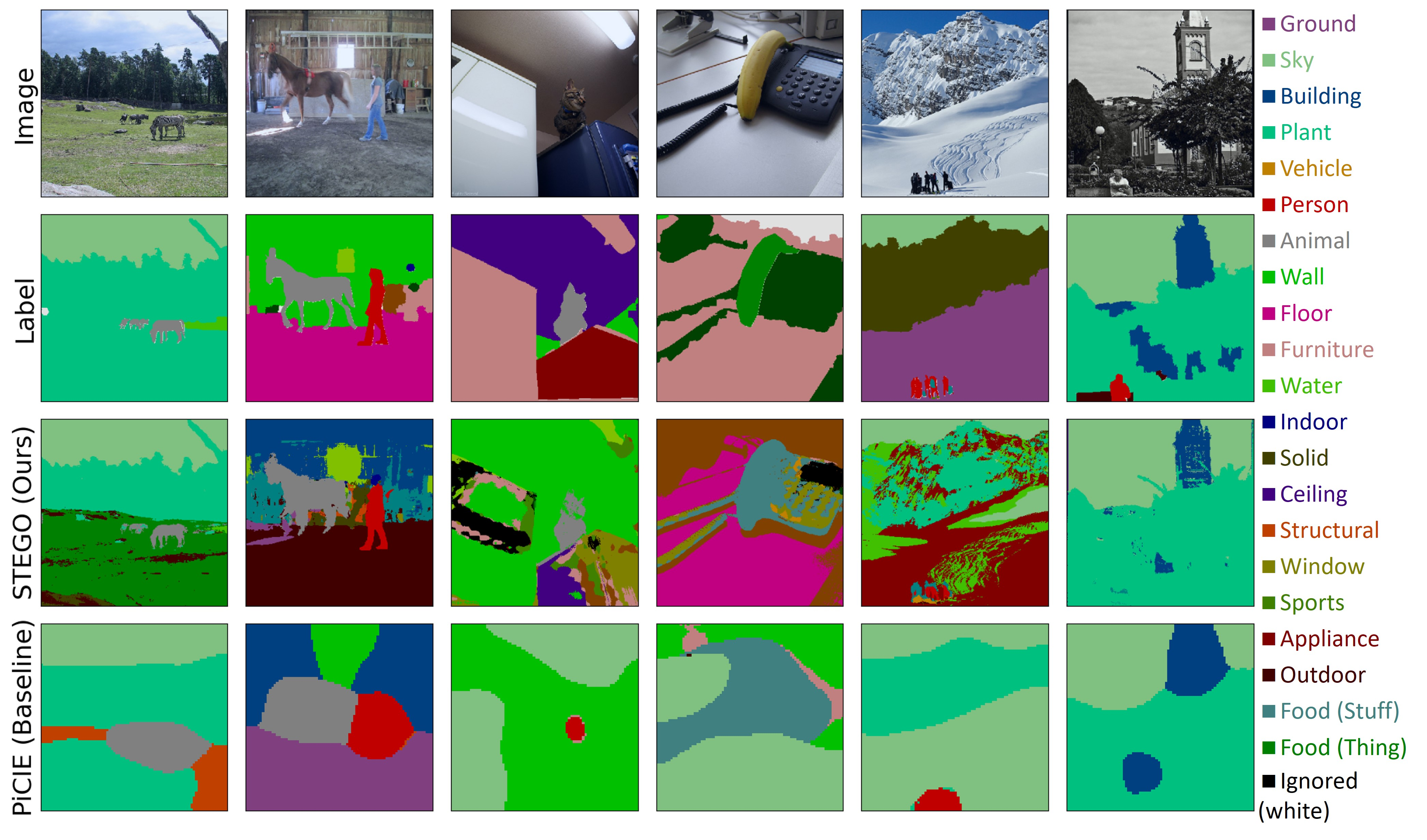
So the hard part, semantic understanding, is already handled. What remains is cluster compactification: taking soft, continuous feature correlations and converting them into hard, discrete assignments. Previous methods tried to do both at once, forcing awkward tradeoffs. STEGO does them in sequence.
The pipeline has two stages:
-
Feature extraction: A frozen DINO backbone (its weights are locked and not further adjusted) generates a semantic descriptor for every image patch. These embeddings are informative but fuzzy, not yet separable into clean groups.
-
Distillation via contrastive loss: A small network trains on top of those frozen features using an energy-based graph optimization loss. For any two images, the system identifies corresponding patches (pairs the pretrained features already consider similar) and trains the segmentation head to assign them consistent cluster labels. The loss preserves the relational structure of the original feature space, preventing all pixels from collapsing into one giant cluster.
The contrastive objective compares pairs of patches and asks: should these belong to the same group? It samples three types of positive correspondences: patches within the same image that are already similar (self-correspondences), patches from a nearest-neighbor image in the dataset (cross-image correspondences), and random spatial samples as a regularizer. Each pairing nudges the learned labels toward consistency. No human-defined category system is consulted at any point.
A linear probe or CRF post-processing step sharpens spatial edges. CRF (conditional random field) is a smoothing technique that refines boundaries by considering whether neighboring pixels likely share a label. K-means clustering over the learned embeddings produces the final segment map.
Why It Matters
STEGO beats the previous best unsupervised method by +14 mIoU on CocoStuff and +9 mIoU on Cityscapes. (mIoU, mean Intersection over Union, measures how accurately predicted segments overlap with the ground truth; 100 is perfect.) Both are large-scale benchmarks with dozens of semantic categories.
This isn’t incremental. It closes a large chunk of the gap with fully supervised systems.
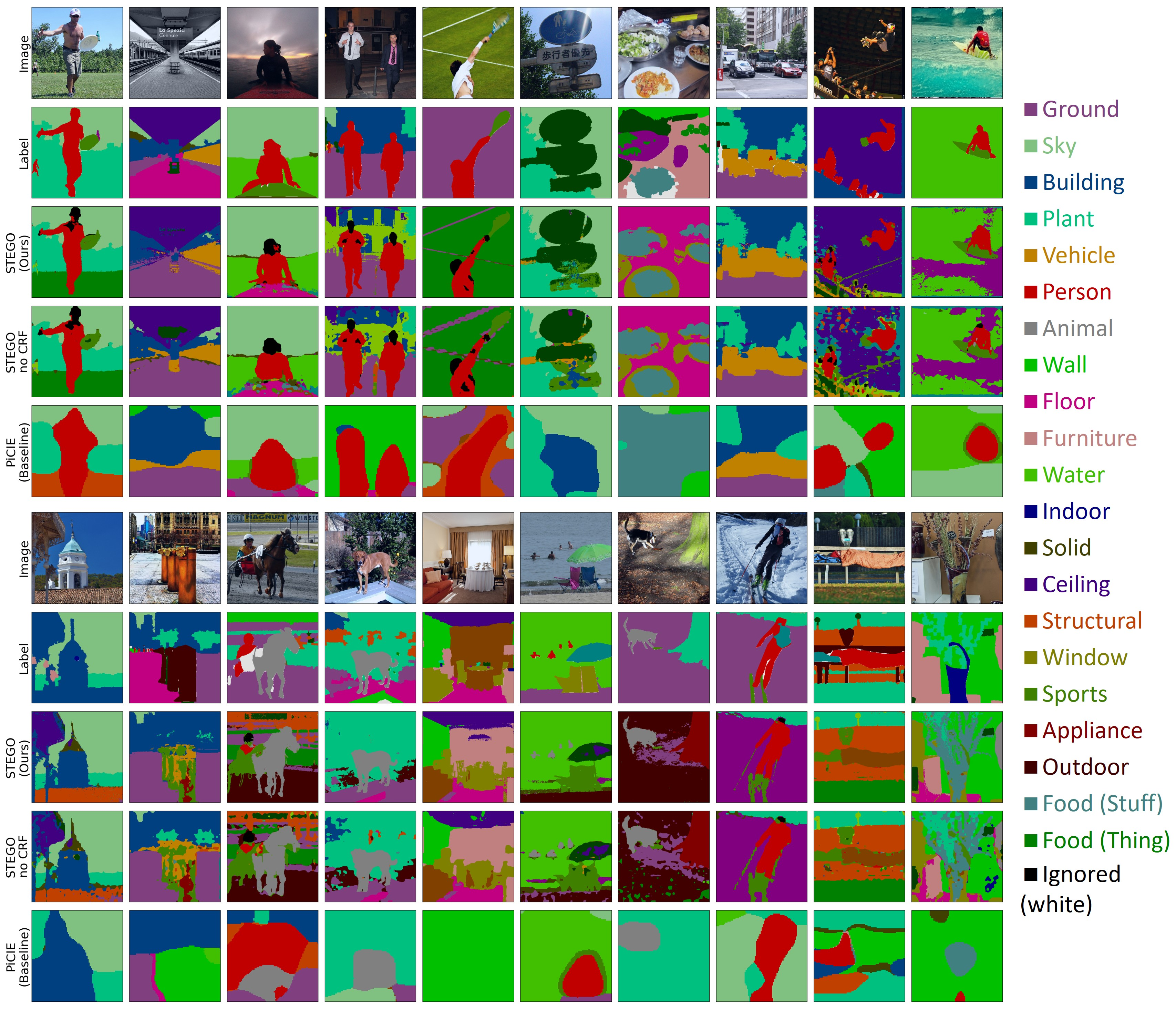
The deeper point is architectural. By decoupling feature learning from label discovery, STEGO becomes modular: as self-supervised feature extractors get better, STEGO can swap in stronger backbones and inherit the gains for free. That’s a design philosophy, not just a method.
Strong unsupervised perception may not require rethinking everything from scratch. It may be enough to organize the semantic knowledge that self-supervised models already encode.
Any domain where annotation is expensive or impossible stands to benefit. Histopathology slides, astronomical surveys, materials science micrographs: all fields where a system that organizes visual data without predefined categories would see immediate use.
Bottom Line: Self-supervised features already contain rich semantic structure. STEGO provides a targeted distillation framework that turns those latent correspondences into state-of-the-art segmentation maps, no human labels required.
IAIFI Research Highlights

Transformer architectures from NLP, combined with self-supervised learning, can solve dense spatial reasoning problems in scientific imaging, including astrophysics domains where ground-truth labels are unknown or poorly defined.

STEGO advances unsupervised computer vision with +14 mIoU and +9 mIoU gains on CocoStuff and Cityscapes over the previous state of the art, showing that separating feature learning from cluster compactification is a winning strategy.

Unsupervised segmentation tools like STEGO open up automated structure discovery in scientific images, from galaxy morphology to particle collision events, where human annotation is prohibitively expensive or the right categories are still debated.
Future work includes applying STEGO's distillation framework to domain-specific scientific datasets and plugging in stronger ViT backbones as self-supervised methods improve. See [arXiv:2203.08414](https://arxiv.org/abs/2203.08414).
Original Paper Details
Unsupervised Semantic Segmentation by Distilling Feature Correspondences
2203.08414
Mark Hamilton, Zhoutong Zhang, Bharath Hariharan, Noah Snavely, William T. Freeman
Unsupervised semantic segmentation aims to discover and localize semantically meaningful categories within image corpora without any form of annotation. To solve this task, algorithms must produce features for every pixel that are both semantically meaningful and compact enough to form distinct clusters. Unlike previous works which achieve this with a single end-to-end framework, we propose to separate feature learning from cluster compactification. Empirically, we show that current unsupervised feature learning frameworks already generate dense features whose correlations are semantically consistent. This observation motivates us to design STEGO ($\textbf{S}$elf-supervised $\textbf{T}$ransformer with $\textbf{E}$nergy-based $\textbf{G}$raph $\textbf{O}$ptimization), a novel framework that distills unsupervised features into high-quality discrete semantic labels. At the core of STEGO is a novel contrastive loss function that encourages features to form compact clusters while preserving their relationships across the corpora. STEGO yields a significant improvement over the prior state of the art, on both the CocoStuff ($\textbf{+14 mIoU}$) and Cityscapes ($\textbf{+9 mIoU}$) semantic segmentation challenges.