

Topological Obstructions to Autoencoding
Authors
Joshua Batson, C. Grace Haaf, Yonatan Kahn, Daniel A. Roberts
Abstract
Autoencoders have been proposed as a powerful tool for model-independent anomaly detection in high-energy physics. The operating principle is that events which do not belong to the space of training data will be reconstructed poorly, thus flagging them as anomalies. We point out that in a variety of examples of interest, the connection between large reconstruction error and anomalies is not so clear. In particular, for data sets with nontrivial topology, there will always be points that erroneously seem anomalous due to global issues. Conversely, neural networks typically have an inductive bias or prior to locally interpolate such that undersampled or rare events may be reconstructed with small error, despite actually being the desired anomalies. Taken together, these facts are in tension with the simple picture of the autoencoder as an anomaly detector. Using a series of illustrative low-dimensional examples, we show explicitly how the intrinsic and extrinsic topology of the dataset affects the behavior of an autoencoder and how this topology is manifested in the latent space representation during training. We ground this analysis in the discussion of a mock "bump hunt" in which the autoencoder fails to identify an anomalous "signal" for reasons tied to the intrinsic topology of $n$-particle phase space.
Concepts
The Big Picture
Imagine trying to flatten a map of the Earth. No matter how clever your projection, you’ll always distort something. Greenland balloons to the size of Africa, Antarctica stretches impossibly wide, and the poles become lines instead of points. This isn’t a flaw in your technique; it’s a mathematical fact about representing a curved, closed surface on a flat plane.
The same kind of problem haunts particle physicists trying to find exotic new particles at a collider. A popular tool for the job is the autoencoder, a neural network that compresses data into a compact representation, then reconstructs it. Train it on ordinary “background” physics events, and when something weird shows up, the autoencoder should fail to reconstruct it cleanly, flagging it as an anomaly. Physicists have used this approach in searches for new particles, hoping to spot signals that defy the Standard Model.
There’s just one problem. The same mathematics that ruins your flat map also ruins your autoencoder. The shape of physics data, the way it curves and connects in mathematical space, creates unavoidable obstructions to autoencoder-based anomaly detection.
When your data lives on a curved, closed surface in mathematical space (like a sphere), an autoencoder is mathematically forced to either distort the data or misclassify perfectly normal events as anomalies. No architecture trick fixes this.
How It Works
Phase space, the mathematical space of all possible particle momenta and energies in a collision, isn’t flat. For $n$ final-state particles, it has the topology of a sphere, $S^{3n-4}$: a curved, closed surface, not a simple box in $\mathbb{R}^k$.
An autoencoder squeezes data through a narrow latent space (a handful of summary coordinates) then expands it back out. If training data lives on a sphere, the autoencoder must map points on that sphere into a flat latent space and back. But you can’t continuously map a sphere onto a line without tearing it somewhere. The autoencoder, as a composition of continuous functions, is bound by the same topological laws that plague mapmakers.
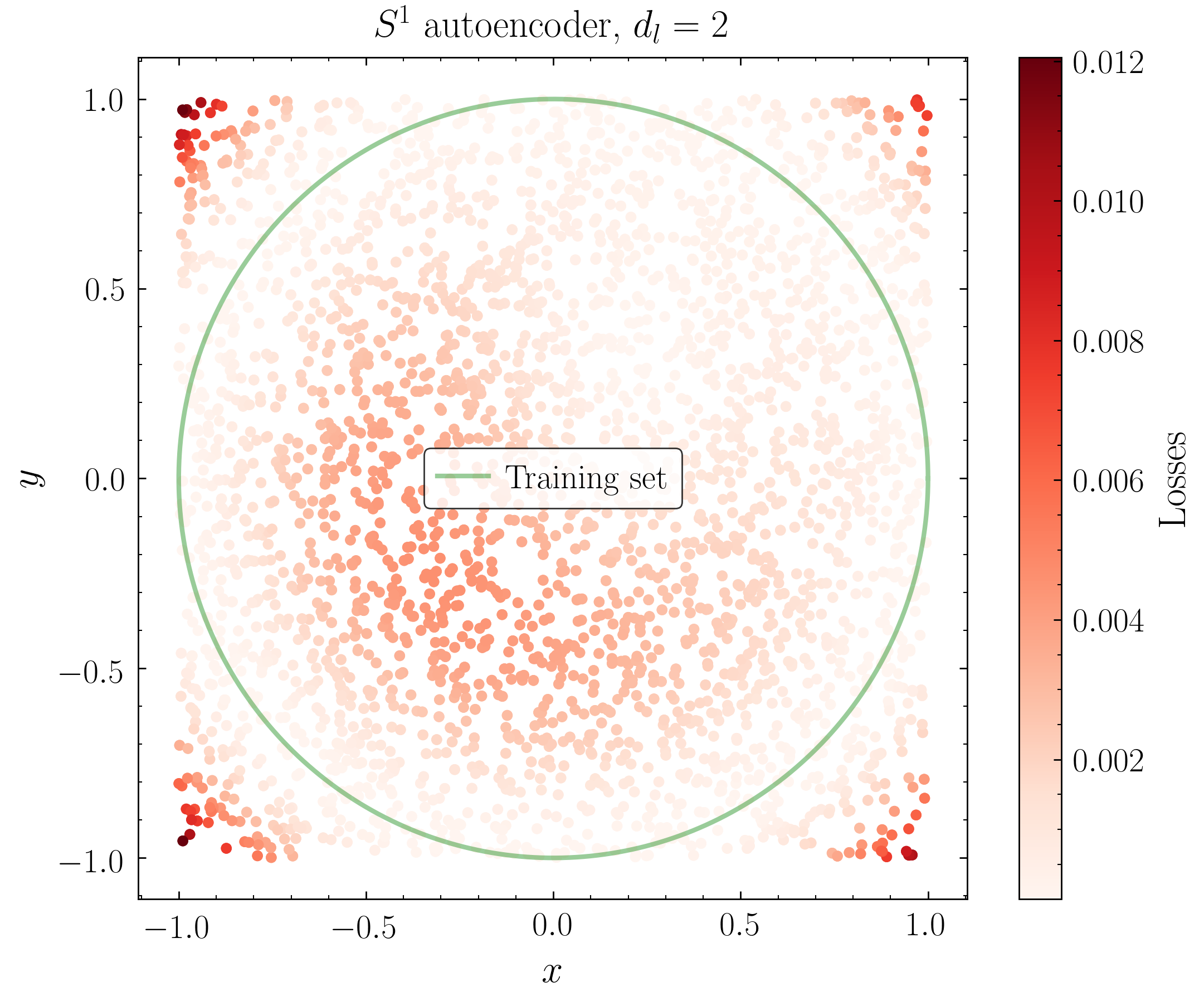
The simplest example is the unit circle $S^1$: every point at exactly distance 1 from a center, like the rim of a wheel. A single angle $\phi$ labels every point, but $\phi$ and $\phi + 2\pi$ are the same point. The angle wraps around.
When an autoencoder compresses the circle onto a line, it must “cut” the circle somewhere. Points near that cut are genuine neighbors on the circle but end up far apart in latent space, so the autoencoder flags them as badly reconstructed outliers. False positives, plain and simple.
Training actual autoencoders on these toy problems confirms the prediction. On a circle dataset, the network reliably produces a “dead zone” where reconstruction error spikes, not because those points are rare, but purely because of topology. The dead zone shifts with random initialization but never disappears.
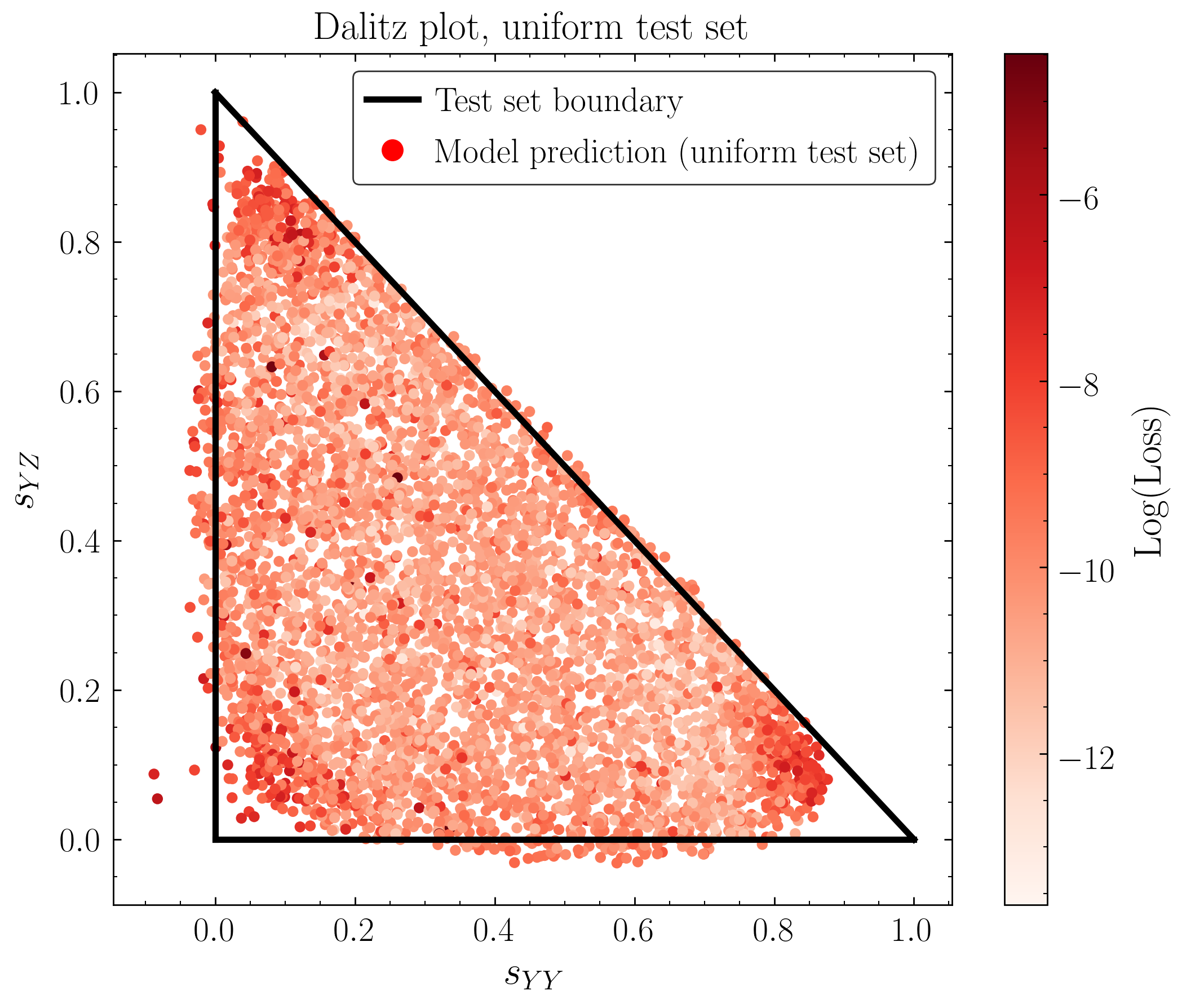
In higher dimensions the problems only get worse. The 2-sphere ($S^2$) has the same mapping failure, now with a larger distorted region around the “pole” of the projection. The double cone, two sheets joined at a point, shows how sharp geometric features and non-uniform sampling pile on additional confusion. 3-body phase space, directly relevant to collider physics, inherits spherical topology and displays all the same pathologies.
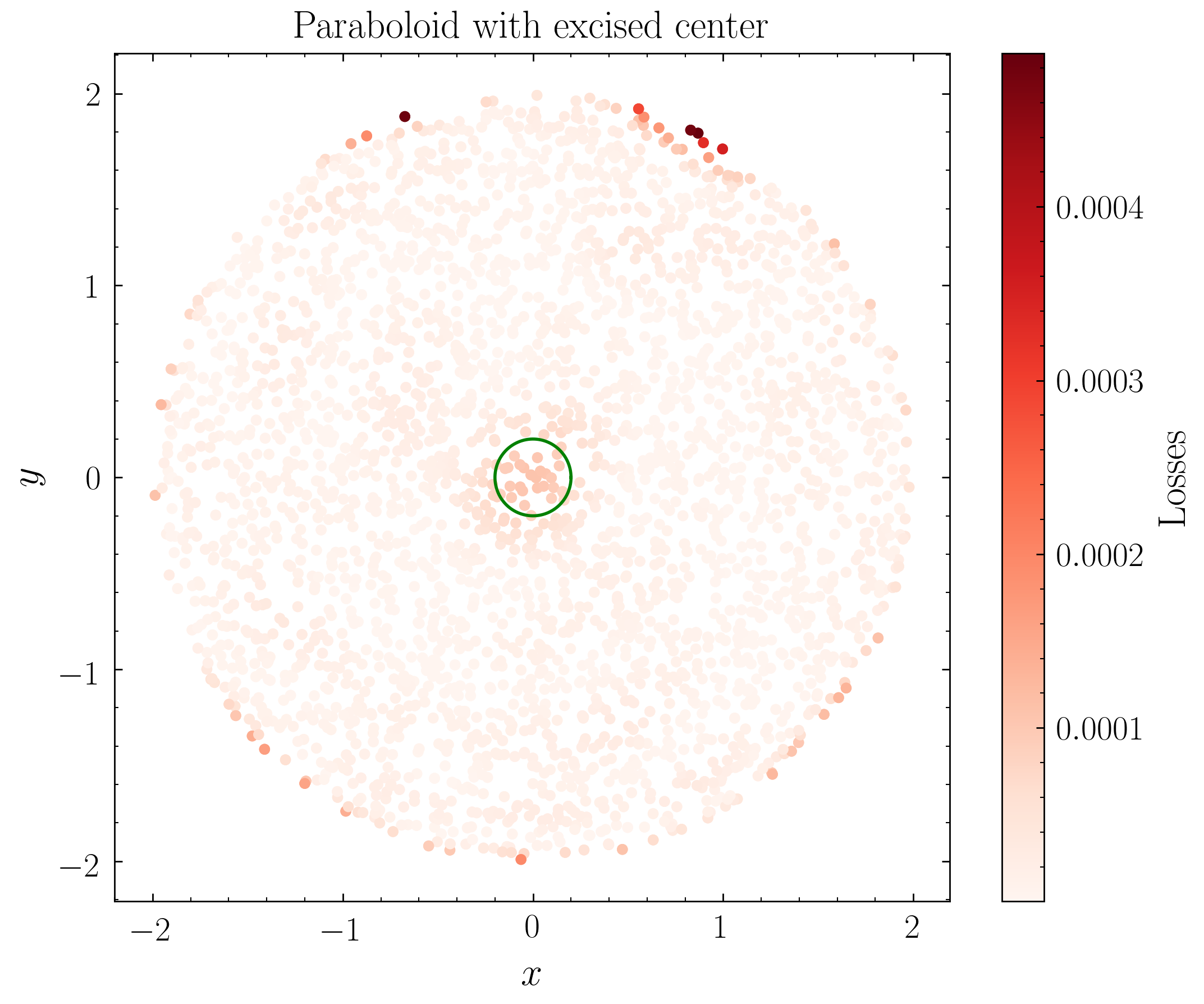
A second failure mode cuts in the opposite direction. Neural networks have a strong inductive bias toward local interpolation: they’re good at smoothly filling gaps between nearby training examples. If an anomaly signal is a rare but localized cluster of events (like Higgs decays concentrated at a specific invariant mass), the autoencoder may reconstruct those events too well. It interpolates across the gap, treats the signal as a natural extension of the background, and assigns a low reconstruction error. That’s exactly the wrong answer.
In a mock bump hunt, the standard search technique where physicists look for an unexpected spike in event counts at a particular energy, this failure plays out in full. The autoencoder misses the signal because the signal events live on a topologically equivalent submanifold that the network confidently interpolates over.
Why It Matters
This is a mathematically precise critique of a widely used tool. Autoencoders have been applied across particle physics, from jet substructure studies to new-physics searches, often with the implicit assumption that high reconstruction error means “anomalous event.” The topological analysis here shows that assumption breaks in predictable, systematic ways depending on the shape of the data manifold, not on sample size or network capacity.
The same issue arises wherever data lives on a non-Euclidean manifold. Possible remedies include variational autoencoders with latent-space priors shaped to match the data topology, anomaly scores that account for expected topological distortion, or hybrid approaches that pair autoencoders with density estimation methods less sensitive to global manifold structure.
How much does this failure mode affect real LHC searches currently underway? Can physicists systematically map the “dead zones” for specific processes before running a search? Studying low-dimensional examples carefully and then extrapolating to full phase space gives a concrete way to start finding out.
Autoencoders can’t escape topology. The same mathematics that prevents a perfect flat map of Earth prevents autoencoders from accurately representing curved data manifolds. Physicists searching for new particles with these tools may be chasing topological artifacts, or missing real signals hiding in plain sight.
IAIFI Research Highlights

This work uses algebraic topology and differential geometry to diagnose neural network failure modes in particle physics, connecting pure mathematics, machine learning theory, and experimental high-energy physics.

The paper identifies a fundamental, architecture-independent limitation of autoencoder-based anomaly detection on data with non-trivial topology, and shows how low-dimensional examples can anticipate these failures before they arise at scale.

By showing that $n$-particle phase space has spherical topology that systematically undermines autoencoder anomaly detection, this work calls into question model-independent new-physics searches at colliders and pushes toward topologically aware analysis methods.
Future work should explore topology-aware latent representations and anomaly scores designed for non-flat data geometry; the full analysis is available at [arXiv:2102.08380](https://arxiv.org/abs/2102.08380) (MIT-CTP/5264).