

Superphot+: Realtime Fitting and Classification of Supernova Light Curves
Authors
Kaylee M. de Soto, Ashley Villar, Edo Berger, Sebastian Gomez, Griffin Hosseinzadeh, Doug Branton, Sandro Campos, Melissa DeLucchi, Jeremy Kubica, Olivia Lynn, Konstantin Malanchev, Alex I. Malz
Abstract
Photometric classifications of supernova (SN) light curves have become necessary to utilize the full potential of large samples of observations obtained from wide-field photometric surveys, such as the Zwicky Transient Facility (ZTF) and the Vera C. Rubin Observatory. Here, we present a photometric classifier for SN light curves that does not rely on redshift information and still maintains comparable accuracy to redshift-dependent classifiers. Our new package, Superphot+, uses a parametric model to extract meaningful features from multiband SN light curves. We train a gradient-boosted machine with fit parameters from 6,061 ZTF SNe that pass data quality cuts and are spectroscopically classified as one of five classes: SN Ia, SN II, SN Ib/c, SN IIn, and SLSN-I. Without redshift information, our classifier yields a class-averaged F1-score of 0.61 +/- 0.02 and a total accuracy of 0.83 +/- 0.01. Including redshift information improves these metrics to 0.71 +/- 0.02 and 0.88 +/- 0.01, respectively. We assign new class probabilities to 3,558 ZTF transients that show SN-like characteristics (based on the ALeRCE Broker light curve and stamp classifiers), but lack spectroscopic classifications. Finally, we compare our predicted SN labels with those generated by the ALeRCE light curve classifier, finding that the two classifiers agree on photometric labels for 82 +/- 2% of light curves with spectroscopic labels and 72% of light curves without spectroscopic labels. Superphot+ is currently classifying ZTF SNe in real time via the ANTARES Broker, and is designed for simple adaptation to six-band Rubin light curves in the future.
Concepts
The Big Picture
Imagine trying to identify a million strangers in a crowd, not by talking to them, but purely by watching how they move. That’s roughly the challenge facing astronomers today. Every year, telescopes detect tens of thousands of stellar explosions called supernovae, each bright enough to outshine an entire galaxy.
To figure out what kind of explosion you’re looking at, you need a chemical fingerprint. Astronomers get this by pointing a spectrograph at each supernova, splitting its light into component wavelengths to reveal which elements are present. That process is slow, and current surveys can only follow up about 10% of detected events.
Things are about to get dramatically worse. The Vera C. Rubin Observatory will deliver roughly 100 times more supernova detections than current surveys. Telescope time for spectroscopic follow-up won’t scale anywhere near that fast. By some estimates, 99.9% of supernovae found by Rubin’s Legacy Survey of Space and Time (LSST) will never receive a spectroscopic classification.
A team led by Kaylee de Soto at the Center for Astrophysics | Harvard & Smithsonian built a tool to handle that flood. Their package, Superphot+, classifies supernovae using only the shape and color of their light curves: graphs tracking how a supernova brightens and fades over days and weeks. No spectrum required. It runs fast enough for real time.
Key Insight: Superphot+ achieves 83% overall accuracy classifying five types of supernovae from light curves alone, making it one of the few classifiers that can operate without redshift information at scale.
How It Works
The pipeline has two stages: fit the raw light curve data to a mathematical model, then feed those model parameters into a machine learning classifier.
The fitting stage uses a parametric model originally developed for the earlier Superphot pipeline. Given brightness measurements over time in multiple color bands (ZTF observes in red and green), Superphot+ finds the best parameters describing a light curve’s rise, peak, and decay. It uses nested sampling, a statistical technique that maps out all plausible parameter combinations rather than relying on random exploration. Each fit takes only seconds, which matters when you’re building a real-time system.
Then machine learning takes over. The best-fit parameters, capturing how sharply a supernova rises, how quickly it fades, and how its color evolves, become input features for a gradient-boosted machine (GBM). This is an ensemble method that builds many decision trees sequentially, with each one correcting the errors of the last. The team trained this classifier on 6,061 ZTF supernovae with confirmed spectroscopic labels, spanning five classes:
- Type Ia: thermonuclear explosions of white dwarf stars, the “standard candles” of cosmology
- Type II: core-collapse explosions of massive stars with hydrogen envelopes
- Type Ib/c: stripped-envelope core-collapse explosions
- Type IIn: explosions interacting with surrounding circumstellar material
- SLSN-I: superluminous supernovae, the brightest explosions known
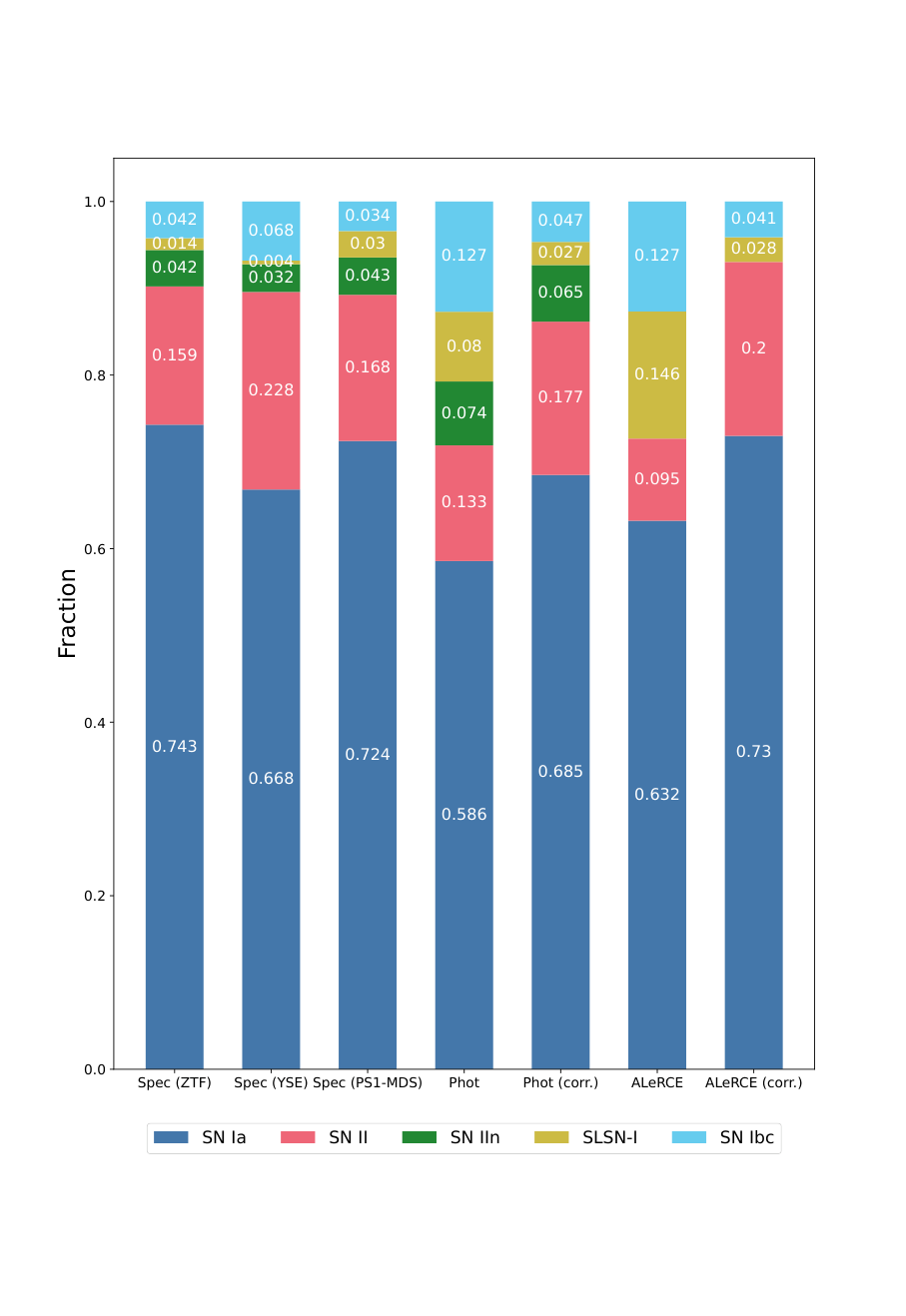
Class imbalance posed a real problem. Type Ia supernovae dominate the training set; rarer types like SLSNe are scarce. To keep the classifier from defaulting to “Type Ia!” for everything, the team synthetically generated extra training examples of underrepresented classes, a technique called oversampling.
Without any redshift information (a measure of how fast a galaxy is receding, used as a proxy for distance), Superphot+ achieves a class-averaged F1-score of 0.61 ± 0.02 and overall accuracy of 0.83 ± 0.01. F1-score penalizes the classifier for ignoring rare classes, so 0.61 across five unequal categories is a meaningful result.
Add redshift as an extra feature and those numbers jump to 0.71 ± 0.02 and 0.88 ± 0.01. The gap is real but not catastrophic, and that’s the point. Redshifts are often unavailable for the most exotic, distant, or host-galaxy-free supernovae, so a capable redshift-free classifier fills an important niche.
Why It Matters
Superphot+ isn’t a research demo. It’s already running. The pipeline operates in real time through the ANTARES Broker, one of the alert-filtering systems that processes ZTF’s nightly stream of detections. It has assigned probabilistic class labels to 3,558 ZTF transients that looked supernova-like but lacked spectroscopic confirmation. That gives astronomers a starting point for deciding where to aim their spectrographs next.
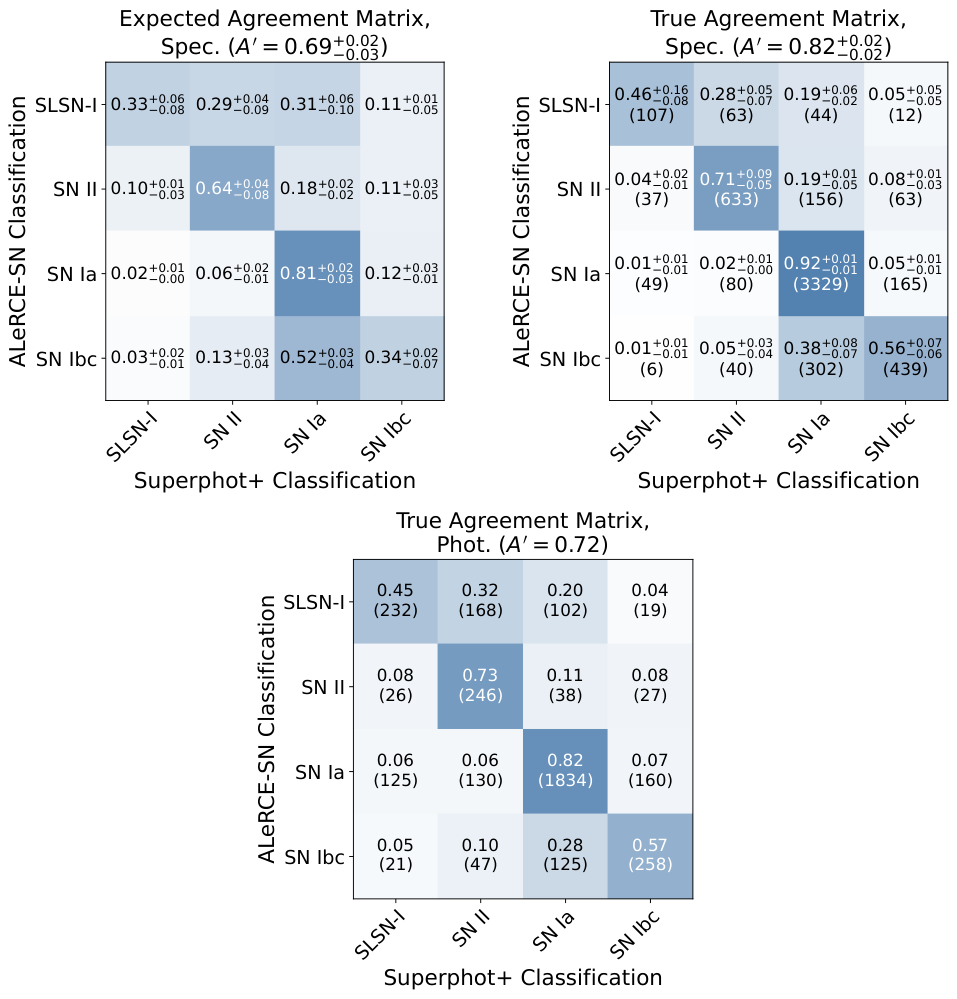
Compared to the independent ALeRCE classifier (another redshift-free system), the two agree on 82% of spectroscopically confirmed events and 72% of unconfirmed ones. Two pipelines built by different teams reaching similar conclusions is a good sign that the underlying signal holds up.
The bigger story is preparation for Rubin. LSST will observe in six photometric bands rather than ZTF’s two, and Superphot+ was built to extend straightforwardly to that richer dataset. When hundreds of thousands of supernovae go unclassified each year, tools like this become the primary scientific record. The classifications Superphot+ assigns will shape which events get studied in detail and which cosmological samples get assembled.
Bottom Line: Machine learning on light curve shapes alone can classify supernovae at better than 80% accuracy, and Superphot+ is already doing it on live telescope data, ready to scale to the Rubin deluge.
IAIFI Research Highlights

Superphot+ puts the IAIFI mission into practice: gradient-boosted ensembles and Bayesian nested sampling applied directly to real astrophysical survey data, turning raw telescope photometry into usable supernova classifications.

A working example of multi-class classification under severe label imbalance with missing features. When expected inputs like redshift are unavailable, the pipeline degrades gracefully rather than failing.

Photometric classification of thousands of supernovae at scale expands the samples available for studying stellar evolution, nucleosynthesis, and the use of Type Ia supernovae as cosmological distance indicators.
The team plans to extend Superphot+ to Rubin's six-band photometry as LSST comes online. The paper is available at [arXiv:2403.07975](https://arxiv.org/abs/2403.07975), and the code is publicly installable as the `superphot-plus` Python package.
Original Paper Details
Superphot+: Realtime Fitting and Classification of Supernova Light Curves
2403.07975
Kaylee M. de Soto, Ashley Villar, Edo Berger, Sebastian Gomez, Griffin Hosseinzadeh, Doug Branton, Sandro Campos, Melissa DeLucchi, Jeremy Kubica, Olivia Lynn, Konstantin Malanchev, Alex I. Malz
Photometric classifications of supernova (SN) light curves have become necessary to utilize the full potential of large samples of observations obtained from wide-field photometric surveys, such as the Zwicky Transient Facility (ZTF) and the Vera C. Rubin Observatory. Here, we present a photometric classifier for SN light curves that does not rely on redshift information and still maintains comparable accuracy to redshift-dependent classifiers. Our new package, Superphot+, uses a parametric model to extract meaningful features from multiband SN light curves. We train a gradient-boosted machine with fit parameters from 6,061 ZTF SNe that pass data quality cuts and are spectroscopically classified as one of five classes: SN Ia, SN II, SN Ib/c, SN IIn, and SLSN-I. Without redshift information, our classifier yields a class-averaged F1-score of 0.61 +/- 0.02 and a total accuracy of 0.83 +/- 0.01. Including redshift information improves these metrics to 0.71 +/- 0.02 and 0.88 +/- 0.01, respectively. We assign new class probabilities to 3,558 ZTF transients that show SN-like characteristics (based on the ALeRCE Broker light curve and stamp classifiers), but lack spectroscopic classifications. Finally, we compare our predicted SN labels with those generated by the ALeRCE light curve classifier, finding that the two classifiers agree on photometric labels for 82 +/- 2% of light curves with spectroscopic labels and 72% of light curves without spectroscopic labels. Superphot+ is currently classifying ZTF SNe in real time via the ANTARES Broker, and is designed for simple adaptation to six-band Rubin light curves in the future.