

Substructure Detection Reanalyzed: Dark Perturber shown to be a Line-of-Sight Halo
Authors
Atınç Çağan Şengül, Cora Dvorkin, Bryan Ostdiek, Arthur Tsang
Abstract
Observations of structure at sub-galactic scales are crucial for probing the properties of dark matter, which is the dominant source of gravity in the universe. It will become increasingly important for future surveys to distinguish between line-of-sight halos and subhalos to avoid wrong inferences on the nature of dark matter. We reanalyze a sub-galactic structure (in lens JVAS B1938+666) that has been previously found using the gravitational imaging technique in galaxy-galaxy lensing systems. This structure has been assumed to be a satellite in the halo of the main lens galaxy. We fit the redshift of the perturber of the system as a free parameter, using the multi-plane thin-lens approximation, and find that the redshift of the perturber is $z_\mathrm{int} = 1.42\substack{+0.10 \\ -0.15}$ (with a main lens redshift of $z=0.881$). Our analysis indicates that this structure is more massive than the previous result by an order of magnitude. This constitutes the first dark perturber shown to be a line-of-sight halo with a gravitational lensing method.
Concepts
The Big Picture
Imagine trying to identify a car’s make and model from its shadow alone, and the shadow might belong to a car parked right beside you or to one miles away. That’s roughly the challenge astronomers face when searching for hidden clumps of dark matter in gravitational lens images, where a foreground galaxy’s gravity bends and distorts light from a background galaxy into stretched arcs or perfect rings.
A tiny distortion in one of those arcs might signal a dark matter satellite: a small clump of invisible matter orbiting the foreground galaxy like a dark moon around a dark planet. Or it might come from a completely separate dark matter cloud drifting somewhere between us and the distant background galaxy. For decades, researchers have assumed the former. A new analysis by Harvard physicists suggests that assumption can be badly wrong.
The system in question, JVAS B1938+666, is one of only a handful of galaxy-galaxy lenses where astronomers have directly imaged a dark gravitational perturber, a clump of matter with no visible stars, detectable only through the tiny distortions it imprints on the lensed Einstein ring. (That’s the complete halo of light that forms when foreground and background galaxies align nearly perfectly.) When first reported by Vegetti and collaborators, this perturber was classified as a subhalo orbiting the main foreground galaxy, with a mass of roughly 190 million solar masses. A reasonable subhalo, if cold dark matter behaves as cosmologists expect. Cold dark matter is the leading theory, predicting that dark matter particles move slowly and clump on small scales.
Atınç Çağan Şengül, Cora Dvorkin, Bryan Ostdiek, and Arthur Tsang asked a different question: what if the perturber isn’t orbiting the lens galaxy at all? What if it’s a free-floating halo sitting somewhere behind it, along the line of sight? Their answer overturns a decade-old result and has uncomfortable implications for the rest of the field.
For the first time, a gravitational lensing analysis has shown that a “dark perturber” previously classified as a satellite of the main lens is actually a free-floating line-of-sight halo, with a true mass ten times larger than originally reported.
How It Works
The gravitational imaging technique works by forward-modeling a lensed image pixel by pixel. You build a model of the main lens galaxy’s mass distribution, a model of the background source, add any small perturbers, and compare the predicted image to the real Hubble Space Telescope observation. Where residuals are too large, you’ve found substructure.
The key move here was simple: treat the redshift of the perturber as a free parameter. Redshift measures how far an object’s light has been stretched by cosmic expansion; the farther away an object is, the higher its redshift. Rather than assuming the perturber shares the main lens galaxy’s redshift (z = 0.881), the team let the fit decide where along the line of sight it actually sits.
The standard assumption makes intuitive sense: satellites orbit their hosts. But gravitational optics doesn’t enforce it. A foreground or background halo can produce similar arc distortions, and without a spectroscopic redshift for a dark, invisible object, a single image can’t pin down its location.
To handle a perturber at a different redshift, the team used the multi-plane thin-lens approximation, a framework that tracks light rays bending through multiple gravitational planes stacked along the line of sight, like a stack of curved glass sheets. A background halo’s deflection pattern carries a non-vanishing curl (a measurable twist in how light rays get redirected) that a single-plane model cannot reproduce. That geometric fingerprint is what breaks the tie between the two scenarios.
Their pipeline used lenstronomy, an open-source Python lensing package, with these components:
- A Power-Law Elliptical Mass Distribution (PEMD) for the main lens, describing how mass falls off from the galaxy’s center in an elliptical, power-law pattern
- A Navarro-Frenk-White (NFW) profile for the perturber, the standard theoretical shape for dark matter halos, dense at the core and tapering toward the edges
- An external shear component to account for nearby mass structures
- Two Sérsic profiles for lens-light subtraction
They sampled the full posterior over all model parameters, including the perturber’s redshift, position, mass, and concentration. The result was unambiguous.
Why It Matters
The perturber’s redshift converged not to z = 0.881, but to z = 1.42 (±0.10/0.15), well behind the main lens galaxy. It’s not a satellite. It’s an interloper: a free-floating dark matter halo between the lens and the source galaxy at z = 2.059.
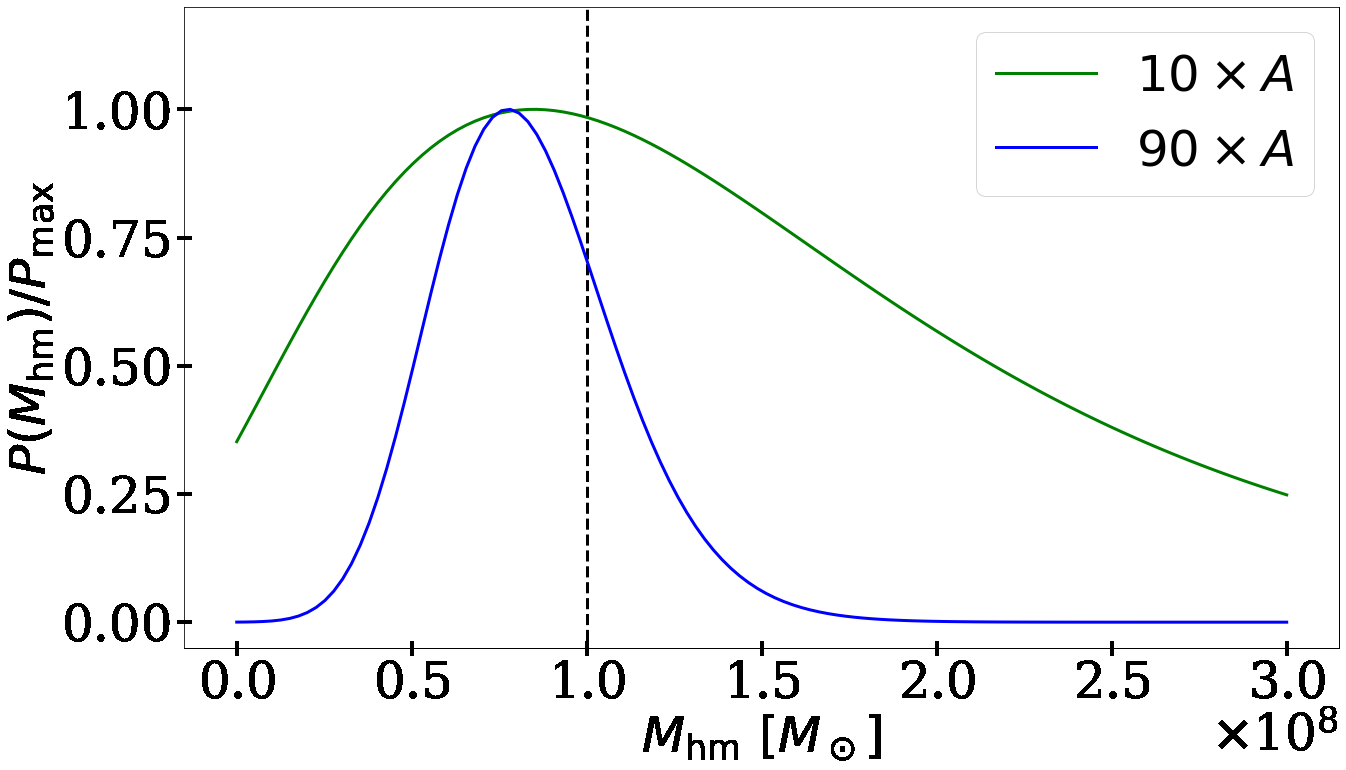
The mass shifts by a factor of ten. As a tightly bound subhalo, the perturber appeared to weigh ~1.9 × 10⁸ solar masses. Placed at its true distance as a background NFW halo, it comes out an order of magnitude heavier. The lensing geometry changes entirely when you relocate the perturber to a different redshift, and the inferred mass changes with it.
This isn’t a minor recalibration. It changes what the object is, where it lives, and which population it belongs to.
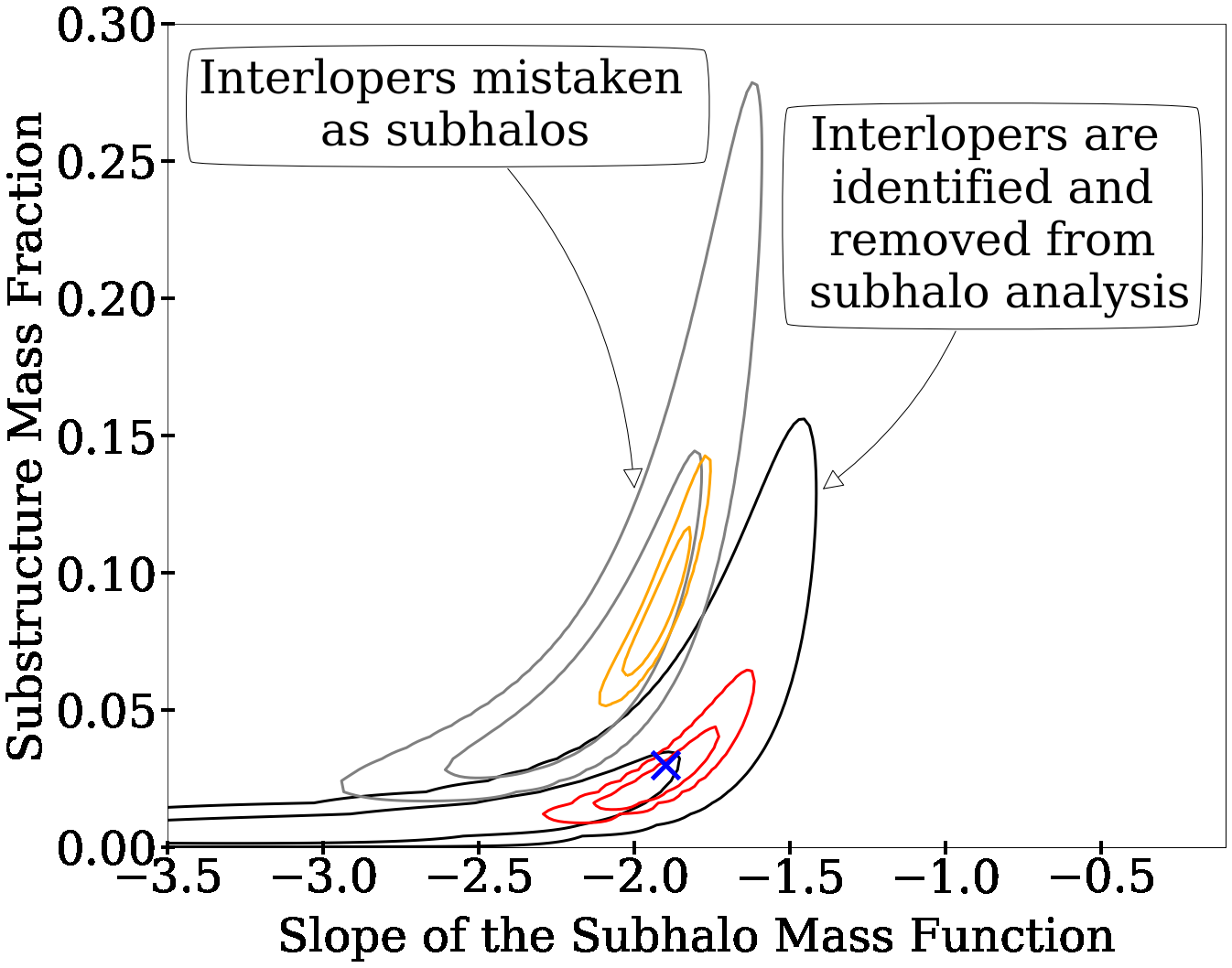
One wrong classification wouldn’t matter much on its own. But strong gravitational lens surveys from Rubin Observatory’s LSST and Euclid will detect hundreds to thousands of dark perturbers in the coming decade. If astronomers keep assuming every detected perturber is a subhalo and use those detections to measure the subhalo mass function, one of the best ways to tell cold dark matter apart from warmer or fuzzier alternatives, they will systematically bias their results with contaminating interlopers.
Previous theoretical work, including from the same Harvard group, had already predicted on statistical grounds that most detected perturbers should be interlopers. This is the first time anyone has confirmed it with real data. Going forward, substructure analyses need to fit perturber redshift as a free parameter or risk drawing the wrong conclusions about what dark matter actually is.
What was thought to be a 190-million-solar-mass dark satellite turns out to be a billion-solar-mass free-floating halo sitting behind the lens: a case of mistaken cosmic identity that exposes a systematic blind spot in how the field measures dark matter substructure.
IAIFI Research Highlights

The team combined gravitational lensing astrophysics with Bayesian posterior sampling and open-source computational tools, overturning a physical interpretation through statistical reanalysis of existing data rather than new observations.

The pipeline relies on differentiable lensing software and full posterior sampling over high-dimensional parameter spaces, a natural fit for future ML-accelerated lens modeling that can systematically fit perturber redshifts across survey-scale datasets.

By reclassifying a canonical "dark matter subhalo" detection as a line-of-sight halo, this work calls into question how the field constrains subhalo mass functions, one of the key measurements for distinguishing cold dark matter from alternative models.
Future strong-lensing surveys must adopt multi-plane lens modeling and treat perturber redshift as a free parameter to avoid biased inferences on dark matter properties; the full analysis is available at [arXiv:2112.00749](https://arxiv.org/abs/2112.00749).
Original Paper Details
Substructure Detection Reanalyzed: Dark Perturber shown to be a Line-of-Sight Halo
2112.00749
["At\u0131n\u00e7 \u00c7a\u011fan \u015eeng\u00fcl", "Cora Dvorkin", "Bryan Ostdiek", "Arthur Tsang"]
Observations of structure at sub-galactic scales are crucial for probing the properties of dark matter, which is the dominant source of gravity in the universe. It will become increasingly important for future surveys to distinguish between line-of-sight halos and subhalos to avoid wrong inferences on the nature of dark matter. We reanalyze a sub-galactic structure (in lens JVAS B1938+666) that has been previously found using the gravitational imaging technique in galaxy-galaxy lensing systems. This structure has been assumed to be a satellite in the halo of the main lens galaxy. We fit the redshift of the perturber of the system as a free parameter, using the multi-plane thin-lens approximation, and find that the redshift of the perturber is $z_\mathrm{int} = 1.42\substack{+0.10 \\ -0.15}$ (with a main lens redshift of $z=0.881$). Our analysis indicates that this structure is more massive than the previous result by an order of magnitude. This constitutes the first dark perturber shown to be a line-of-sight halo with a gravitational lensing method.