

Structure factor and topological bound of twisted bilayer semiconductors at fractional fillings
Authors
Timothy Zaklama, Di Luo, Liang Fu
Abstract
The structure factor is a useful observable for probing charge density correlations in real materials, and its long-wavelength behavior encapsulated by ``quantum weight'' has recently gained prominence in the study of quantum geometry and topological phases of matter. Here we employ the static structure factor, S(q), to explore the phase diagram of twisted transition metal dichalcogenides (TMDs), specifically tMoTe2, at filling factors n=1/3, 2/3 under varying displacement fields. Our results reveal a topological phase transition between a fractional Chern insulator (FCI) and a generalized Wigner crystal (GWC). This transition is marked by the appearance of Bragg peaks at charge-density-wave vectors, and simultaneously, large decrease of S(q) at small q which lowers the interaction energy. We further calculate the quantum weight of various FCI states, verifying the universal topological bound. Our findings provide new insights into the phase diagram of twisted TMDs and establish a general framework for characterizing topological phases through structure factor analysis.
Concepts
The Big Picture
Think of tuning a radio dial. Most frequencies give you static or a clear station, but at certain spots you catch the signal flickering between two broadcasts at once. Physicists face something similar with exotic quantum materials: how do you pinpoint the moment a material switches between two very different quantum phases?
In twisted bilayer semiconductors, sheets of atomically thin material stacked at a slight angle, electrons organize into different states depending on experimental conditions. At specific fractional fillings (simple fractions like 1/3 or 2/3 of available quantum states), the system tips into one of two phases. One is a fractional Chern insulator (FCI), a fluid-like state where electrons collectively behave as exotic quasiparticles. The other is a generalized Wigner crystal (GWC), where electrons lock into a rigid periodic arrangement, frozen in place to minimize their mutual repulsion. Telling these two apart experimentally has been a persistent challenge.
Researchers at MIT (Timothy Zaklama, Di Luo, and Liang Fu) found a direct diagnostic: the structure factor, a quantity that measures how charge clumps and spreads at different length scales, accessible through X-ray or electron scattering. They used it to map the full phase diagram of twisted molybdenum ditelluride (tMoTe₂) and, along the way, verified a universal inequality linking quantum geometry to a topological integer that remains constant even as other conditions change.
Key Insight: The structure factor reveals a sharp phase transition between topological and crystalline states in twisted semiconductors, and its long-wavelength behavior obeys a universal bound set by the material’s topological invariant.
How It Works
The static structure factor S(q) measures the likelihood of charge density fluctuations at a given spatial wavelength q in the material’s ground state. In a crystal, S(q) shows sharp Bragg peaks at specific wavevectors: spikes that fingerprint the regular spacing of charges. In a topological liquid, those peaks vanish, but the small-q regime carries its own information.
The central quantity is quantum weight K, the coefficient describing how fast S(q) grows as q goes to zero. Quantum weight connects to optical conductivity, charge fluctuations, and many-body quantum geometry, which captures how the collective electron state shifts when boundary conditions change.
A recently proven theorem establishes a universal lower bound: K ≥ |C|, where C is the many-body Chern number, the integer-valued topological invariant that classifies quantum Hall-like states. Idealized quantum Hall states under strong magnetic fields saturate this bound. Whether it holds for the more complex, field-free FCIs found in moiré materials was an open question.
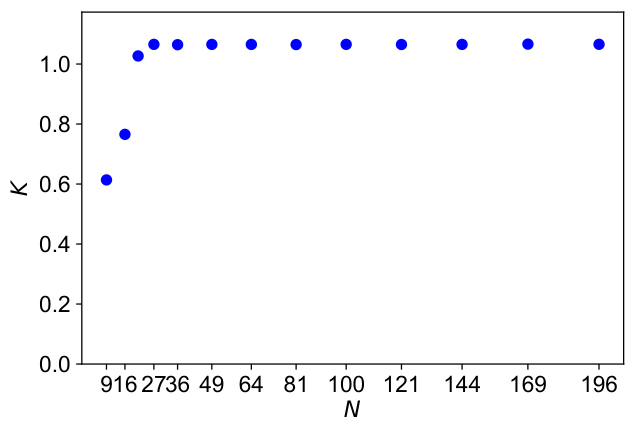
The team answered it using band-projected exact diagonalization (ED), solving the full quantum many-body problem exactly within the low-energy bands that govern the physics. They modeled tMoTe₂ at filling fractions ν = 1/3 and 2/3, systematically varying the displacement field D (an electric field perpendicular to the layers that controls band topology). At low fields, the relevant bands carry Chern number C = 1, placing electrons in a topological phase. At large fields, the bands become trivial (C = 0).
Their workflow had three steps:
- Construct the single-particle continuum model for spin-1/2 holes in the twisted bilayer
- Diagonalize the full interacting Hamiltonian (including Coulomb repulsion) for small finite-size systems at fixed filling
- Compute S(q) across all momenta and extract quantum weight K from the small-q behavior
At ν = 1/3 and low displacement fields, S(q) shows no Bragg peaks, consistent with an FCI liquid. Quantum weight sits above the topological bound. As the displacement field increases past a critical value, the picture changes abruptly.
Bragg peaks appear at charge-density-wave vectors, momenta that correspond to a crystalline charge pattern where electrons have settled into a periodic arrangement. This is the GWC. At the same time, S(q) at small q drops sharply, falling below the topological bound K ≥ |C|. That drop is self-consistent: the GWC has C = 0, so the bound no longer applies. But the discontinuity marks the topological phase transition clearly and quantitatively.
At ν = 2/3, the FCI-to-GWC transition is even sharper. The team also identified a specific twist angle where the FCI’s quantum weight nearly saturates the topological bound, meaning the state is as geometrically tight as possible. At larger twist angles, K still exceeds |C| but by a wider margin. There is an analogy here to the magic angles in twisted bilayer graphene, where flat bands and strong correlations coincide.
The bound held across every computed FCI state: both filling fractions, all tested twist angles, all displacement fields. This is the first numerical confirmation of the universal inequality for strongly interacting fractional quantum Hall-like systems.
Why It Matters
Experimentalists now have a measurable signature to distinguish topological from crystalline phases in moiré materials without relying on transport or Hall conductivity measurements. X-ray scattering and electron energy-loss spectroscopy can probe S(q) in real samples, making this framework applicable to ongoing experiments on tMoTe₂ and related systems.
Verifying K ≥ |C| for interacting FCIs also matters on a theoretical level. It puts quantum weight, rooted in many-body quantum geometry, on equal footing with topological invariants. The structure factor becomes a probe of quantum geometry in settings where traditional topological diagnostics are difficult or inaccessible.
The same approach can be applied to other fractional fillings, other moiré platforms, and potentially other symmetry classes or dimensions. Can bound saturation be achieved experimentally? What happens at Jain-sequence fillings like ν = 2/5 or 3/7? Those are questions for the next round of calculations and experiments.
Bottom Line: By computing the structure factor across the tMoTe₂ phase diagram, researchers pinpointed the topological-to-crystalline phase transition and confirmed a universal law linking quantum geometry to topology, giving experimentalists a new tool to read the quantum fingerprints of exotic matter.
IAIFI Research Highlights

This work connects quantum topology, condensed matter experiment, and many-body computation, using a measurable scattering observable to diagnose and characterize exotic quantum phases in moiré semiconductors.

The exact diagonalization framework pushes forward computational methods for strongly correlated quantum systems, with relevance to quantum simulation and machine learning approaches to many-body Hamiltonians.

This paper provides the first numerical verification of the universal topological bound K ≥ |C| for interacting fractional Chern insulators, a foundational result in the theory of topological quantum matter.
Future work will extend this structure factor framework to other moiré systems and fractional fillings; the paper is available at [arXiv:2411.03496](https://arxiv.org/abs/2411.03496).
Original Paper Details
Structure factor and topological bound of twisted bilayer semiconductors at fractional fillings
2411.03496
["Timothy Zaklama", "Di Luo", "Liang Fu"]
The structure factor is a useful observable for probing charge density correlations in real materials, and its long-wavelength behavior encapsulated by ``quantum weight'' has recently gained prominence in the study of quantum geometry and topological phases of matter. Here we employ the static structure factor, S(q), to explore the phase diagram of twisted transition metal dichalcogenides (TMDs), specifically tMoTe2, at filling factors n=1/3, 2/3 under varying displacement fields. Our results reveal a topological phase transition between a fractional Chern insulator (FCI) and a generalized Wigner crystal (GWC). This transition is marked by the appearance of Bragg peaks at charge-density-wave vectors, and simultaneously, large decrease of S(q) at small q which lowers the interaction energy. We further calculate the quantum weight of various FCI states, verifying the universal topological bound. Our findings provide new insights into the phase diagram of twisted TMDs and establish a general framework for characterizing topological phases through structure factor analysis.