

Stochastic logic in biased coupled photonic probabilistic bits
Authors
Michael Horodynski, Charles Roques-Carmes, Yannick Salamin, Seou Choi, Jamison Sloan, Di Luo, Marin Soljačić
Abstract
Optical computing often employs tailor-made hardware to implement specific algorithms, trading generality for improved performance in key aspects like speed and power efficiency. An important computing approach that is still missing its corresponding optical hardware is probabilistic computing, used e.g. for solving difficult combinatorial optimization problems. In this study, we propose an experimentally viable photonic approach to solve arbitrary probabilistic computing problems. Our method relies on the insight that coherent Ising machines composed of coupled and biased optical parametric oscillators can emulate stochastic logic. We demonstrate the feasibility of our approach by using numerical simulations equivalent to the full density matrix formulation of coupled optical parametric oscillators.
Concepts
The Big Picture
Imagine solving a puzzle where thousands of pieces must fit together simultaneously. Not one at a time, but all at once. Classical computers tackle such problems sequentially, which becomes impossibly slow as the puzzle grows. Nature, on the other hand, solves similar problems constantly: atoms in magnets spontaneously arrange into minimum-energy configurations without trying every combination. What if we could build a computer that worked the same way, using light?
That’s the idea behind probabilistic computing. Individual bits don’t hold fixed 0s and 1s but fluctuate randomly between both states, like a coin spinning in mid-air. String enough of these “probabilistic bits” together and the whole system naturally gravitates toward solutions to hard optimization problems.
The catch: nobody had built a fully functional optical version. A team from MIT and Stanford now shows that networks of coupled laser-like devices, guided by carefully injected beams of light, can carry out any kind of probabilistic logic operation. The result turns existing optical hardware (machines already used to search for optimal solutions) into a general-purpose probabilistic computer.
Key Insight: By injecting a small coherent bias field into each node of an optical parametric oscillator network, researchers can implement the full Ising Hamiltonian, including the previously missing “Zeeman term.” This enables any probabilistic logic circuit to run on optical hardware.
How It Works
The approach converts any computational problem into something a photonic network can solve natively, in three steps.
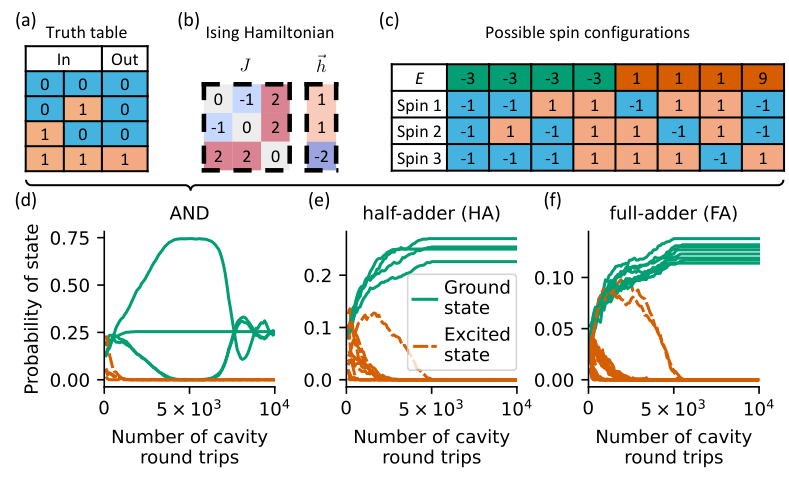
Step 1: Write the truth table. Every logic gate (AND, OR, XOR) can be described by a table listing all possible input-output combinations.
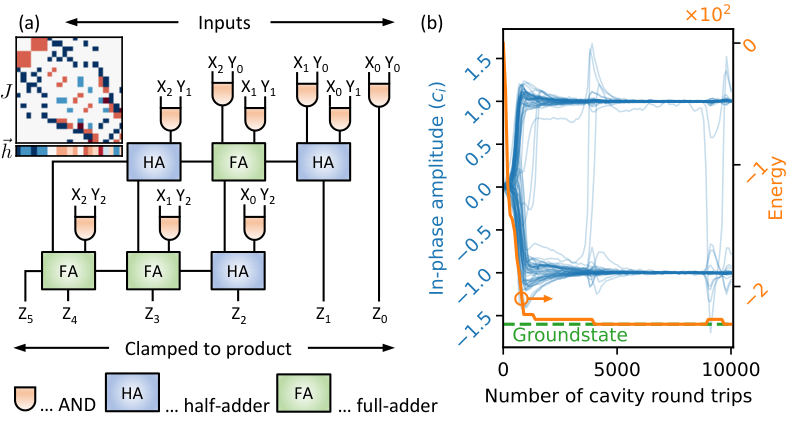
Step 2: Map to an Ising model. The truth table gets translated into an Ising Hamiltonian, the physics framework describing how a collection of interacting binary spins (pointing up or down) settles into its lowest-energy state. The Hamiltonian has two parts: a coupling matrix J that captures how spins interact, and a Zeeman vector h that acts as a local field pushing each spin toward 0 or 1. Previous optical Ising machines could handle the coupling part. They couldn’t handle the Zeeman term. A simple AND gate requires a nonzero Zeeman term, so without it, general probabilistic logic is off the table.
Step 3: Build the OPO network. Optical parametric oscillators (OPOs) are laser-like devices where a powerful pump drives a specially designed optical cavity. Above a threshold pump power, each OPO spontaneously settles into one of two output phases (+1 or −1), chosen at random. That binary, random choice is exactly what a probabilistic bit does.
The key addition is a weak bias field injected into each OPO cavity at the signal frequency. This nudges the cavity’s internal state, tilting the odds of landing in +1 versus −1. Tune the bias field strength and you tune the probability. That’s the optical equivalent of a magnetic field pushing on a spin.
The team derived this behavior from the density matrix formulation of quantum optics, which tracks both quantum uncertainty and classical randomness at once. The formalism reduces to a set of stochastic differential equations governing how probabilities evolve over time. By expanding the OPO’s in-phase amplitude in powers of the coupling/bias strength ε, they proved analytically that the network’s steady state minimizes the full Ising energy, Zeeman term included.
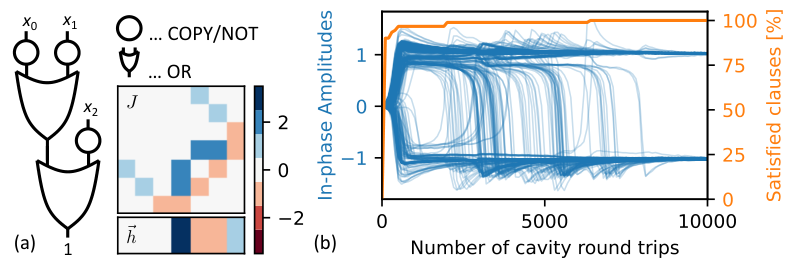
Numerical simulations backed this up. Networks implementing AND, OR, and other stochastic logic gates reproduced the correct probabilistic truth tables, matching predictions from p-bit theory.
Why It Matters
Probabilistic computing has a growing list of uses: combinatorial optimization, Bayesian inference, quantum Monte Carlo acceleration, and training restricted Boltzmann machines. Building dedicated hardware for each is expensive. A general-purpose photonic p-computer could handle all of them on the same chip.
Moore’s law is stalling. Neural network accelerators are everywhere. Optical hardware is maturing fast. What’s been missing is a way to do probabilistic computing optically without exotic new components, just clever use of existing OPO technology with added bias fields.
The path from proposal to hardware looks short. OPO networks already exist in labs, and injecting coherent bias fields is technically straightforward. Next steps are scaling to larger networks and benchmarking against electronic p-bit implementations on real optimization problems.
Bottom Line: Adding a bias field to optical parametric oscillator networks unlocks fully general probabilistic computing in the optical domain. Coherent Ising machines become all-purpose stochastic logic engines, with the potential to beat electronic alternatives on speed and energy efficiency.
IAIFI Research Highlights
This work sits at the intersection of quantum optics and computer science, mapping probabilistic computing frameworks onto the physics of nonlinear optical cavities. The stochastic behavior of these quantum systems turns out to be a computational resource, not just noise.
Photonic probabilistic computing could accelerate AI workloads like Bayesian inference and restricted Boltzmann machine training by tapping the natural randomness of optical systems instead of simulating it in software.
The paper gives a rigorous density-matrix-level derivation linking OPO quantum dynamics to Ising Hamiltonians with nonzero Zeeman terms, sharpening the connection between quantum optical physics and computational complexity.
The proposed platform is experimentally viable with current OPO technology. Scaling to larger networks could open the door to optical solutions for NP-hard optimization problems. Full derivations and simulation results are in the paper: [arXiv:2406.04000](https://arxiv.org/abs/2406.04000)
Original Paper Details
Stochastic logic in biased coupled photonic probabilistic bits
2406.04000
Michael Horodynski, Charles Roques-Carmes, Yannick Salamin, Seou Choi, Jamison Sloan, Di Luo, Marin Soljačić
Optical computing often employs tailor-made hardware to implement specific algorithms, trading generality for improved performance in key aspects like speed and power efficiency. An important computing approach that is still missing its corresponding optical hardware is probabilistic computing, used e.g. for solving difficult combinatorial optimization problems. In this study, we propose an experimentally viable photonic approach to solve arbitrary probabilistic computing problems. Our method relies on the insight that coherent Ising machines composed of coupled and biased optical parametric oscillators can emulate stochastic logic. We demonstrate the feasibility of our approach by using numerical simulations equivalent to the full density matrix formulation of coupled optical parametric oscillators.