

Seeing Faces in Things: A Model and Dataset for Pareidolia
Authors
Mark Hamilton, Simon Stent, Vasha DuTell, Anne Harrington, Jennifer Corbett, Ruth Rosenholtz, William T. Freeman
Abstract
The human visual system is well-tuned to detect faces of all shapes and sizes. While this brings obvious survival advantages, such as a better chance of spotting unknown predators in the bush, it also leads to spurious face detections. ``Face pareidolia'' describes the perception of face-like structure among otherwise random stimuli: seeing faces in coffee stains or clouds in the sky. In this paper, we study face pareidolia from a computer vision perspective. We present an image dataset of ``Faces in Things'', consisting of five thousand web images with human-annotated pareidolic faces. Using this dataset, we examine the extent to which a state-of-the-art human face detector exhibits pareidolia, and find a significant behavioral gap between humans and machines. We find that the evolutionary need for humans to detect animal faces, as well as human faces, may explain some of this gap. Finally, we propose a simple statistical model of pareidolia in images. Through studies on human subjects and our pareidolic face detectors we confirm a key prediction of our model regarding what image conditions are most likely to induce pareidolia. Dataset and Website: https://aka.ms/faces-in-things
Concepts
The Big Picture
Look at the front of a car. Do you see a face staring back at you? Most people do: the headlights become eyes, the grille a grinning mouth. This isn’t imagination running wild. It’s one of the most deeply wired reflexes in the human brain, called face pareidolia: the tendency to perceive faces in random objects, from wood grain to burnt toast to cloud formations.
For most of human evolutionary history, this hair-trigger face detector was a survival advantage. Spot a predator’s eyes in the brush a fraction of a second sooner, and you live. The cost of occasionally “seeing” a face in a rock was cheap. But AI face-recognition systems that match or exceed human performance on real faces are essentially blind to pareidolic ones. A model trained on millions of face photos will stare at a cloud shaped like a grinning skull and see nothing at all.
A team from MIT, Microsoft, and Toyota Research Institute set out to close that gap. They built the first large-scale dataset of pareidolic faces and investigated why the machine-human divide exists. They also proposed a mathematical model that predicts when and why pareidolia strikes.
Key Insight: Face pareidolia isn’t a quirk or a bug in human perception. It may be a direct consequence of our evolutionary need to detect all kinds of animal faces, not just human ones. AI systems trained only on human faces miss this broader tuning almost entirely.
How It Works
The foundation is a new dataset: “Faces in Things”, five thousand web-collected images, each containing a pareidolic face. Human annotators marked each image with bounding boxes around face-like regions and labeled them for perceived emotion, gender, and whether the face-like quality seemed intentional.
The team then ran RetinaFace, a detector trained on the WIDER FACE benchmark (a standard industry measure of face-detection performance), against these pareidolic images. It almost completely failed to detect what humans found obvious. Even with the confidence threshold lowered far below normal operating levels, the machine struggled. The gap wasn’t just quantitative; it was qualitative.
To understand why, the researchers tried several interventions:
- Image augmentation: digitally manipulating training images to resemble pareidolic scenes
- Threshold relaxation: lowering the model’s bar for what counts as a detection
- Fine-tuning on animal faces: continuing to train the model on images of dogs, cats, and primates
The animal face result was the most revealing. Fine-tuning on non-human animals went a good way toward closing the performance gap, without ever showing the model a single pareidolic image. Human pareidolia, it turns out, isn’t purely about human face detection. It emerges from a broader, evolutionarily ancient system tuned to recognize faces across species.
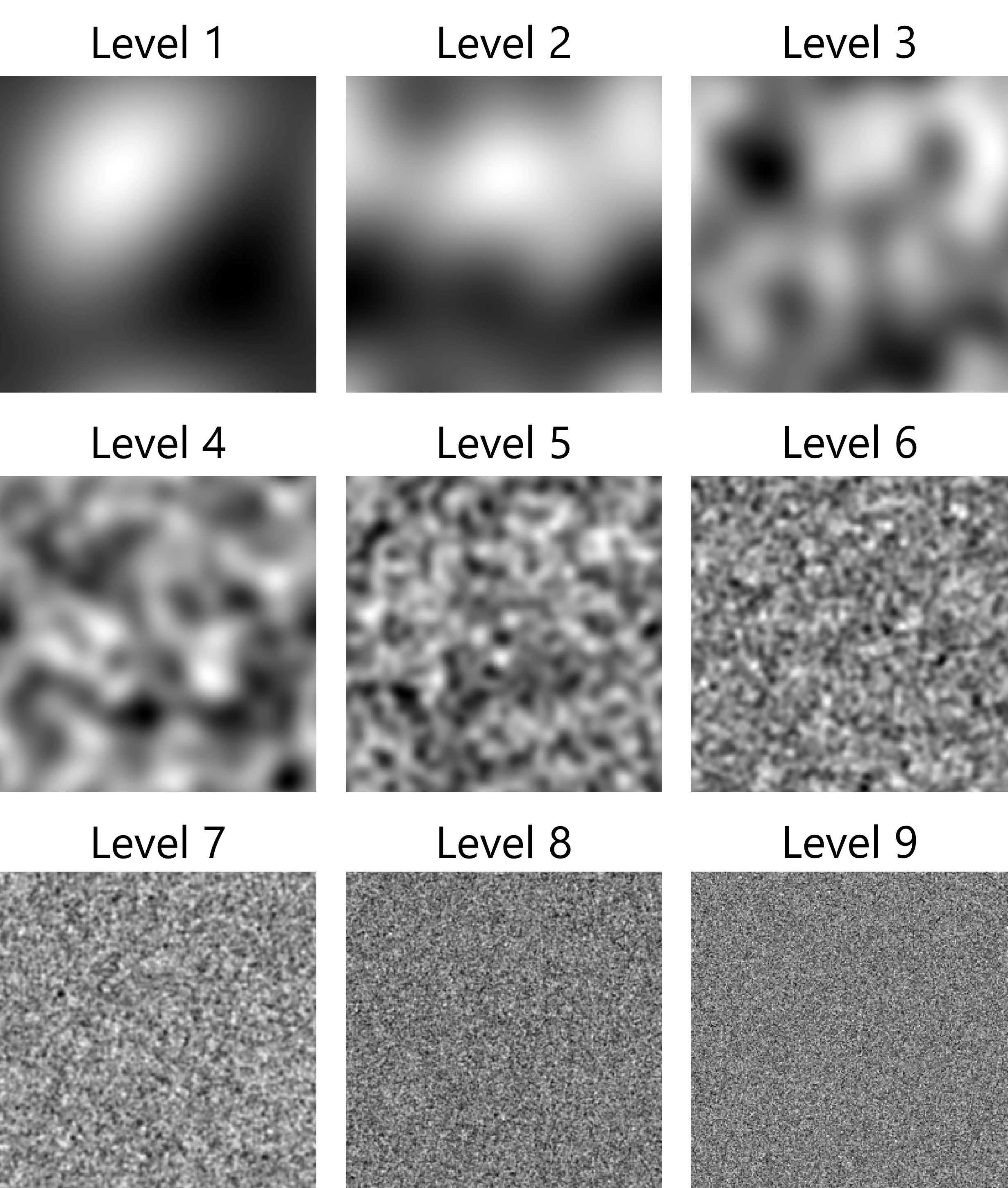
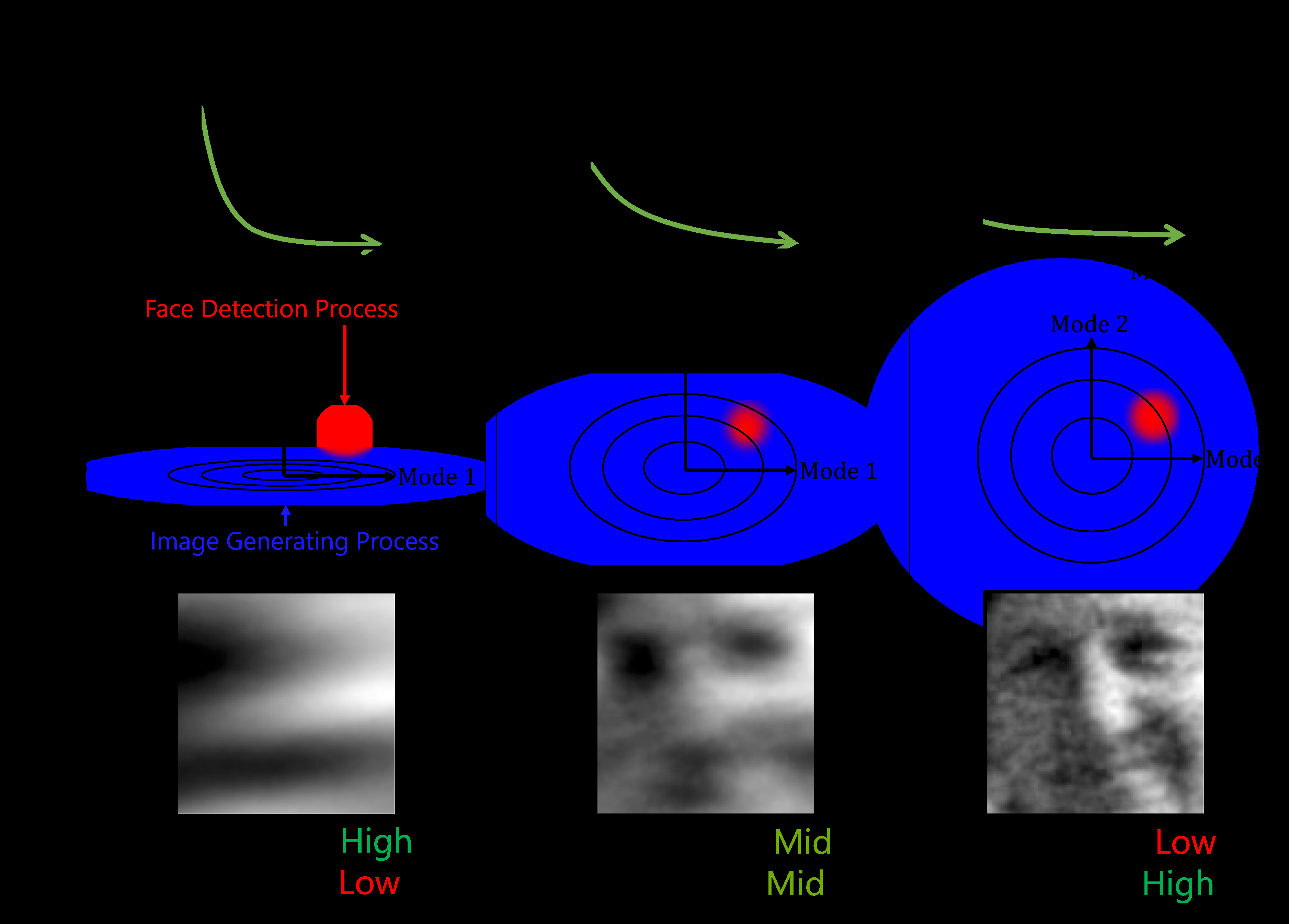
So why doesn’t pareidolia trigger everywhere? Any sufficiently blurry texture could, in principle, trip the face detector, yet it doesn’t.
The researchers proposed two frameworks to explain this. The first treats image patches as samples from a Gaussian process, a statistical model describing how similar neighboring pixels tend to be across a surface. The second uses deep feature similarity, measuring how closely a neural network’s extracted patterns match a typical face template. Both predict the same thing: pareidolia occurs in a “Goldilocks zone” of visual complexity.
A flat gray wall has nothing face-like. Pure static overwhelms the detection mechanism. Pareidolia peaks in between, where texture is structured enough to suggest faces but random enough to produce them by accident. Perception experiments on human subjects confirmed this: both humans and trained detectors showed the same inverted U-shaped response curve, peaking at intermediate complexity.
Why It Matters
Treated as a controlled probe, pareidolia tells us something concrete about visual object recognition. When someone sees a face in random texture, you learn what face templates their visual system carries, how sensitive those templates are, and what triggers them. Building machines that replicate this behavior lets us ask whether they’re solving the problem for the same reasons we do, or using entirely different internal machinery.
The animal face finding matters most for AI development. It tells us that general-purpose visual systems need training on the full diversity of natural scenes, not just human faces. Human-only datasets, however large, produce systematically narrow perception.
Several open questions follow. Can pareidolia work as a test of perceptual generalization? Could the Goldilocks model guide synthetic training data generation? And what happens when large vision-language models, trained on internet-scale data saturated with pareidolic content, are measured against this benchmark?
Bottom Line: “Faces in Things” gives the computer vision community its first serious tool for studying pareidolia at scale. The results expose a gap in how machines learn to see, one that traces back to millions of years of evolutionary pressure on the animal recognition systems we carry in our skulls.
IAIFI Research Highlights

This work sits at the intersection of cognitive neuroscience, evolutionary biology, and computer vision, using a curated perceptual dataset to test computational models against human psychophysics.

The "Faces in Things" dataset and pareidolic face detector establish an evaluation benchmark for visual generalization, showing that diversity of training categories, not just scale, matters for building perceptual systems that match human flexibility.

The Goldilocks statistical model provides a mathematical account of when structured randomness triggers face perception, connecting information-theoretic ideas to a concrete observable phenomenon in visual cognition.
Future work could use this benchmark to probe large vision-language models and guide synthetic data generation; the dataset and models are publicly available at https://aka.ms/faces-in-things.
Original Paper Details
Seeing Faces in Things: A Model and Dataset for Pareidolia
[arXiv:2409.16143](https://arxiv.org/abs/2409.16143)
Mark Hamilton, Simon Stent, Vasha DuTell, Anne Harrington, Jennifer Corbett, Ruth Rosenholtz, William T. Freeman
The human visual system is well-tuned to detect faces of all shapes and sizes. While this brings obvious survival advantages, such as a better chance of spotting unknown predators in the bush, it also leads to spurious face detections. "Face pareidolia" describes the perception of face-like structure among otherwise random stimuli: seeing faces in coffee stains or clouds in the sky. In this paper, we study face pareidolia from a computer vision perspective. We present an image dataset of "Faces in Things", consisting of five thousand web images with human-annotated pareidolic faces. Using this dataset, we examine the extent to which a state-of-the-art human face detector exhibits pareidolia, and find a significant behavioral gap between humans and machines. We find that the evolutionary need for humans to detect animal faces, as well as human faces, may explain some of this gap. Finally, we propose a simple statistical model of pareidolia in images. Through studies on human subjects and our pareidolic face detectors we confirm a key prediction of our model regarding what image conditions are most likely to induce pareidolia. Dataset and Website: https://aka.ms/faces-in-things