

QCD constraints on isospin-dense matter and the nuclear equation of state
Authors
Ryan Abbott, William Detmold, Marc Illa, Assumpta Parreño, Robert J. Perry, Fernando Romero-López, Phiala E. Shanahan, Michael L. Wagman
Abstract
Understanding the behavior of dense hadronic matter is a central goal in nuclear physics as it governs the nature and dynamics of astrophysical objects such as supernovae and neutron stars. Because of the non-perturbative nature of quantum chromodynamics (QCD), little is known rigorously about hadronic matter in these extreme conditions. Here, lattice QCD calculations are used to compute thermodynamic quantities and the equation of state of QCD over a wide range of isospin chemical potentials with controlled systematic uncertainties. Agreement is seen with chiral perturbation theory when the chemical potential is small. Comparison to perturbative QCD at large chemical potential allows for an estimate of the gap in the superconducting phase, and this quantity is seen to agree with perturbative determinations. Since the partition function for an isospin chemical potential, $μ_I$, bounds the partition function for a baryon chemical potential $μ_B=3μ_I/2$, these calculations also provide rigorous non-perturbative QCD bounds on the symmetric nuclear matter equation of state over a wide range of baryon densities for the first time.
Concepts
The Big Picture
Trying to understand what’s inside a neutron star is a decades-old headache. These objects pack more mass than the Sun into a sphere the size of a city, and the physics governing their interiors refuses to cooperate with our best calculation tools.
The strong nuclear force, described by quantum chromodynamics (QCD), dictates how quarks and gluons behave at the extreme densities found inside neutron stars. But QCD becomes ferociously difficult to compute with under those conditions. The standard numerical approach, lattice QCD, works by breaking spacetime into a discrete grid and letting supercomputers grind through the math. At neutron-star densities, though, the calculations hit a wall called the sign problem: the quantities being computed oscillate so wildly they cancel each other out, leaving you with nothing useful.
This has kept the nuclear equation of state (the relationship between pressure and density in dense matter) out of reach from first principles. That equation of state determines how massive a neutron star can grow, whether it collapses into a black hole, and how it behaves when it merges with another. Without direct QCD calculations, physicists have been stuck relying on models anchored by indirect observations.
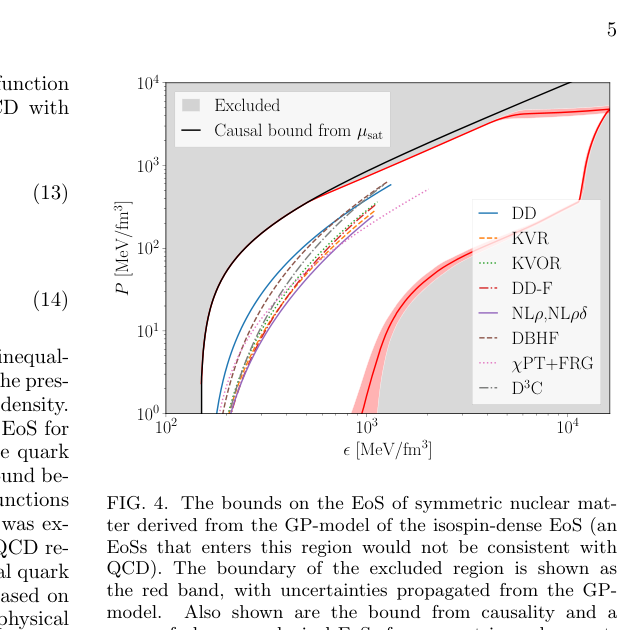
A team from MIT, Fermilab, and the University of Barcelona found a way around the wall. By working with a hypothetical type of matter called isospin-dense matter, they produced the first rigorous QCD constraints on the nuclear equation of state, with all systematic errors understood and controlled.
Key Insight: Computing the equation of state for matter with an isospin chemical potential (an imbalance between up and down quarks) instead of a baryon chemical potential sidesteps the sign problem entirely. A mathematical inequality then lets the team bound the nuclear equation of state directly from QCD.
How It Works
Instead of tackling baryon-dense matter head-on, where the sign problem lurks, the researchers study isospin-dense matter: a hypothetical state with a chemical imbalance between up and down quarks, quantified by the isospin chemical potential μI. The sign problem doesn’t affect this system, which makes it fair game for lattice QCD.
The connection to real nuclear matter comes through a path-integral inequality. The partition function for isospin chemical potential μI provides a rigorous upper bound on the partition function for baryon chemical potential μB = 3μI/2. Whatever you learn about the isospin system gives you a hard, provable ceiling on the pressure of nuclear matter at corresponding densities.
Here’s how the calculation was done:
- The team ran lattice QCD simulations at multiple lattice spacings and quark masses, then extrapolated to the physical continuum limit. This two-pronged extrapolation is what separates the work from earlier proof-of-concept studies and brings systematic uncertainties under genuine control.
- They extracted thermodynamic quantities (pressure, energy density, isospin charge density, speed of sound) across a wide sweep of μI values, spanning the hadronic regime up to densities where perturbative methods apply.
- At small μI, the results match chiral perturbation theory (χPT), a low-energy effective theory for composite quark-based particles. Good news: the lattice calculations capture the correct low-density physics.
- At large μI, comparison with perturbative QCD (pQCD) yielded an estimate of the color-superconducting gap, the energy scale associated with quarks forming Cooper pairs (analogous to the electron pairs behind ordinary superconductivity). The extracted value agrees with perturbative predictions.
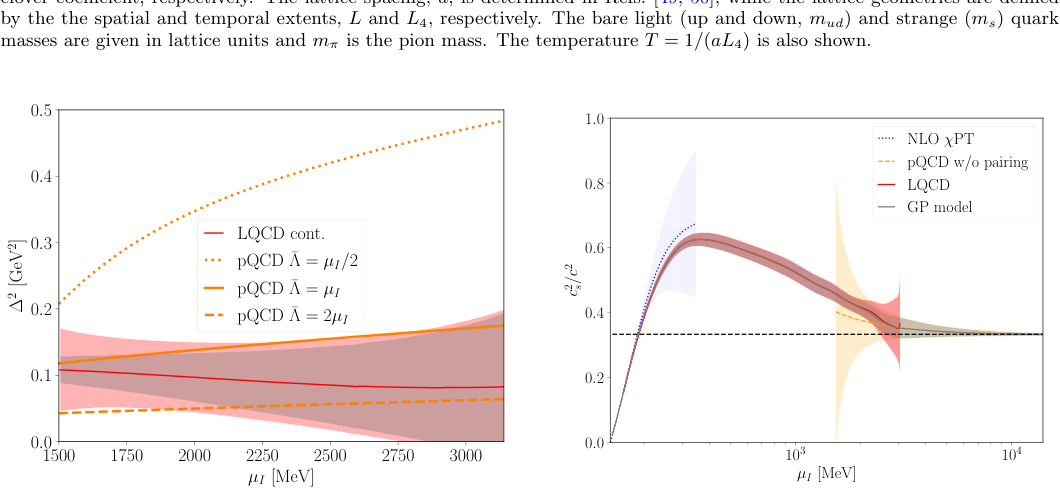
One result that deserves attention: the speed of sound. For a gas of non-interacting massless particles, the speed of sound can’t exceed c²s/c² = 1/3, the conformal limit. The calculations show this limit is significantly exceeded over a wide range of isospin chemical potentials. Dense, strongly interacting matter is far from a simple gas. This has been debated for years in neutron star physics, and the lattice data now weigh in directly.
To build a complete equation of state valid at all densities, the team used Bayesian model mixing: a statistical framework that weights χPT at low densities, lattice QCD in the middle, and pQCD at high densities according to how well each fits the data in its domain. The result is a continuous, smooth equation of state grounded in theory across all scales.
Why It Matters
The nuclear equation of state sits at the intersection of particle physics, astrophysics, and gravitational wave astronomy. Every neutron star merger detected by LIGO, every X-ray measurement of a neutron star’s radius, every supernova simulation depends on assumptions about the equation of state. None of those assumptions had been anchored to QCD from first principles with controlled errors. Until now.
This work doesn’t replace phenomenological models. It constrains them in a way that is model-independent and derived directly from the Standard Model. Future lattice calculations at finer spacings and lighter quark masses will sharpen the bounds. And as gravitational wave and X-ray observations improve in parallel, a first-principles picture of the densest matter in the universe is starting to come into focus.
Bottom Line: Lattice QCD has produced the first provable, error-controlled bounds on the nuclear equation of state by exploiting a mathematical link between isospin-dense and baryon-dense matter. QCD is finally making contact with astrophysics.
IAIFI Research Highlights

This work ties together nuclear theory, lattice QCD computation, and neutron star astrophysics, producing the first QCD constraints on quantities that feed directly into gravitational wave science and multi-messenger astronomy.

The Bayesian model mixing framework, which combines χPT, lattice QCD, and pQCD across different density regimes, represents a methodological advance for uncertainty-aware scientific inference applicable to other multi-scale physics problems.

The calculation produces the first non-perturbative, systematically controlled QCD estimate of the color-superconducting gap in isospin-dense matter, along with rigorous bounds on the nuclear equation of state at multiple baryon densities derived directly from the Standard Model.
Future work will sharpen these bounds with finer lattice spacings and physical quark masses, with direct implications for neutron star modeling and gravitational wave observations; full results are available at [arXiv:2406.09273](https://arxiv.org/abs/2406.09273).
Original Paper Details
QCD constraints on isospin-dense matter and the nuclear equation of state
2406.09273
Ryan Abbott, William Detmold, Marc Illa, Assumpta Parreño, Robert J. Perry, Fernando Romero-López, Phiala E. Shanahan, Michael L. Wagman
Understanding the behavior of dense hadronic matter is a central goal in nuclear physics as it governs the nature and dynamics of astrophysical objects such as supernovae and neutron stars. Because of the non-perturbative nature of quantum chromodynamics (QCD), little is known rigorously about hadronic matter in these extreme conditions. Here, lattice QCD calculations are used to compute thermodynamic quantities and the equation of state of QCD over a wide range of isospin chemical potentials with controlled systematic uncertainties. Agreement is seen with chiral perturbation theory when the chemical potential is small. Comparison to perturbative QCD at large chemical potential allows for an estimate of the gap in the superconducting phase, and this quantity is seen to agree with perturbative determinations. Since the partition function for an isospin chemical potential, μ_I, bounds the partition function for a baryon chemical potential μ_B=3μ_I/2, these calculations also provide rigorous non-perturbative QCD bounds on the symmetric nuclear matter equation of state over a wide range of baryon densities for the first time.