

PQ Axiverse
Authors
Mehmet Demirtas, Naomi Gendler, Cody Long, Liam McAllister, Jakob Moritz
Abstract
We show that the strong CP problem is solved in a large class of compactifications of string theory. The Peccei-Quinn mechanism solves the strong CP problem if the CP-breaking effects of the ultraviolet completion of gravity and of QCD are small compared to the CP-preserving axion potential generated by low-energy QCD instantons. We characterize both classes of effects. To understand quantum gravitational effects, we consider an ensemble of flux compactifications of type IIB string theory on orientifolds of Calabi-Yau hypersurfaces in the geometric regime, taking a simple model of QCD on D7-branes. We show that the D-brane instanton contribution to the neutron electric dipole moment falls exponentially in $N^4$, with $N$ the number of axions. In particular, this contribution is negligible in all models in our ensemble with $N>17$. We interpret this result as a consequence of large $N$ effects in the geometry that create hierarchies in instanton actions and also suppress the ultraviolet cutoff. We also compute the CP breaking due to high-energy instantons in QCD. In the absence of vectorlike pairs, we find contributions to the neutron electric dipole moment that are not excluded, but that could be accessible to future experiments if the scale of supersymmetry breaking is sufficiently low. The existence of vectorlike pairs can lead to a larger dipole moment. Finally, we show that a significant fraction of models are allowed by standard cosmological and astrophysical constraints.
Concepts
The Big Picture
Imagine a perfectly balanced scale. Nature, according to our best theories, has no reason to keep it balanced, yet every experiment we run shows it sitting perfectly level, to one part in ten billion.
This is the strong CP problem, one of the oldest puzzles in fundamental physics. “CP” refers to a symmetry in nature’s laws: physics should look the same whether you simultaneously flip all electric charges and mirror the universe left-to-right. QCD, the theory describing how quarks bind together inside protons and neutrons, contains a parameter called θ that could violate this symmetry. But experiments show θ ≲ 10⁻¹⁰, essentially zero. Why?
The leading explanation, proposed by Peccei and Quinn in 1977, promotes θ from a fixed number to a dynamic field, a physical quantity that can evolve and settle like a marble rolling to the bottom of a bowl. This field is the QCD axion, and its energy naturally relaxes to zero, restoring the symmetry. Even incredibly tiny nudges from quantum gravity, though, can knock the axion out of its valley and ruin the whole mechanism.
That vulnerability is known as the Peccei-Quinn quality problem, and addressing it properly demands a theory of quantum gravity.
Demirtas, Gendler, Long, McAllister, and Moritz have now tackled this directly. By surveying more than 100,000 explicit string theory models drawn from the string landscape (the enormous space of possible universes that string theory can describe), they show that the PQ mechanism works across the vast majority of them.
Key Insight: In string theory compactifications with more than 17 axions, the quantum gravity corrections that could ruin the Peccei-Quinn solution are exponentially suppressed, falling as exp(−cN⁴) where N is the number of axions, rendering them negligible in 99.7% of all models examined.
How It Works
The authors work in a well-understood corner of string theory: type IIB flux compactifications. Our four-dimensional universe emerges from a ten-dimensional spacetime with six extra dimensions curled into a compact shape, stabilized by threading those hidden dimensions with background fields called fluxes. Those extra dimensions form a Calabi-Yau manifold, a geometrically rich space whose shape determines the physical laws we observe, much as the shape of a drumhead determines its sound.
QCD lives on a stack of D7-branes, membrane-like objects that wrap around a surface inside the Calabi-Yau, somewhat like a sheet of paper folded around a sphere. The QCD axion arises naturally from this wrapping as a four-form field integrated over that surface. Trouble comes from D-brane instantons: brief quantum events in which Euclidean D3-branes wrap other surfaces in the geometry, generating tiny energy contributions that can shift the axion away from its CP-preserving minimum.
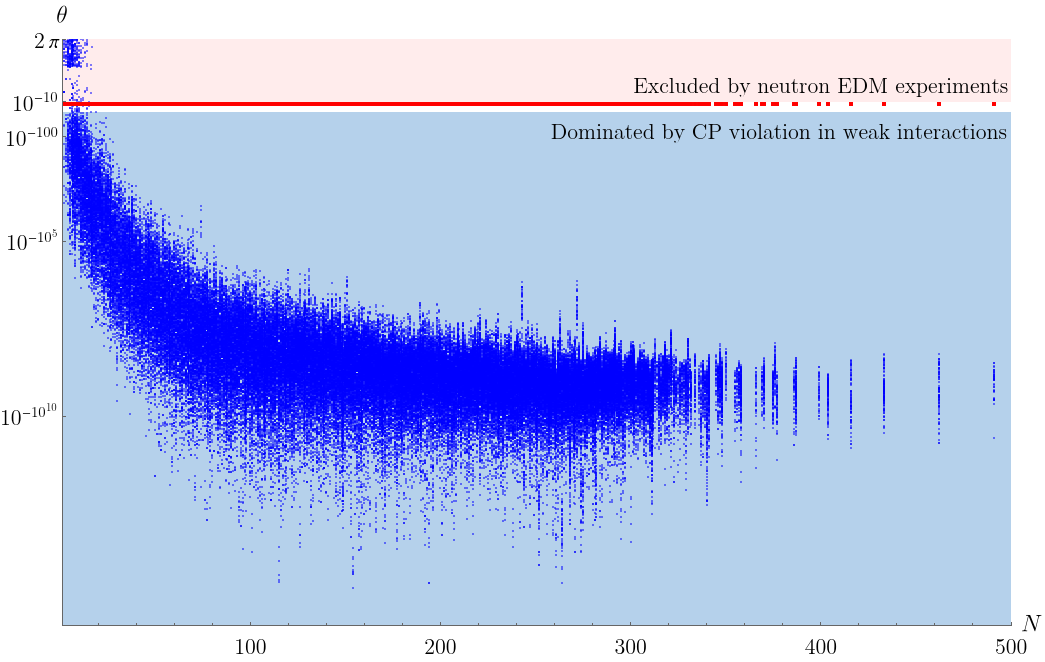
The geometry itself turns out to be the remedy. An instanton’s coupling strength depends on the volume of the cycle it wraps; larger cycles give exponentially smaller couplings. Across their ensemble, the authors computed four-cycle volumes and tracked what happens as N, the total number of axions, grows.
As N increases:
- The geometry develops increasingly large four-cycles, exponentially suppressing the dangerous instanton contributions
- The ultraviolet cutoff of the theory is also suppressed by large-N effects
- The net contribution to the neutron electric dipole moment, the observable most sensitive to CP violation, falls as exp(−cN⁴), with c ≈ 1.8
In every model with N > 17, D-brane instanton effects are negligible. The PQ mechanism works.
The team also had to contend with high-energy QCD instantons, quantum tunneling events in QCD at energy scales above where the Standard Model quarks get their masses.
With supersymmetry (a theoretical extension pairing each known particle with a heavier partner) at some high scale, these instantons produce neutron EDM contributions that current experiments don’t yet exclude. Next-generation experiments could detect them if supersymmetry breaking occurs at sufficiently low scales. Adding vectorlike pairs, exotic quarks that come in opposite-quantum-number pairs, can amplify these contributions significantly.
The same geometric data determines the cosmological fate of axions. Light axions can contribute to dark matter via the misalignment mechanism: they start displaced from their energy minimum in the early universe, then oscillate and settle, gradually accumulating as dark matter. They also couple to photons in ways detectable by experiments like ADMX. Applying standard cosmological and astrophysical constraints to their ensemble, the authors found that for models with 26 ≤ N ≤ 433, at least half survive every constraint simultaneously.
Why It Matters
For decades, the PQ mechanism has been theoretically attractive but practically precarious. It required assuming that quantum gravity is “well-behaved” in ways no one could verify. By embedding the calculation inside explicit, computable string models, this team has moved from assumption to calculation.
The exponential suppression, exp(−cN⁴), is not a lucky coincidence. It follows from the geometric structure itself: large-N effects in Calabi-Yau geometry naturally create hierarchies among instanton actions.
The predictions are testable. If supersymmetry is broken at relatively low scales, next-generation neutron EDM experiments already in development may detect the high-energy QCD instanton contributions calculated here. If vectorlike matter pairs exist near the TeV scale, the signals could be even larger. It’s rare for a paper on string landscape statistics to make genuine contact with experimental physics.
Bottom Line: String theory doesn’t just accommodate the Peccei-Quinn mechanism; its geometry actively enforces it, exponentially suppressing the dangerous corrections in models with N > 17 axions. The strong CP problem is solved across a large class of string compactifications.
IAIFI Research Highlights

This work combines large-scale computational surveys of the string landscape, analyzing over 100,000 compactifications, with precision quantum field theory calculations to address one of particle physics' oldest puzzles.

The ensemble-based, data-driven approach to surveying string vacua parallels how machine learning extracts patterns from large datasets. Future work could apply AI methods directly to speed up exploration of the string landscape.

This is the first systematic, quantitative study showing that D-brane instanton corrections to the neutron electric dipole moment are exponentially suppressed across a vast class of string compactifications, putting the Peccei-Quinn mechanism on firm theoretical ground within quantum gravity.
Future work will extend these results to count vectorlike matter pairs more carefully and compare with upcoming neutron EDM experiments; the paper is available at [arXiv:2112.04503](https://arxiv.org/abs/2112.04503).
Original Paper Details
PQ Axiverse
2112.04503
Mehmet Demirtas, Naomi Gendler, Cody Long, Liam McAllister, Jakob Moritz
We show that the strong CP problem is solved in a large class of compactifications of string theory. The Peccei-Quinn mechanism solves the strong CP problem if the CP-breaking effects of the ultraviolet completion of gravity and of QCD are small compared to the CP-preserving axion potential generated by low-energy QCD instantons. We characterize both classes of effects. To understand quantum gravitational effects, we consider an ensemble of flux compactifications of type IIB string theory on orientifolds of Calabi-Yau hypersurfaces in the geometric regime, taking a simple model of QCD on D7-branes. We show that the D-brane instanton contribution to the neutron electric dipole moment falls exponentially in $N^4$, with $N$ the number of axions. In particular, this contribution is negligible in all models in our ensemble with $N>17$. We interpret this result as a consequence of large $N$ effects in the geometry that create hierarchies in instanton actions and also suppress the ultraviolet cutoff. We also compute the CP breaking due to high-energy instantons in QCD. In the absence of vectorlike pairs, we find contributions to the neutron electric dipole moment that are not excluded, but that could be accessible to future experiments if the scale of supersymmetry breaking is sufficiently low. The existence of vectorlike pairs can lead to a larger dipole moment. Finally, we show that a significant fraction of models are allowed by standard cosmological and astrophysical constraints.