

Polarization Multi-Image Synthesis with Birefringent Metasurfaces
Authors
Dean Hazineh, Soon Wei Daniel Lim, Qi Guo, Federico Capasso, Todd Zickler
Abstract
Optical metasurfaces composed of precisely engineered nanostructures have gained significant attention for their ability to manipulate light and implement distinct functionalities based on the properties of the incident field. Computational imaging systems have started harnessing this capability to produce sets of coded measurements that benefit certain tasks when paired with digital post-processing. Inspired by these works, we introduce a new system that uses a birefringent metasurface with a polarizer-mosaicked photosensor to capture four optically-coded measurements in a single exposure. We apply this system to the task of incoherent opto-electronic filtering, where digital spatial-filtering operations are replaced by simpler, per-pixel sums across the four polarization channels, independent of the spatial filter size. In contrast to previous work on incoherent opto-electronic filtering that can realize only one spatial filter, our approach can realize a continuous family of filters from a single capture, with filters being selected from the family by adjusting the post-capture digital summation weights. To find a metasurface that can realize a set of user-specified spatial filters, we introduce a form of gradient descent with a novel regularizer that encourages light efficiency and a high signal-to-noise ratio. We demonstrate several examples in simulation and with fabricated prototypes, including some with spatial filters that have prescribed variations with respect to depth and wavelength. Visit the Project Page at https://deanhazineh.github.io/publications/Multi_Image_Synthesis/MIS_Home.html
Concepts
The Big Picture
You take a photo, then run it through a filter to sharpen edges or blur the background. Want a different effect? Run another filter. Each one costs computation proportional to the filter’s size. For real-time embedded systems or power-constrained sensors, that cost adds up fast.
People have long wanted to offload some of this work to optics itself, letting physics do the math before a photon ever hits the sensor. Previous systems could pull this off, but only for one filter at a time, and only with bulky bench-sized hardware: beamsplitters, carefully aligned parallel optical paths, the works.
A team at Harvard has built a compact, single-optic system that captures four differently-coded images simultaneously in one exposure. From those four images, it reconstructs not just one spatial filter but an entire continuous family of filters, all without computation beyond a simple weighted sum.
Key Insight: By pairing a specially engineered flat lens with a sensor that measures light arriving at different orientations, this system offloads multi-filter image processing to optics, reducing digital computation to a per-pixel weighted sum regardless of filter size.
How It Works
Two components make the system tick. First is a birefringent metasurface: a flat optical element just hundreds of nanometers thick, patterned with an array of precisely shaped silicon nanofins. “Metasurface” refers to any engineered surface with structures finer than the wavelength of light. “Birefringent” means it treats light differently depending on polarization, meaning which direction the light wave oscillates.
Each nanofin acts as a tiny polarization prism, delaying light oscillating in one direction by a different amount than the other. By controlling each nanofin’s width parameters (wx and wy), engineers sculpt how light from any scene point fans out across the sensor (the point spread function, or PSF) and make that spreading pattern differ by polarization.
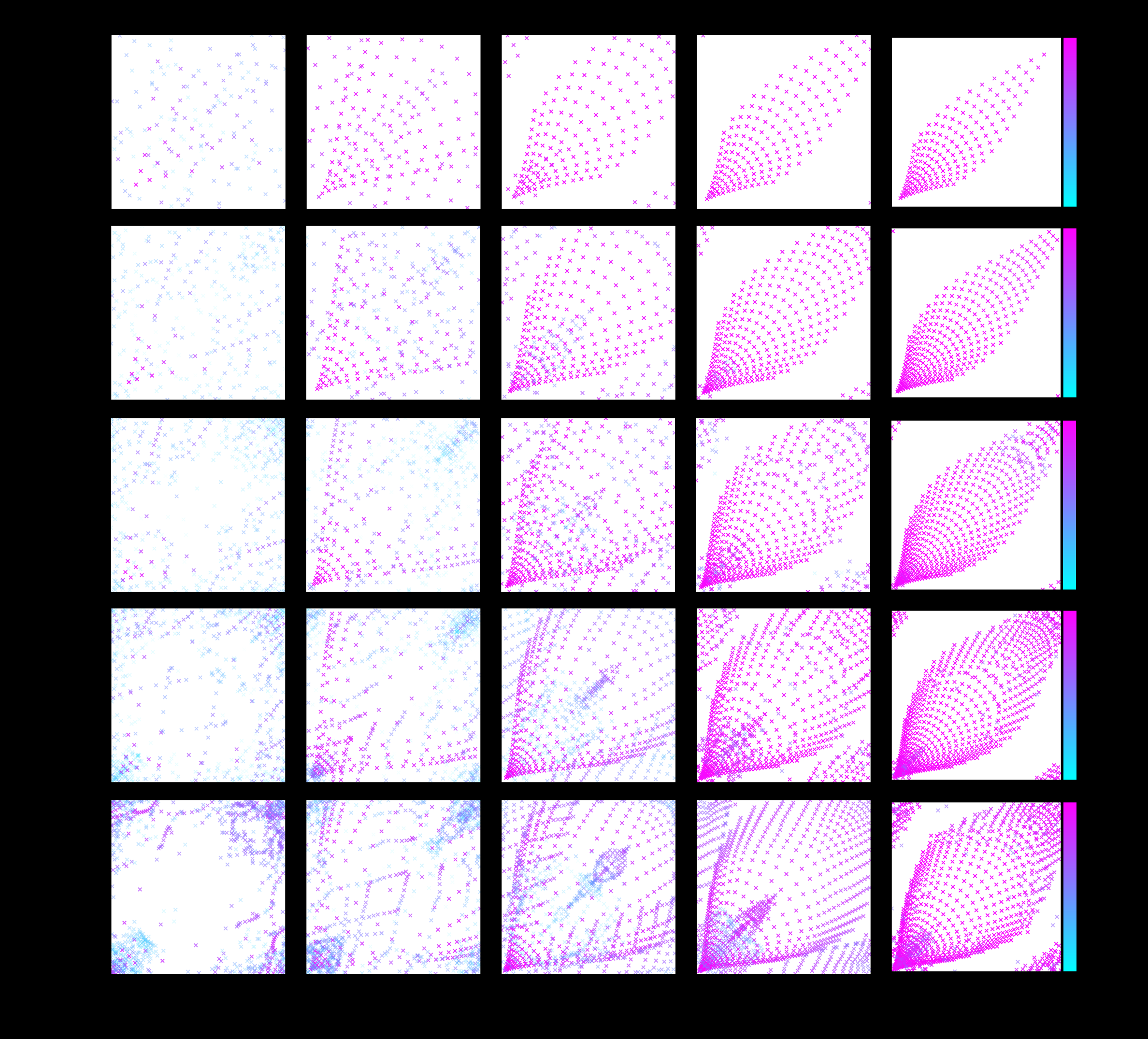
Second is a polarization-mosaicked photosensor: a camera sensor tiled with tiny polarization filters, analogous to how a Bayer RGB sensor tiles red, green, and blue filters across pixels. Four linear polarization orientations (0°, 45°, 90°, 135°) cover the pixel array. When light passes through the metasurface and lands on this sensor, each of the four polarization channels records a differently-coded version of the scene. The coding is baked into the optics; the metasurface’s nanofin geometry determines the four PSFs.
Any target spatial filter can be approximated as a linear combination of those four PSFs. So synthesizing a filtered image reduces to:
- Capture one exposure, with four polarization channels recorded simultaneously
- Choose summation weights α₀°, α₄₅°, α₉₀°, α₁₃₅°
- Compute a per-pixel weighted sum across channels
No digital convolution. No sliding a filter template pixel by pixel across an image. Filter size doesn’t matter computationally, because physics already handled the heavy lifting. Change only the weights after capture and you get a different filter from the continuous family the metasurface was designed to span.
Designing the metasurface is a hard inverse problem: working backwards from desired filters to precise nanofin shapes. The team solves it with gradient descent, iteratively nudging the design toward better solutions. They add a regularizer (a penalty term that discourages theoretically valid but practically useless solutions) to steer the optimizer away from designs that are too dim or too noisy for real imaging.
Why It Matters
Previous systems combining optics and electronics for filtering could synthesize exactly one spatial filter. They needed beamsplitters and parallel optical paths, and couldn’t distinguish scene content from the natural polarization of materials in the scene.
This system changes all three constraints at once. A single flat metasurface replaces bulky conventional optics. The four-channel architecture unlocks an entire filter family from one capture. And because polarization filters are applied at the aperture rather than at the scene, the system works on unpolarized real-world scenes without assumptions about material properties.
Spatial filtering sits at the core of computer vision, scientific imaging, and machine perception. Edge detection, depth-layer isolation, material identification by spectral signature: all spatial filtering. The team shows edge detection, depth-selective focus, and wavelength-selective imaging in both simulation and with fabricated prototypes, including filters whose response varies with depth and wavelength.
For embedded sensors, satellite imagers, and real-time robotics, where computational power is scarce, moving filtering into optics could matter a lot. The team has also released D-Flat, an open-source package for end-to-end metasurface design, so other groups can build on this work.

Bottom Line: A metasurface thinner than a wavelength of light, paired with a polarization sensor and a weighted sum, can replace large digital convolutions entirely and do so for an infinite family of filters from a single snapshot.
IAIFI Research Highlights

This work draws on nanophotonic engineering, computational imaging, and machine learning optimization. The team uses gradient-based methods from AI to solve an inverse optics problem: determining nanostructure geometry at the sub-wavelength scale.

AI-inspired optimization (gradient descent with task-specific regularization) can design physical systems that shift computational workloads from software to hardware. The approach hints at physics-accelerated inference pipelines where optics handles operations traditionally done in code.

By engineering how light interacts with precisely patterned nanostructures depending on polarization, the work shows that birefringent metasurfaces can independently manipulate orthogonal polarization states to encode information optically.
Future directions include extending the filter family to higher-dimensional spans and integrating D-Flat for automated metasurface co-design. The paper is available at [arXiv:2307.08106](https://arxiv.org/abs/2307.08106), with the project page at https://deanhazineh.github.io/publications/Multi_Image_Synthesis/MIS_Home.html.
Original Paper Details
Polarization Multi-Image Synthesis with Birefringent Metasurfaces
[2307.08106](https://arxiv.org/abs/2307.08106)
Dean Hazineh, Soon Wei Daniel Lim, Qi Guo, Federico Capasso, Todd Zickler