

Pileup and Infrared Radiation Annihilation (PIRANHA): A Paradigm for Continuous Jet Grooming
Authors
Samuel Alipour-Fard, Patrick T. Komiske, Eric M. Metodiev, Jesse Thaler
Abstract
Jet grooming is an important strategy for analyzing relativistic particle collisions in the presence of contaminating radiation. Most jet grooming techniques introduce hard cutoffs to remove soft radiation, leading to discontinuous behavior and associated experimental and theoretical challenges. In this paper, we introduce Pileup and Infrared Radiation Annihilation (PIRANHA), a paradigm for continuous jet grooming that overcomes the discontinuity and infrared sensitivity of hard-cutoff grooming procedures. We motivate PIRANHA from the perspective of optimal transport and the Energy Mover's Distance and review Apollonius Subtraction and Iterated Voronoi Subtraction as examples of PIRANHA-style grooming. We then introduce a new tree-based implementation of PIRANHA, Recursive Subtraction, with reduced computational costs. Finally, we demonstrate the performance of Recursive Subtraction in mitigating sensitivity to soft distortions from hadronization and detector effects, and additive contamination from pileup and the underlying event.
Concepts
The Big Picture
Imagine trying to photograph a hummingbird in a rainstorm. The bird is what you care about, fast and precise and full of information, but the rain muddies every frame.
Particle physicists face the same problem every time the Large Hadron Collider fires up. When protons smash together at nearly the speed of light, the collisions produce jets, tight sprays of subatomic debris carrying traces of the underlying physics. But those jets don’t travel through vacuum. They’re surrounded by a constant drizzle of unwanted radiation: detector noise, overlapping collisions called pileup, and background particle activity from the collision remnants (the underlying event). Separating signal from noise is the job of jet grooming, a family of algorithms that clean up jets before physicists analyze them.
Most grooming tools today are blunt instruments. They apply hard cutoffs: if a particle carries less than some fraction z_cut of the jet’s energy, it gets discarded. That sounds reasonable, but it creates a nasty artifact. A tiny energy fluctuation can flip a grooming decision and reshape the entire jet. This discontinuity isn’t just aesthetically unpleasant. It complicates detector corrections and makes theoretical calculations harder.
A team from MIT and IAIFI has introduced PIRANHA (Pileup and Infrared Radiation Annihilation), a new grooming approach that replaces hard cutoffs with continuous subtraction built on optimal transport theory.
Key Insight: Instead of binary cutoffs that cause abrupt, unphysical jumps in groomed jet shapes, PIRANHA continuously redistributes and removes soft radiation in a way that varies smoothly with the event. The result is groomed jets that are far more stable under small perturbations.
How It Works
The mathematical backbone is the Energy Mover’s Distance (EMD), a measure of how different two collider events are. It comes from optimal transport, the mathematics of moving distributions as efficiently as possible. Picture each event as a pile of dirt spread across the detector. The EMD is the minimum work needed to rearrange one pile into another. Jets that look similar physically should have a small EMD between them, and any grooming procedure that respects this geometry should map similar inputs to similar outputs.
PIRANHA turns this intuition into an algorithm. Rather than removing particles below a threshold, it subtracts energy from particles in a way that minimizes transport cost: the work needed to redistribute that energy into a hypothetical background. The result:
- No particle is sharply excluded based on a single threshold
- Outputs respond smoothly as soft particles are added, removed, or shifted
- The geometric structure of the jet is preserved while contamination is removed
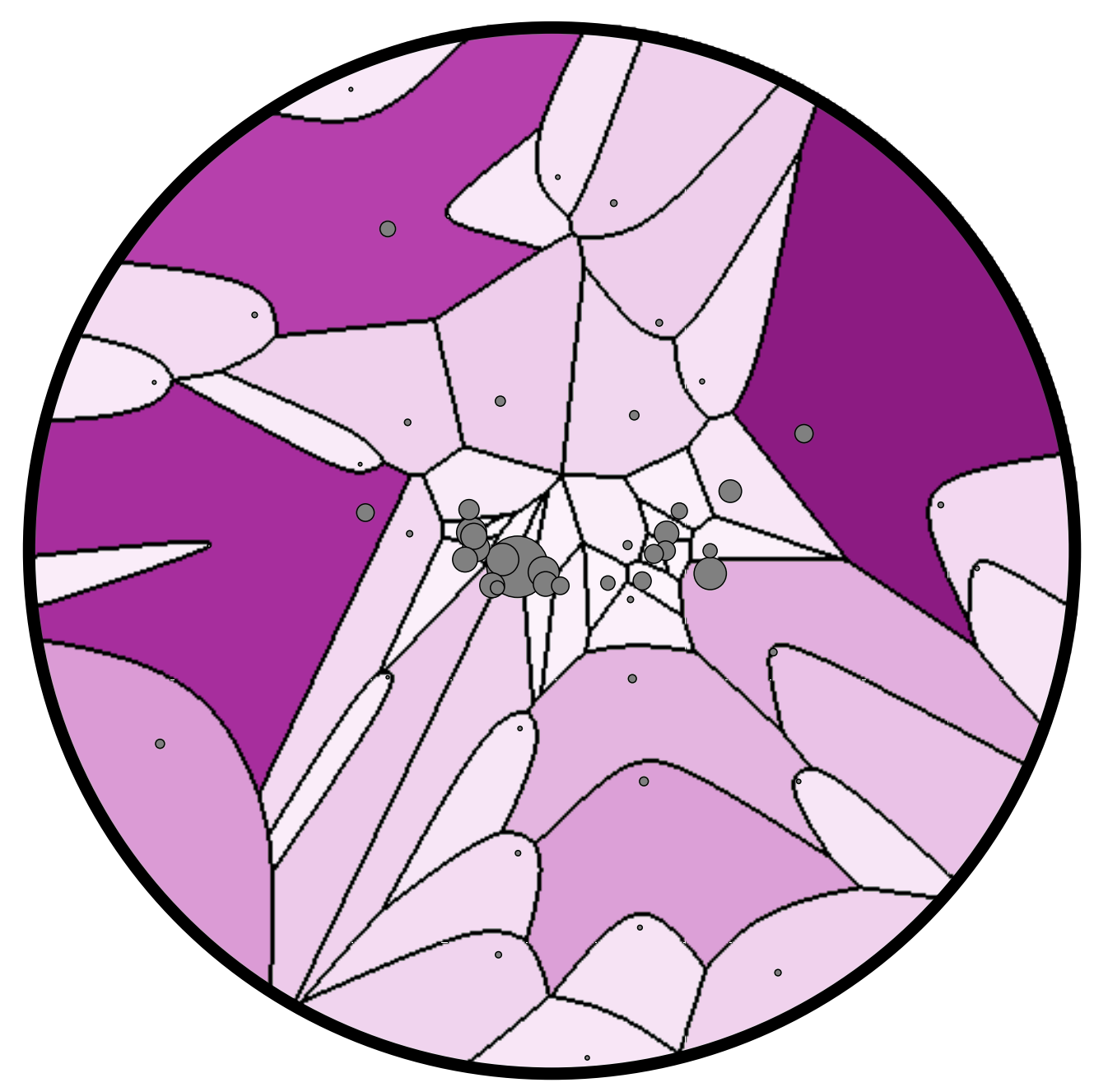
The paper presents three concrete implementations. Apollonius Subtraction (P-AS) assigns each particle a region of influence based on an Apollonius diagram, a generalization of the Voronoi tessellation (dividing space into nearest-neighbor regions) that also accounts for particle energy. Background is then subtracted within each region. The method is continuous but computationally expensive. Iterated Voronoi Subtraction (P-IVS) approximates P-AS using standard Voronoi regions applied iteratively, trading some precision for speed. Both were introduced in earlier work.
The new contribution is Recursive Subtraction (P-RS), specifically P-RSF (Recursive Subtraction with a Fraction f). P-RSF operates on the clustering tree, the hierarchical branching structure that jet-finding algorithms already produce. At each branch point, it subtracts a fraction f of the softer branch’s energy from the harder branch, then propagates upward. This is dramatically cheaper to compute and fits directly into existing analysis pipelines. The special case f = 1/2 is the only fully soft-continuous variant, producing no abrupt jumps as low-energy particles come and go, and it’s the focus throughout the paper.
Why It Matters
The authors test Recursive Subtraction against several contamination sources: hadronization (the process by which quarks and gluons bind into detectable particles), charged-only versus full-particle reconstruction, pileup from overlapping collisions, and the underlying event. In each case, P-RSF shows smaller sensitivity than traditional groomers like Soft Drop. For measuring W boson and top quark jet masses, two standard LHC benchmarks, Recursive Subtraction delivers cleaner mass peaks with less smearing from pileup.
The paper also provides a perturbative analysis tracing why hard-cutoff groomers suffer from discontinuities and how PIRANHA avoids them. The authors distinguish soft discontinuities (sensitivity to changes in particle energies) from angular discontinuities (sensitivity to changes in particle directions) and locate each type precisely in the mathematics of different algorithms. An appendix pushes toward a full resummed perturbative calculation for Recursive Subtraction, which would enable precision QCD (Quantum Chromodynamics, the theory of the strong force) predictions using PIRANHA-groomed observables.
Optimal transport has gained significant traction in machine learning over the past decade. By grounding jet grooming in EMD, PIRANHA gains access to that mathematical toolkit and a natural connection with modern data analysis methods. As collider physics increasingly incorporates machine learning for anomaly detection, classification, and precision measurements, grooming procedures that speak the same geometric language could fit tightly with AI-based approaches.
Open questions remain. Angular discontinuities in P-RSF are suppressed but not eliminated; future variants may resolve them fully. Extending the resummation calculations to higher accuracy is another goal. The PIRANHA framework may also find applications in boosted object tagging, heavy ion collisions, or future collider environments.
Bottom Line: PIRANHA replaces the blunt, discontinuous cutoffs of traditional jet grooming with a continuous, transport-theory-based framework, making LHC measurements more stable, detector corrections easier, and theoretical predictions more tractable.
IAIFI Research Highlights

This work brings optimal transport theory, now widely used in machine learning, into high-energy experimental physics, grounding jet grooming algorithms in geometric probability theory.

PIRANHA demonstrates how tools from the ML toolkit, like the Earth Mover's Distance, can directly improve physics analysis pipelines, providing a concrete example of ML-inspired algorithm design in data-intensive science.

By eliminating hard-cutoff discontinuities in jet grooming, PIRANHA reduces systematic uncertainties in LHC measurements of QCD, electroweak bosons, and top quarks, directly improving the precision of fundamental physics extractions.
Future work includes extending the resummation framework to higher logarithmic accuracy and developing implementations that fully eliminate angular discontinuities; see [arXiv:2305.00989](https://arxiv.org/abs/2305.00989) for the full paper.