

Physics-Augmented Learning: A New Paradigm Beyond Physics-Informed Learning
Authors
Ziming Liu, Yunyue Chen, Yuanqi Du, Max Tegmark
Abstract
Integrating physical inductive biases into machine learning can improve model generalizability. We generalize the successful paradigm of physics-informed learning (PIL) into a more general framework that also includes what we term physics-augmented learning (PAL). PIL and PAL complement each other by handling discriminative and generative properties, respectively. In numerical experiments, we show that PAL performs well on examples where PIL is inapplicable or inefficient.
Concepts
The Big Picture
Imagine teaching someone to paint portraits. One approach: show them a finished painting, then correct every brushstroke that violates proportion. Another: hand them a brush that physically cannot make out-of-proportion marks.
Both methods enforce the same rules, but they work differently. For different kinds of rules, one will outperform the other. That tradeoff sits at the center of how physicists and machine learning researchers have been trying to teach neural networks the laws of nature.
The dominant strategy has been physics-informed learning (PIL), which embeds physical knowledge into training by penalizing outputs that violate known physics. Want to enforce energy conservation? Punish solutions that break it. Want to enforce governing equations? Add a penalty whenever the model strays from them. It’s powerful, widely used, and well understood.
But PIL carries a hidden assumption: it only works when you can efficiently check whether a solution violates the physics. Not all physical properties are checkable this way.
Ziming Liu, Yunyue Chen, Yuanqi Du, and Max Tegmark at MIT and IAIFI identified this blind spot and built a complementary framework to address it. Their proposal, physics-augmented learning (PAL), takes the opposite approach. Instead of penalizing violations, PAL wires physical properties directly into the model’s architecture, making violations structurally impossible from the start.
Physics-informed learning can only enforce properties you can test for. But some of the most important physical structures, like Lagrangian dynamics and hidden symmetries, can be generated but not efficiently tested. PAL handles exactly these cases.
How It Works
Physical properties fall into two categories, and the distinction has real practical consequences.
Discriminative properties are those you can write an efficient test for. If a function satisfies the property, the test returns zero; if not, it returns something nonzero. Generative properties are those where you can construct objects satisfying the property but have no efficient way to check whether an arbitrary object satisfies it.
Machine learning can exploit each type differently. PIL adds a penalty term to the training loss using a discriminator operator, essentially a mathematical test for whether the physics holds. For differential equation constraints, separability conditions, or directly visible symmetries, this works well.
Now consider the Lagrangian property: whether a given set of equations of motion can be derived from an underlying energy function (a Lagrangian). Generation is trivial. Pick a Lagrangian and derive the dynamics. But determining whether an arbitrary acceleration field is Lagrangian? No known efficient solution exists. PIL simply cannot enforce this structure.
The same goes for positive definiteness, which guarantees that a quantity like energy always stays non-negative. And for hidden symmetries: patterns in the physics that aren’t obvious from the surface form of equations but deeply constrain the solutions. You can build objects with these properties. You can’t cheaply test whether a given object has them.
PAL’s solution is architectural. Rather than starting with a generic network and constraining it, PAL builds the property into the network’s structure. For Lagrangian systems, the model directly parameterizes the Lagrangian function $L(q, \dot{q}; \theta)$ and derives accelerations via the Euler-Lagrange equations (the classical rules connecting an energy function to the motion it implies). The model cannot output non-Lagrangian dynamics. Not because it’s penalized, but because the architecture makes it impossible.
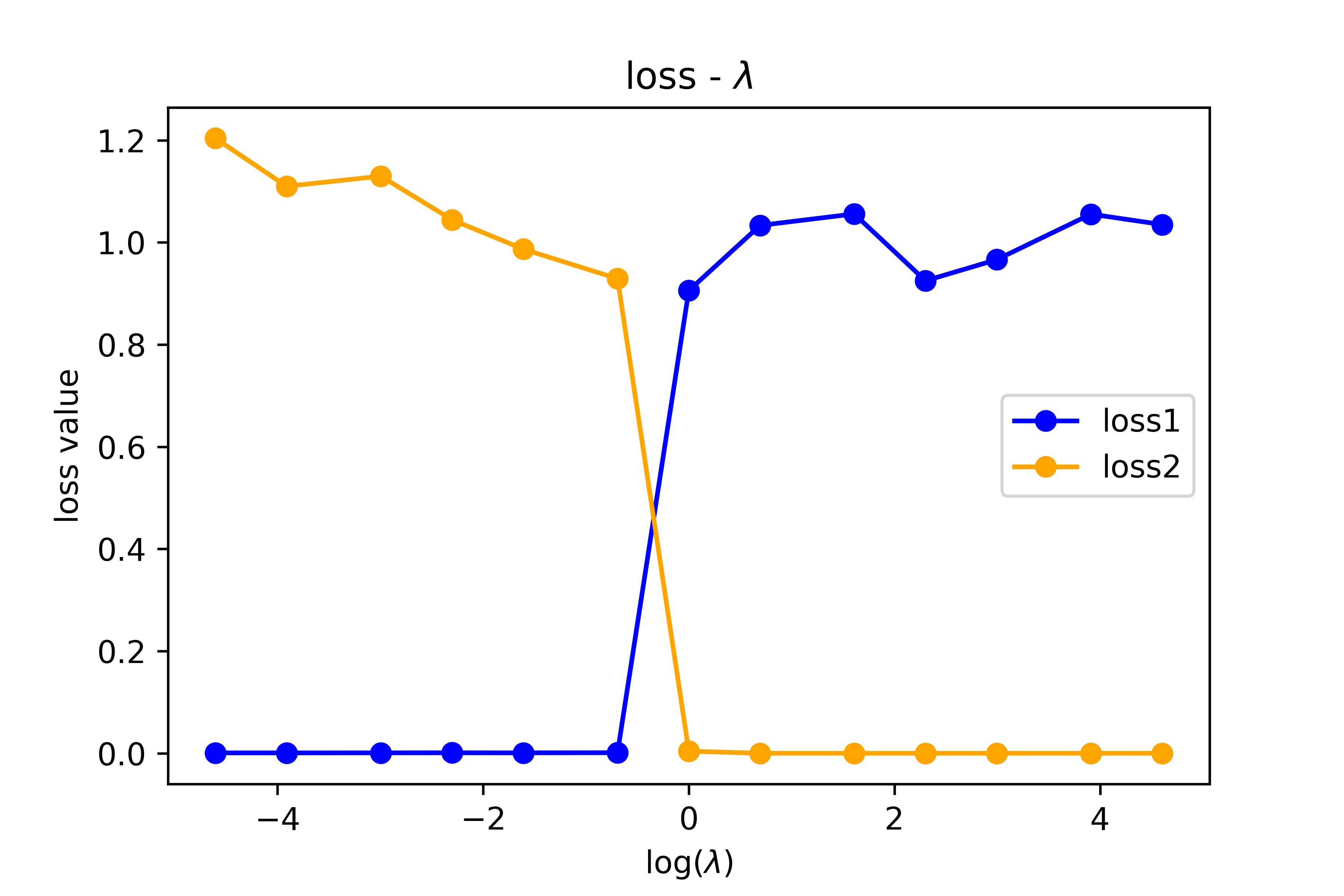
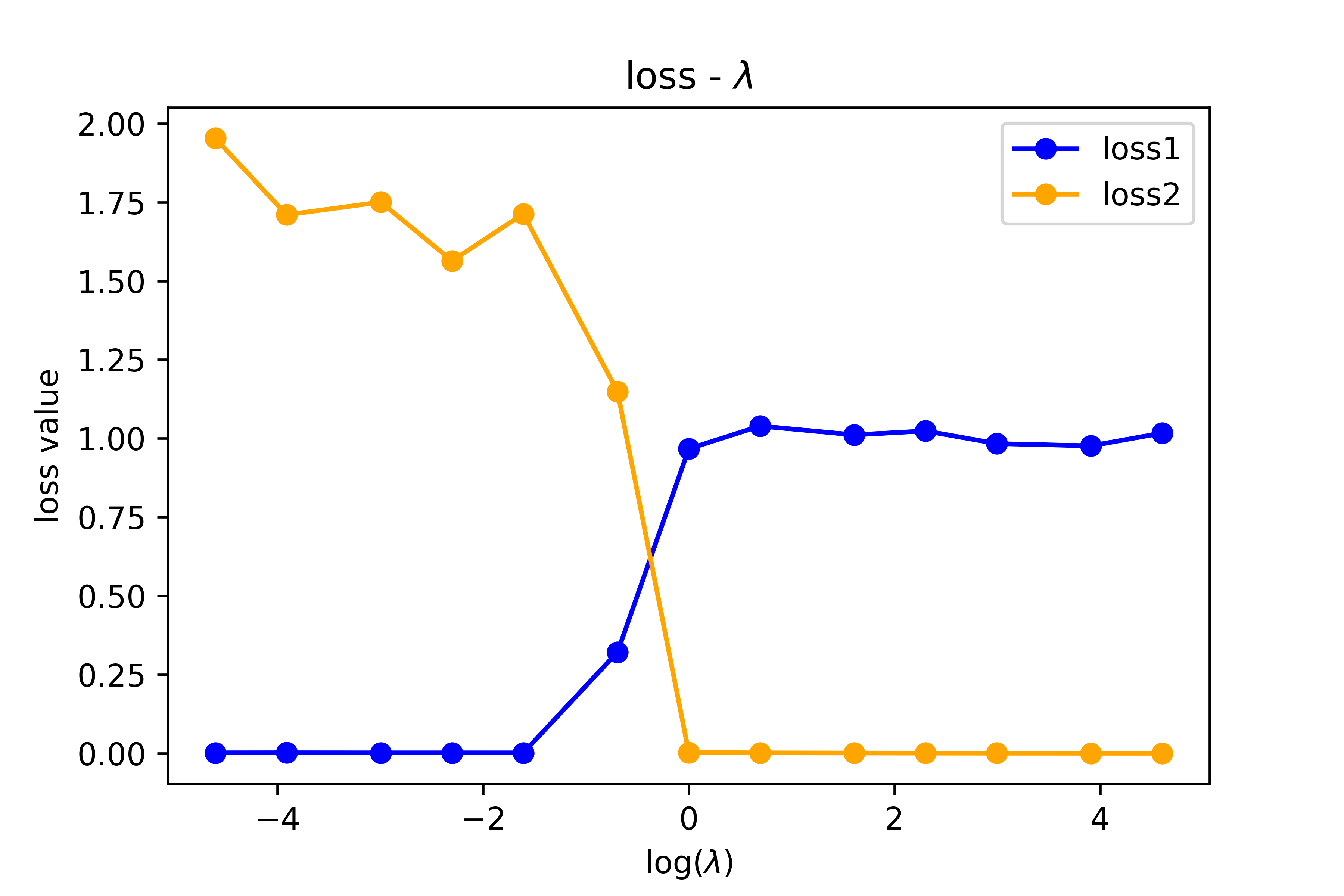
The paper uses additive separability, where $f(x_1, x_2) = f_1(x_1) + f_2(x_2)$, as a benchmark where both approaches go head-to-head. Separability is both discriminative (via the cross-derivative test $\partial^2 f / \partial x_1 \partial x_2 = 0$) and generative, so it allows a direct comparison. In PAL, the network is structured as $f_1(x_1; \theta_1) + f_2(x_2; \theta_2) + f_{12}(x_1, x_2; \theta_{12})$, with a loss penalizing the residual $f_{12}$ term. PIL uses a single network with a cross-derivative penalty. Both work here. For purely generative properties, only PAL succeeds.
The full taxonomy covers Lagrangian structure, positive definiteness, manifest and hidden symmetry, separability, and PDE satisfiability. A table in the paper sorts these by whether each is generative, discriminative, or both. PIL covers the discriminative column; PAL covers the generative column. Together they span the full space.
Why It Matters
Much of modern physics involves quantities that are easy to construct but hard to verify. Action principles say physical systems follow paths that minimize a certain quantity. Gauge symmetries encode real physical structure through mathematical redundancies in how we describe forces. Symplectic structures and integrability conditions impose powerful constraints on dynamics. PIL’s penalty-based approach doesn’t apply to any of them.
There’s a practical efficiency argument too. Even when a property is discriminative and PIL could handle it, an architectural embedding may train faster and generalize better. The constraint is exact by construction rather than approximately enforced through a tuned penalty coefficient. The paper shows cases where PIL fails to converge or requires enormous penalty weights, while PAL works without any tuning.
Neural networks are pushing deeper into scientific computing: modeling molecular dynamics, predicting gravitational wave signals, emulating cosmological simulations. Whether these models are trustworthy depends on how faithfully they encode physical structure. PAL covers the territory that PIL cannot reach.
The work also sketches a concrete research agenda. One direction is systematically cataloguing physical properties by their generative and discriminative nature. Another is developing PAL architectures for increasingly complex structures, or hybrid approaches combining both paradigms. Equivariant neural networks, Hamiltonian neural networks, and neural ODEs all already embed specific physical constraints into network design, making them natural starting points for extensions.
PAL complements PIL. By building physical properties into network architecture rather than penalizing their violation, it handles the broad class of generative physical structures (Lagrangian dynamics, hidden symmetries) that conventional physics-informed methods can’t reach.
IAIFI Research Highlights

This work formalizes a precise mathematical distinction between discriminative and generative physical properties, connecting GAN-inspired machine learning concepts with classical structures like Lagrangian mechanics and Lie group symmetries.

PAL provides a way to embed physical inductive biases directly into network architecture, covering cases that existing loss-based approaches cannot encode.

By enabling neural networks to represent Lagrangian systems, hidden symmetries, and positive-definite operators, PAL opens ML-based modeling to a much wider class of fundamental physics problems where no efficient discriminator is known.
Future work will extend PAL to more complex physical symmetries and hybrid PIL+PAL architectures; the paper appeared at the NeurIPS 2021 AI for Science Workshop and is available as [arXiv:2109.13901](https://arxiv.org/abs/2109.13901).
Original Paper Details
Physics-Augmented Learning: A New Paradigm Beyond Physics-Informed Learning
2109.13901
Ziming Liu, Yunyue Chen, Yuanqi Du, Max Tegmark
Integrating physical inductive biases into machine learning can improve model generalizability. We generalize the successful paradigm of physics-informed learning (PIL) into a more general framework that also includes what we term physics-augmented learning (PAL). PIL and PAL complement each other by handling discriminative and generative properties, respectively. In numerical experiments, we show that PAL performs well on examples where PIL is inapplicable or inefficient.