

Opening the AI black box: program synthesis via mechanistic interpretability
Authors
Eric J. Michaud, Isaac Liao, Vedang Lad, Ziming Liu, Anish Mudide, Chloe Loughridge, Zifan Carl Guo, Tara Rezaei Kheirkhah, Mateja Vukelić, Max Tegmark
Abstract
We present MIPS, a novel method for program synthesis based on automated mechanistic interpretability of neural networks trained to perform the desired task, auto-distilling the learned algorithm into Python code. We test MIPS on a benchmark of 62 algorithmic tasks that can be learned by an RNN and find it highly complementary to GPT-4: MIPS solves 32 of them, including 13 that are not solved by GPT-4 (which also solves 30). MIPS uses an integer autoencoder to convert the RNN into a finite state machine, then applies Boolean or integer symbolic regression to capture the learned algorithm. As opposed to large language models, this program synthesis technique makes no use of (and is therefore not limited by) human training data such as algorithms and code from GitHub. We discuss opportunities and challenges for scaling up this approach to make machine-learned models more interpretable and trustworthy.
Concepts
The Big Picture
Imagine hiring a brilliant but completely mute mathematician. She solves every problem you give her with perfect accuracy, but she can’t explain her work. She just hands you the answer. You know that she solved it; you have no idea how.
That’s where AI researchers stand with modern neural networks. These systems learn to perform complex tasks, sometimes better than any human algorithm, but their internal computations remain opaque, locked inside billions of numbers. The field of mechanistic interpretability exists to crack this opacity open, mostly through painstaking human analysis. A team at MIT and IAIFI wants to know: can the process be automated entirely?
Their answer is MIPS (Mechanistic Interpretability-based Program Synthesis). The system watches a neural network solve problems, reverse-engineers what it learned, and writes clean Python code that does the same thing. No human interpretation required.
Key Insight: MIPS can look inside a trained neural network, extract the algorithm it discovered, and express it as readable Python code, solving problems that even GPT-4 can’t crack and using zero human-written code as training data.
How It Works
The MIPS pipeline turns a black-box neural network into human-readable code in four stages.
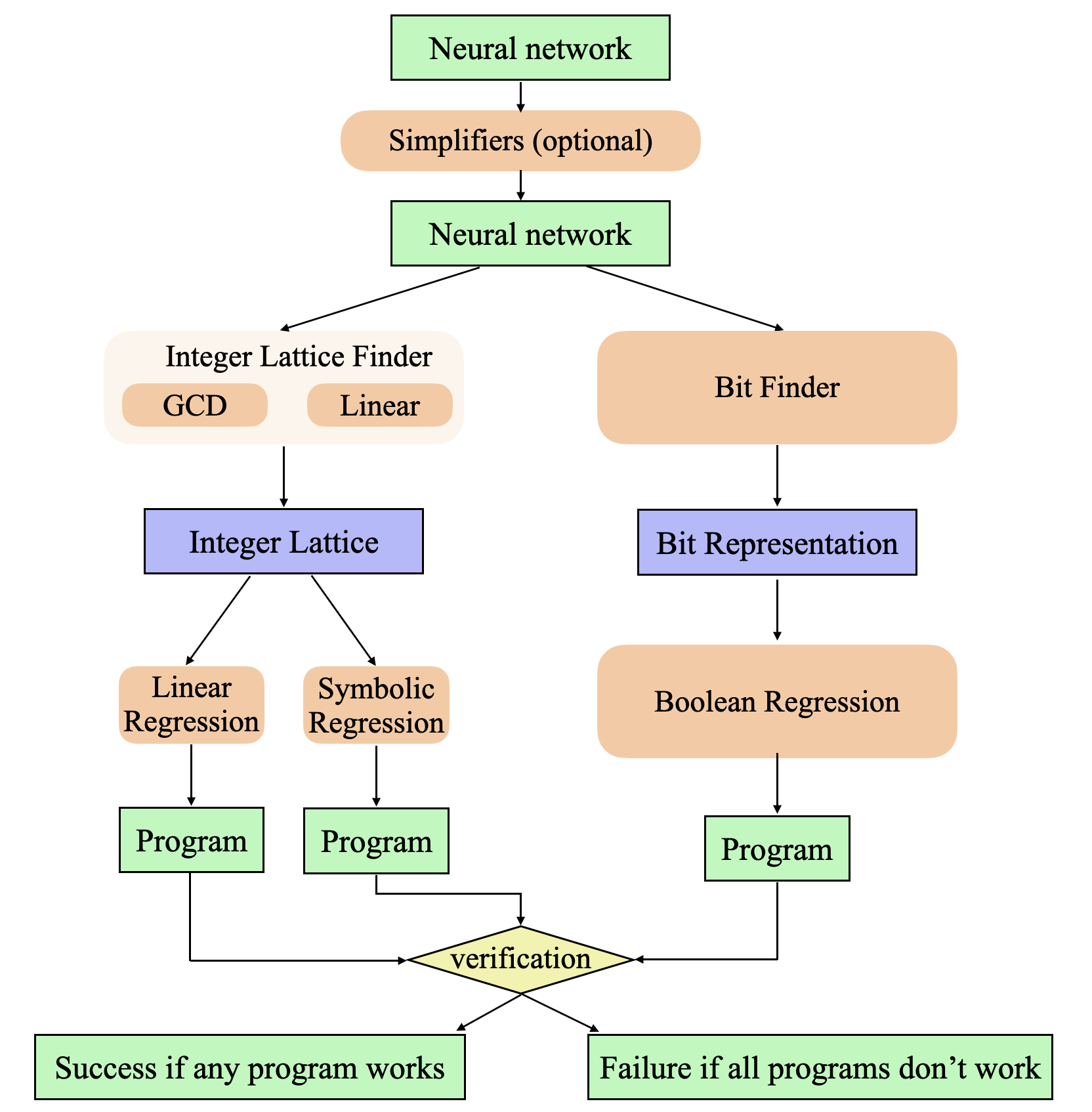
Stage 1: Train a neural network to learn the task. MIPS uses a recurrent neural network (RNN), a network that processes sequences by maintaining a running “memory” called a hidden state. The team also runs an AutoML search, an automated process that tries thousands of different network designs, to find the simplest RNN that achieves perfect accuracy. Simpler networks are easier to reverse-engineer.
Stage 2: Simplify the network. MIPS prunes and compresses the trained network to strip out redundancy, making later analysis cleaner.
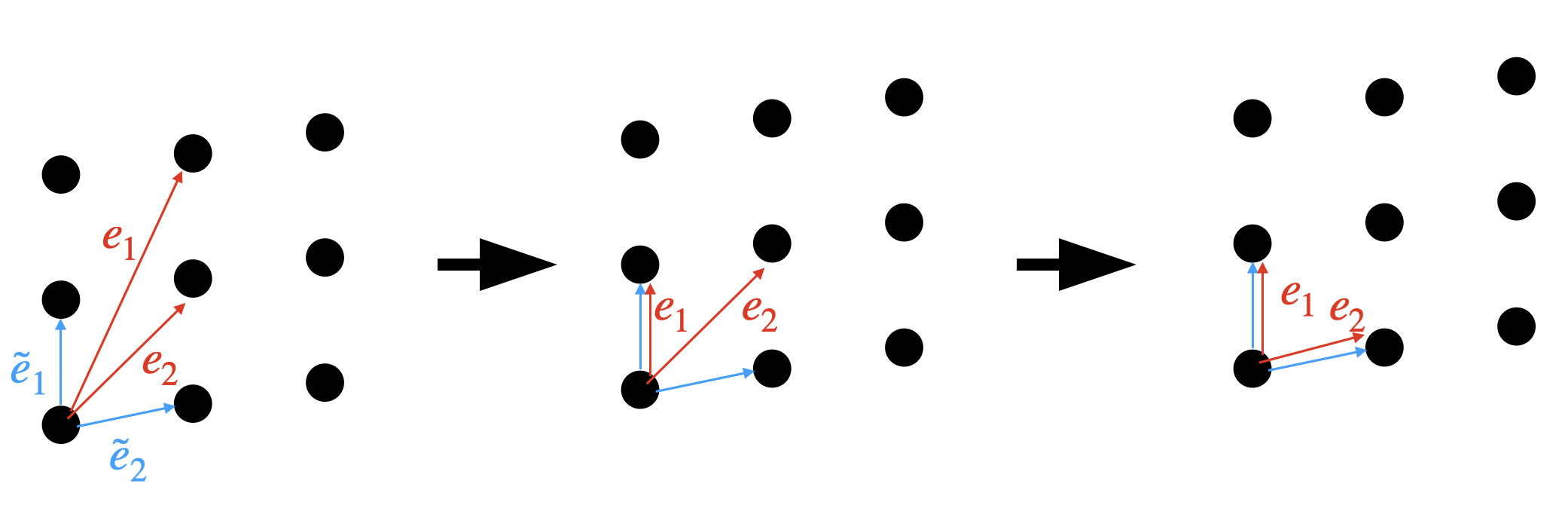
Stage 3: Convert to a finite state machine. When a network processes discrete inputs (integers, tokens, symbols), its hidden states cluster into groups rather than wandering freely through space. MIPS uses an integer autoencoder to discover and label these clusters, describing each one using only whole numbers or yes/no flags. The clusters often sit on a regular, grid-like arrangement where each point is one possible “mode” the network can be in. The continuous RNN becomes a discrete finite state machine: a lookup table mapping state-plus-input to next state.
Stage 4: Apply symbolic regression. With a finite state machine in hand, MIPS applies Boolean or integer symbolic regression to find compact mathematical formulas that fit the transition data. The result is Python code that implements the algorithm the network discovered on its own.
The team tested MIPS against a benchmark of 62 algorithmic tasks: detecting balanced parentheses, computing modular arithmetic, tracking state through a sequence. They compared it to GPT-4, which tackles the same benchmark by generating code from verbal problem descriptions.
- GPT-4 solved 30 of 62 tasks
- MIPS solved 32 of 62 tasks
- 13 tasks solved by MIPS were not solved by GPT-4
- 11 tasks solved by GPT-4 were not solved by MIPS
They’re not just close in score; they’re solving different problems. GPT-4 draws on vast human-written code to recognize familiar patterns. MIPS uses zero human training data, discovering algorithms from scratch by watching a network think. The two approaches cover problems that neither handles alone.
Why It Matters
MIPS goes after one of the hard problems in AI: we increasingly deploy systems we don’t understand. A network that aces benchmarks may still fail in subtle, dangerous ways when conditions shift. We usually can’t tell why, because we don’t know how it worked in the first place. If you could automatically extract the algorithm a network learned, you could audit it, verify it, and trust it far more thoroughly.
This is a proof of concept, at least for small RNNs on well-defined tasks. The authors are upfront that scaling to large transformer models remains a major challenge. Transformers are vastly more complex, and their hidden states don’t cluster as neatly. But the direction is clear: find the right representation and you can extract the algorithm.
There’s a physics angle too. The tools MIPS uses (symbolic regression, sparse representations, minimal descriptions) are the same tools physicists use to discover natural laws from data. The integer autoencoder is essentially finding the “quantum numbers” of the network’s internal states, the conserved quantities that characterize its behavior. Treating neural networks as physical systems to be understood, not just engineered, is a distinctly IAIFI way of thinking.
Bottom Line: MIPS shows that neural networks can be reverse-engineered automatically, turned from opaque black boxes into readable code. It solves 13 problems GPT-4 cannot, making human-free algorithm discovery a genuine complement to LLM-based coding.
IAIFI Research Highlights

MIPS applies physics-inspired tools (symbolic regression, minimal representations, finite-state abstractions) to AI interpretability, treating neural networks as physical systems whose internal "laws" can be discovered from observation.

Fully automated mechanistic interpretability solves 32 of 62 algorithmic benchmark tasks without any human-written training data, a step toward AI systems that can be meaningfully audited.

The integer autoencoder technique discovers discrete, structured representations inside continuous neural networks, an approach that carries over to scientific machine learning problems where hidden discrete structure is common.
The next challenge is pushing MIPS beyond small RNNs to larger transformer architectures. The paper is available at [arXiv:2402.05110](https://arxiv.org/abs/2402.05110) and comes from a collaboration between MIT CSAIL and the IAIFI.
Original Paper Details
Opening the AI black box: program synthesis via mechanistic interpretability
2402.05110
Eric J. Michaud, Isaac Liao, Vedang Lad, Ziming Liu, Anish Mudide, Chloe Loughridge, Zifan Carl Guo, Tara Rezaei Kheirkhah, Mateja Vukelić, Max Tegmark
We present MIPS, a novel method for program synthesis based on automated mechanistic interpretability of neural networks trained to perform the desired task, auto-distilling the learned algorithm into Python code. We test MIPS on a benchmark of 62 algorithmic tasks that can be learned by an RNN and find it highly complementary to GPT-4: MIPS solves 32 of them, including 13 that are not solved by GPT-4 (which also solves 30). MIPS uses an integer autoencoder to convert the RNN into a finite state machine, then applies Boolean or integer symbolic regression to capture the learned algorithm. As opposed to large language models, this program synthesis technique makes no use of (and is therefore not limited by) human training data such as algorithms and code from GitHub. We discuss opportunities and challenges for scaling up this approach to make machine-learned models more interpretable and trustworthy.