

Measurement of atmospheric neutrino oscillation parameters using convolutional neural networks with 9.3 years of data in IceCube DeepCore
Authors
IceCube Collaboration
Abstract
The DeepCore sub-detector of the IceCube Neutrino Observatory provides access to neutrinos with energies above approximately 5 GeV. Data taken between 2012-2021 (3,387 days) are utilized for an atmospheric $ν_μ$ disappearance analysis that studied 150,257 neutrino-candidate events with reconstructed energies between 5-100 GeV. An advanced reconstruction based on a convolutional neural network is applied, providing increased signal efficiency and background suppression, resulting in a measurement with both significantly increased statistics compared to previous DeepCore oscillation results and high neutrino purity. For the normal neutrino mass ordering, the atmospheric neutrino oscillation parameters and their 1$σ$ errors are measured to be $Δ$m$^2_{32}$ = $2.40\substack{+0.05 \\ -0.04} \times 10^{-3} \textrm{ eV}^2$ and sin$^2$$θ_{23}$=$0.54\substack{+0.04 \\ -0.03}$. The results are the most precise to date using atmospheric neutrinos, and are compatible with measurements from other neutrino detectors including long-baseline accelerator experiments.
Concepts
The Big Picture
Imagine building a particle detector the size of a cubic kilometer, burying it under a mile of Antarctic ice, and using it to catch subatomic particles that pass through the entire Earth as if it weren’t there. That’s IceCube. Its innermost region, DeepCore, has just delivered the most precise measurement of neutrino oscillations ever made using atmospheric neutrinos, with a serious boost from deep learning.
Neutrinos come in three “flavors” (electron, muon, and tau), and as they travel, they quantum-mechanically morph from one flavor to another. When first observed, neutrino oscillation proved neutrinos have mass, something the Standard Model originally said was impossible.
Two parameters govern this shape-shifting. The mass-squared splitting (Δm²₃₂) sets the oscillation rate, while the mixing angle (sin²θ₂₃) controls how completely the flavors blend. Pinning these numbers down remains one of the central goals of particle physics.
The IceCube Collaboration combined 9.3 years of data with a convolutional neural network to produce the most precise atmospheric neutrino oscillation measurement to date.
Key Insight: By using deep learning to reconstruct neutrino events in Antarctic ice, IceCube DeepCore has measured the fundamental parameters governing neutrino flavor change with precision rivaling dedicated long-baseline accelerator experiments.
How It Works
The raw material is atmospheric neutrinos: particles born when cosmic rays slam into Earth’s upper atmosphere. Muon neutrinos streaming downward arrive at IceCube nearly unaltered, while those traveling upward have crossed thousands of kilometers through Earth, enough distance to oscillate into tau neutrinos. Comparing these two populations lets physicists measure oscillation parameters directly.
IceCube DeepCore detects neutrinos through Cherenkov radiation. When a neutrino interacts with ice, it produces a charged particle moving faster than light travels through ice (though not faster than light in vacuum). This generates a cone of blue photons, caught by more than 5,000 optical sensors. The spatial and temporal pattern of these hits encodes the neutrino’s energy, direction, and flavor.
Reconstruction is hard. Three factors work against clean measurements:
- Non-uniform ice: Antarctic ice contains layers and bubbles that scatter photons unpredictably.
- Sensor variation: Individual optical sensors have different efficiencies and calibrated responses.
- Atmospheric muon background: Cosmic-ray showers rain muons down from above, outnumbering signal neutrinos by thousands to one before filtering.
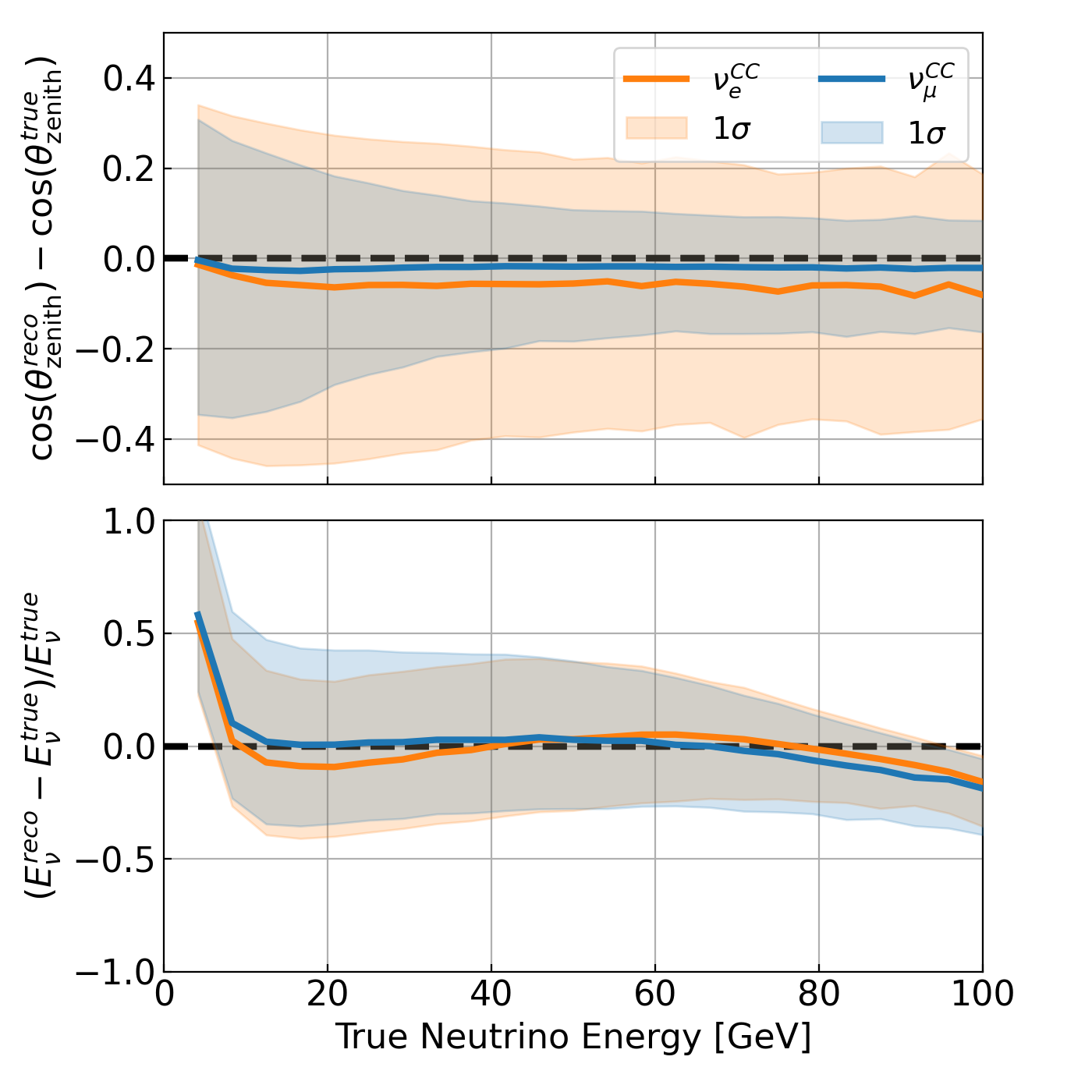
Previous analyses used traditional likelihood-based methods, scoring each event against an explicit mathematical model of the detector. This analysis uses a convolutional neural network (CNN) instead, trained to separate signal from noise more effectively than hand-crafted approaches.
The CNN processes raw photon hit data directly. It learns to distinguish genuine neutrino interactions from muon contamination without being told exactly what to look for. Its output feeds into an oscillation analysis comparing 150,257 neutrino-candidate events, spanning 5 to 100 GeV, against detailed Monte Carlo simulations across a grid of oscillation parameter values. (Monte Carlo simulations are computer-generated synthetic datasets that statistically model every step of the physics.)
Assuming normal neutrino mass ordering (the two lighter mass states grouped together, rather than apart from the heaviest), the results are: Δm²₃₂ = 2.40 ⁺⁰·⁰⁵₋₀.₀₄ × 10⁻³ eV² and sin²θ₂₃ = 0.54 ⁺⁰·⁰⁴₋₀.₀₃. The CNN boosted signal statistics while maintaining high neutrino purity, a tradeoff that traditional approaches struggle to make cleanly.
What does sin²θ₂₃ = 0.54 tell us? A value of exactly 0.5 would mean muon and tau neutrinos mix with perfect symmetry: maximal mixing. IceCube’s result sits slightly above 0.5, hinting at a preference for the upper octant (θ₂₃ > 45°), though the uncertainty still admits maximal mixing.
Why It Matters
Precision neutrino measurements are one of the best tools for finding physics beyond the Standard Model. The parameters measured here feed directly into global fits combining data from reactor detectors, solar neutrino experiments, and long-baseline accelerators like T2K in Japan and NOvA in the United States.
IceCube’s result agrees with these dedicated beam experiments, and it comes from an entirely different systematic environment: real cosmic-ray neutrinos, a different detector technology, different oscillation baselines. Agreement strengthens the oscillation picture. Disagreement would be a discovery signal.
Machine learning is also shifting how experimental particle physics gets done. Traditional reconstruction algorithms encode human understanding of detector physics into hand-crafted likelihood functions. These work well but are slow to develop and bounded by what humans can explicitly model. CNNs learn directly from simulated data, picking up on correlations that human-designed algorithms miss.
As detectors grow more complex and datasets larger, that advantage compounds. The upcoming IceCube-Upgrade will add denser instrumentation to DeepCore, and these CNN techniques will scale with it, with a real shot at sub-percent precision on oscillation parameters from atmospheric neutrinos alone.
Bottom Line: IceCube DeepCore combined 9.3 years of Antarctic ice data with convolutional neural network reconstruction to deliver the most precise atmospheric neutrino oscillation measurement ever made: Δm²₃₂ = 2.40 × 10⁻³ eV² and sin²θ₂₃ = 0.54. Deep learning is changing how precision particle physics works at kilometer-scale detectors.
IAIFI Research Highlights

This work pairs convolutional neural networks with a cubic-kilometer ice detector, pushing precision measurements of neutrino mass and mixing past what traditional reconstruction algorithms could reach alone.

The CNN-based event reconstruction shows that deep learning can simultaneously improve signal efficiency and background rejection in complex, high-dimensional particle physics datasets, an approach transferable across detector technologies.

The measurement of Δm²₃₂ = 2.40 ⁺⁰·⁰⁵₋₀.₀₄ × 10⁻³ eV² and sin²θ₂₃ = 0.54 ⁺⁰·⁰⁴₋₀.₀₃ is the world's most precise atmospheric neutrino oscillation result. It tightens constraints on both the mass ordering and the octant question.
These methods carry over directly to the IceCube-Upgrade and next-generation detectors, with the potential to resolve the neutrino mass ordering definitively. See [arXiv:2405.02163](https://arxiv.org/abs/2405.02163) for complete technical details.
Original Paper Details
Measurement of atmospheric neutrino oscillation parameters using convolutional neural networks with 9.3 years of data in IceCube DeepCore
2405.02163
IceCube Collaboration
The DeepCore sub-detector of the IceCube Neutrino Observatory provides access to neutrinos with energies above approximately 5 GeV. Data taken between 2012-2021 (3,387 days) are utilized for an atmospheric $ν_μ$ disappearance analysis that studied 150,257 neutrino-candidate events with reconstructed energies between 5-100 GeV. An advanced reconstruction based on a convolutional neural network is applied, providing increased signal efficiency and background suppression, resulting in a measurement with both significantly increased statistics compared to previous DeepCore oscillation results and high neutrino purity. For the normal neutrino mass ordering, the atmospheric neutrino oscillation parameters and their 1$σ$ errors are measured to be $Δ$m$^2_{32}$ = $2.40\substack{+0.05 \\ -0.04} \times 10^{-3} \textrm{ eV}^2$ and sin$^2$$θ_{23}$=$0.54\substack{+0.04 \\ -0.03}$. The results are the most precise to date using atmospheric neutrinos, and are compatible with measurements from other neutrino detectors including long-baseline accelerator experiments.