

Low-Budget Simulation-Based Inference with Bayesian Neural Networks
Authors
Arnaud Delaunoy, Maxence de la Brassinne Bonardeaux, Siddharth Mishra-Sharma, Gilles Louppe
Abstract
Simulation-based inference methods have been shown to be inaccurate in the data-poor regime, when training simulations are limited or expensive. Under these circumstances, the inference network is particularly prone to overfitting, and using it without accounting for the computational uncertainty arising from the lack of identifiability of the network weights can lead to unreliable results. To address this issue, we propose using Bayesian neural networks in low-budget simulation-based inference, thereby explicitly accounting for the computational uncertainty of the posterior approximation. We design a family of Bayesian neural network priors that are tailored for inference and show that they lead to well-calibrated posteriors on tested benchmarks, even when as few as $O(10)$ simulations are available. This opens up the possibility of performing reliable simulation-based inference using very expensive simulators, as we demonstrate on a problem from the field of cosmology where single simulations are computationally expensive. We show that Bayesian neural networks produce informative and well-calibrated posterior estimates with only a few hundred simulations.
Concepts
The Big Picture
Imagine solving a cosmic puzzle with only a handful of clues. A detective with ten clues might crack the case, or might jump to a wildly wrong conclusion if those clues happen to be misleading. In science, this problem is everywhere: you have an expensive computer simulation of how dark matter clusters in the universe, you can only afford to run it a few dozen times, and you need to extract reliable conclusions from those precious runs. Getting it wrong isn’t just wasteful. It can seed false discoveries that ripple through the field.
This is the challenge of simulation-based inference (SBI), a family of methods that uses machine learning to map simulation inputs (physical parameters) to outputs (observed data). Standard SBI trains a neural network on thousands of simulation runs to approximate a posterior distribution, essentially a probability map of which physical settings best explain your observation and how confident you should be in each answer.
When simulations are scarce, the neural network has too little to go on. Many different internal configurations fit the limited training data equally well, yet each makes different predictions on new observations. The network becomes confident not because it’s right, but because it doesn’t know what it doesn’t know.
Researchers at the University of Liège and MIT’s IAIFI propose a fix: equip the neural network with uncertainty about its own internal settings, and design that uncertainty carefully from the start.
Key Insight: By treating neural network weights as probability distributions rather than fixed numbers, and designing those distributions specifically for the inference task, Bayesian neural networks can deliver reliable, well-calibrated posteriors even when only a handful of simulations are available.
How It Works
The idea builds on Bayesian deep learning, a framework that replaces the usual single “best-fit” set of network weights with a full probability distribution over all plausible weight configurations. Instead of asking “what are the right weights?”, a Bayesian neural network (BNN) asks “given our data, how confident are we about any particular set of weights?” When making predictions, it averages over all plausible networks rather than committing to just one. This averaging procedure is called Bayesian model averaging.
The paper’s main contribution concerns the prior over neural network weights. A prior encodes beliefs about the weights before seeing any training data. Most BNN work defaults to vague, generic priors (Gaussians centered at zero, chosen for mathematical convenience). But this choice matters enormously when data is limited.
With very few simulations, the prior dominates the posterior over weights. A prior that conveys the wrong beliefs will produce a miscalibrated inference network from the start.
The team’s solution: design priors tailored for inference. They construct priors that enforce a specific property. When no training data is available, the network outputs a uniform (flat) distribution over parameters, the most conservative answer possible. As training data accumulates, the network smoothly updates toward more informative posteriors.
This behavior is baked into the prior itself, not tacked on after the fact. The authors build a family of such priors and analyze their properties both theoretically and empirically across a suite of benchmarks.
What do they find?
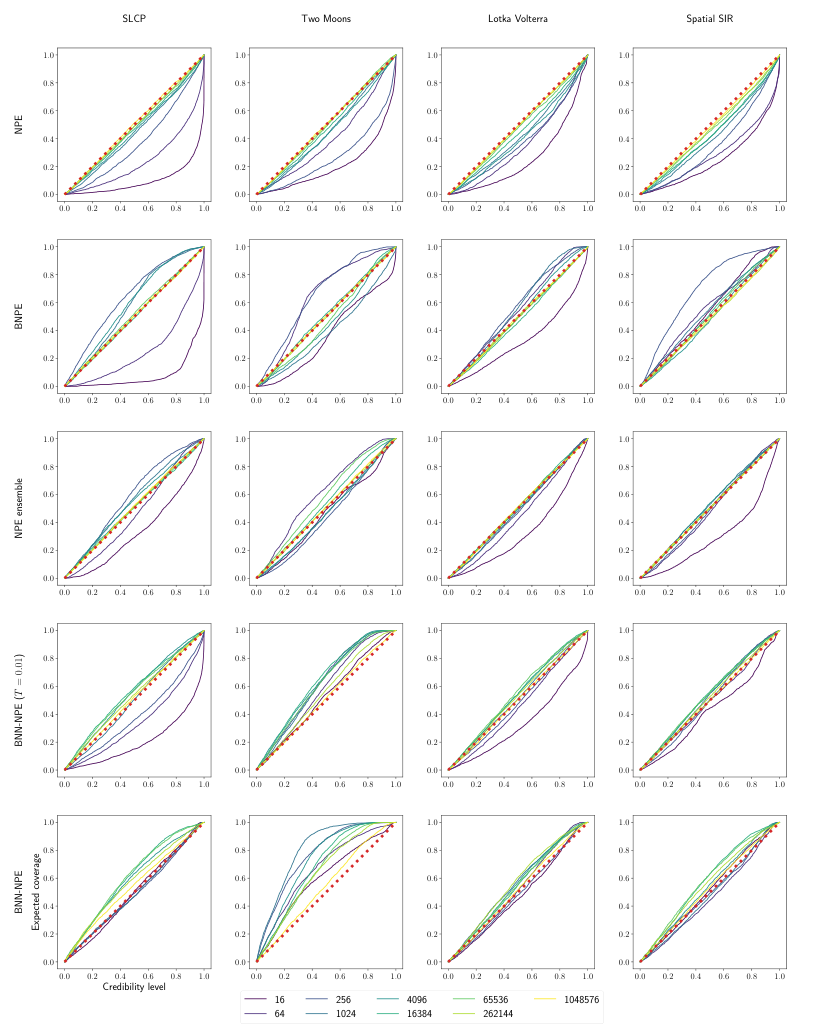
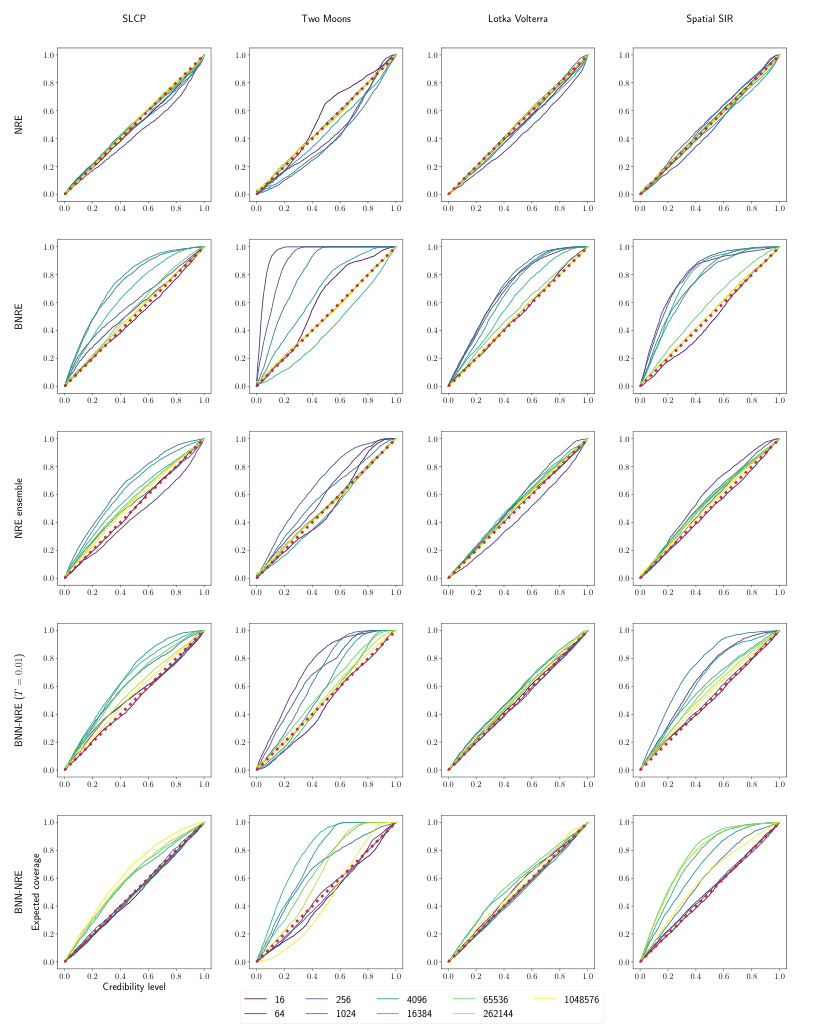
- With as few as O(10) simulations, the BNN with tailored priors produces well-calibrated posteriors on standard benchmarks
- Standard neural SBI methods produce overconfident posteriors at the same simulation budgets; they think they know more than they do
- Ensemble methods (training many independent networks and averaging) help somewhat, but BNNs with principled priors beat them, especially in the most extreme low-data regime
Why It Matters
The cosmology application makes the stakes concrete. A single simulation of large-scale structure (modeling how galaxies and dark matter are distributed across the cosmos) can eat up substantial compute. Running thousands of them to train a standard inference network isn’t practical. Running a few hundred might be. With only a few hundred simulations, the BNN approach here produces informative and well-calibrated posterior estimates of cosmological parameters.
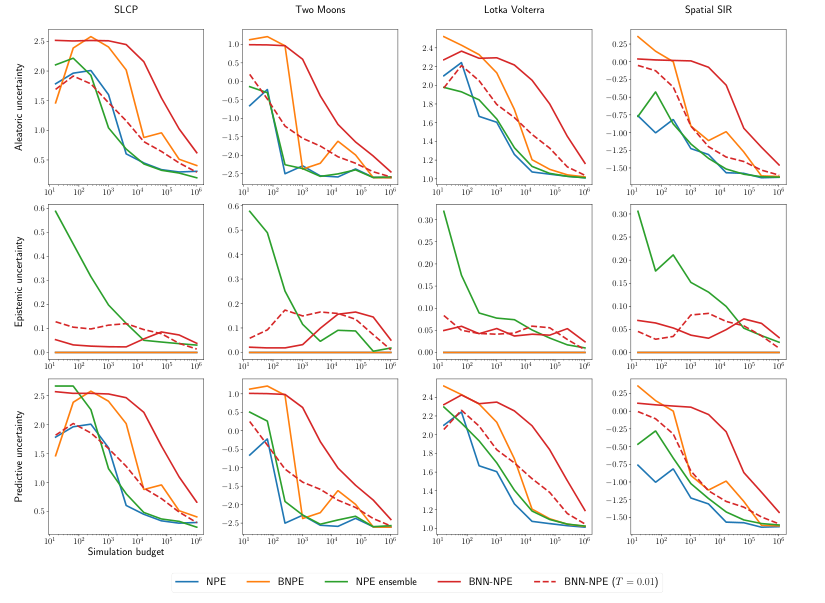
The distinction between aleatoric uncertainty (genuine randomness in the data) and epistemic uncertainty (ignorance due to limited training data) is often glossed over in applied ML. In scientific inference, conflating the two can be catastrophic. You need to know whether your uncertainty comes from the stochasticity of nature or from not having run enough simulations. The BNN framework developed here handles epistemic uncertainty honestly, and the approach generalizes well beyond cosmology to particle physics, climate modeling, drug discovery, and materials science.
Open questions remain. Sampling from a BNN’s weight posterior costs more than training a standard network, and scaling to very high-dimensional parameter spaces is still being worked out. Optimal prior design for different problem structures needs more attention too. But the core point holds: acknowledging what a network doesn’t know is just as important as what it does know.
Bottom Line: Bayesian neural networks with inference-tailored priors can perform reliable simulation-based inference with as few as ten simulations, making rigorous scientific inference feasible for problems where running the simulator is genuinely expensive.
IAIFI Research Highlights

This work draws on Bayesian statistics, deep learning theory, and observational cosmology. The ML tools it develops are motivated by and validated on real problems in fundamental physics.

The paper introduces a principled way to design BNN priors that enforce calibration by construction, advancing uncertainty quantification in neural density estimation.

Reliable inference with only hundreds of cosmological simulations means Bayesian parameter estimation becomes tractable for computationally expensive simulators of large-scale structure and other physical systems.
Future work includes scaling to higher-dimensional problems and more complex simulators. The paper is available at [arXiv:2408.15136](https://arxiv.org/abs/2408.15136) and code is open-sourced at [github.com/ADelau/low_budget_sbi_with_bnn](https://github.com/ADelau/low_budget_sbi_with_bnn).
Original Paper Details
Low-Budget Simulation-Based Inference with Bayesian Neural Networks
2408.15136
Arnaud Delaunoy, Maxence de la Brassinne Bonardeaux, Siddharth Mishra-Sharma, Gilles Louppe
Simulation-based inference methods have been shown to be inaccurate in the data-poor regime, when training simulations are limited or expensive. Under these circumstances, the inference network is particularly prone to overfitting, and using it without accounting for the computational uncertainty arising from the lack of identifiability of the network weights can lead to unreliable results. To address this issue, we propose using Bayesian neural networks in low-budget simulation-based inference, thereby explicitly accounting for the computational uncertainty of the posterior approximation. We design a family of Bayesian neural network priors that are tailored for inference and show that they lead to well-calibrated posteriors on tested benchmarks, even when as few as $O(10)$ simulations are available. This opens up the possibility of performing reliable simulation-based inference using very expensive simulators, as we demonstrate on a problem from the field of cosmology where single simulations are computationally expensive. We show that Bayesian neural networks produce informative and well-calibrated posterior estimates with only a few hundred simulations.