

Limits on Simultaneous and Delayed Optical Emission from Well-localized Fast Radio Bursts
Authors
Daichi Hiramatsu, Edo Berger, Brian D. Metzger, Sebastian Gomez, Allyson Bieryla, Iair Arcavi, D. Andrew Howell, Ryan Mckinven, Nozomu Tominaga
Abstract
We present the largest compilation to date of optical observations during and following fast radio bursts (FRBs). The data set includes our dedicated simultaneous and follow-up observations, as well as serendipitous archival survey observations, for a sample of 15 well-localized FRBs: eight repeating and seven one-off sources. Our simultaneous (and nearly simultaneous with a $0.4$ s delay) optical observations of 13 (1) bursts from the repeating FRB 20220912A provide the deepest such limits to date for any extragalactic FRB, reaching a luminosity limit of $νL_ν\lesssim 10^{42}$ erg s$^{-1}$ ($\lesssim 2\times10^{41}$ erg s$^{-1}$) with $15-400$ s exposures; an optical-flux-to-radio-fluence ratio of $f_{\rm opt}/F_{\rm radio}\lesssim 10^{-7}$ ms$^{-1}$ ($\lesssim 10^{-8}$ ms$^{-1}$); and flux ratio of $f_{\rm opt}/f_{\rm radio}\lesssim 0.02-\lesssim 2\times 10^{-5}$ ($\lesssim 10^{-6}$) on millisecond to second timescales. These simultaneous limits provide useful constraints in the context of FRB emission models, such as the pulsar magnetosphere and pulsar nebula models. Interpreting all available optical limits in the context of the synchrotron maser model, we find that they constrain the flare energies to $\lesssim 10^{43}-10^{49}$ erg (depending on the distances of the various repeating FRBs, with $\lesssim 10^{39}$ erg for the Galactic SGR 1935+2154). These limits are generally at least an order of magnitude larger than those inferred from the FRBs themselves, although in the case of FRB 20220912A our simultaneous and rapid follow-up observations severely restrict the model parameter space. We conclude by exploring the potential of future simultaneous and rapid-response observations with large optical telescopes.
Concepts
The Big Picture
A fast radio burst is a millisecond-long flash of radio energy powerful enough to outshine entire galaxies. These signals arrive from billions of light-years away, and after nearly two decades of detections, we still don’t know what produces them. They’re bright enough to see across the universe, fast enough to blink out before your neurons finish registering the pulse, and completely silent at every other wavelength.
That silence is the crux of the problem. Since the first FRB was spotted in 2007, the catalog has grown to thousands of events, but nearly all our knowledge comes from radio waves alone. It’s like trying to identify a fire by listening for the crackle while being forbidden from looking at the flame. Theory predicts that whatever produces these radio screams should also glow briefly in visible light. Nobody has ever caught that glow.
A team led by Daichi Hiramatsu and Edo Berger at the Harvard Center for Astrophysics has now assembled the largest and most sensitive campaign of simultaneous optical observations of FRBs ever conducted. They found no optical light. What they didn’t see turns out to be the interesting part.
Key Insight: By watching 13 radio bursts from FRB 20220912A in visible light at the exact moment they fired, this study sets the tightest constraints ever placed on the optical brightness of any extragalactic FRB, severely restricting several theoretical explanations.
How It Works
The team compiled data on 15 well-localized FRBs, sources pinpointed precisely enough to identify their host galaxies. Eight are repeating FRBs (sources that fire multiple times) and seven are one-off events. Optical data came from dedicated telescope campaigns and archival surveys that happened to be imaging the right patch of sky at the right moment.
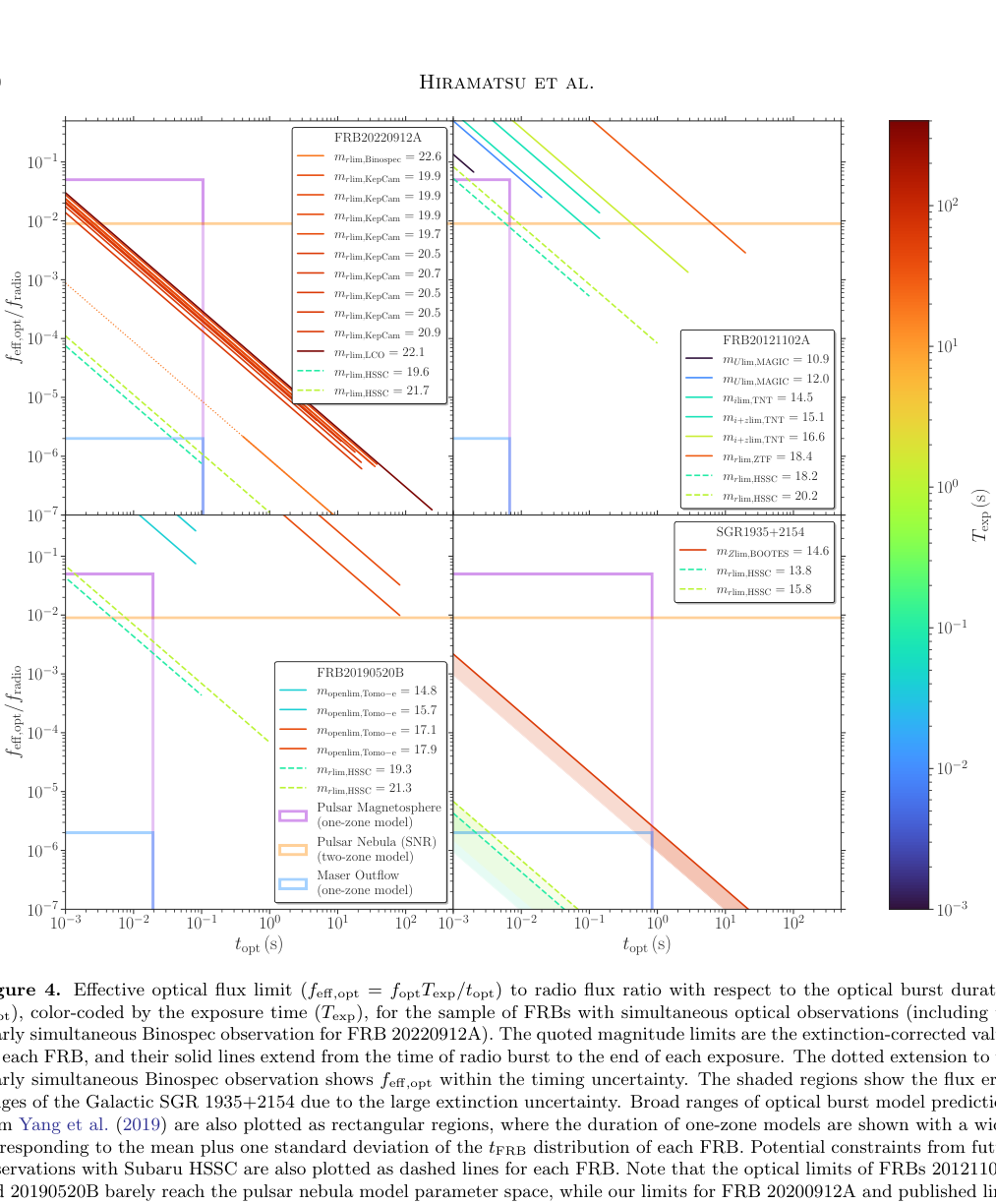
The centerpiece is FRB 20220912A, a prolific repeater about 1 billion light-years away. The team coordinated real-time radio alerts from the CHIME telescope with optical cameras, snapping exposures of 15 to 400 seconds either simultaneously with or within 0.4 seconds of individual bursts. They caught 13 bursts simultaneously and one nearly so. No optical flash appeared in any of them.
“Not detected” has a precise meaning here. The team calculated upper limits, the maximum brightness consistent with seeing nothing. Their tightest numbers:
- Luminosity: dimmer than roughly 10^42 ergs per second
- Optical-to-radio flux ratio: less than 0.02, and as low as 2×10^-5 across timescales from milliseconds to seconds
- Optical-to-radio fluence ratio: less than 10^-7 per millisecond (fluence is total energy delivered per unit collecting area)
These are the deepest such limits ever achieved for any extragalactic FRB.
Why It Matters
Non-detections get interesting when you test them against theory. The synchrotron maser model, currently the leading explanation, proposes that FRBs are powered by magnetar flares: catastrophic magnetic energy releases from ultra-dense, rapidly spinning neutron stars. Charged particles accelerated by the flare produce both the radio burst and a brief optical afterglow via synchrotron emission, the light radiated when charged particles spiral through magnetic fields.
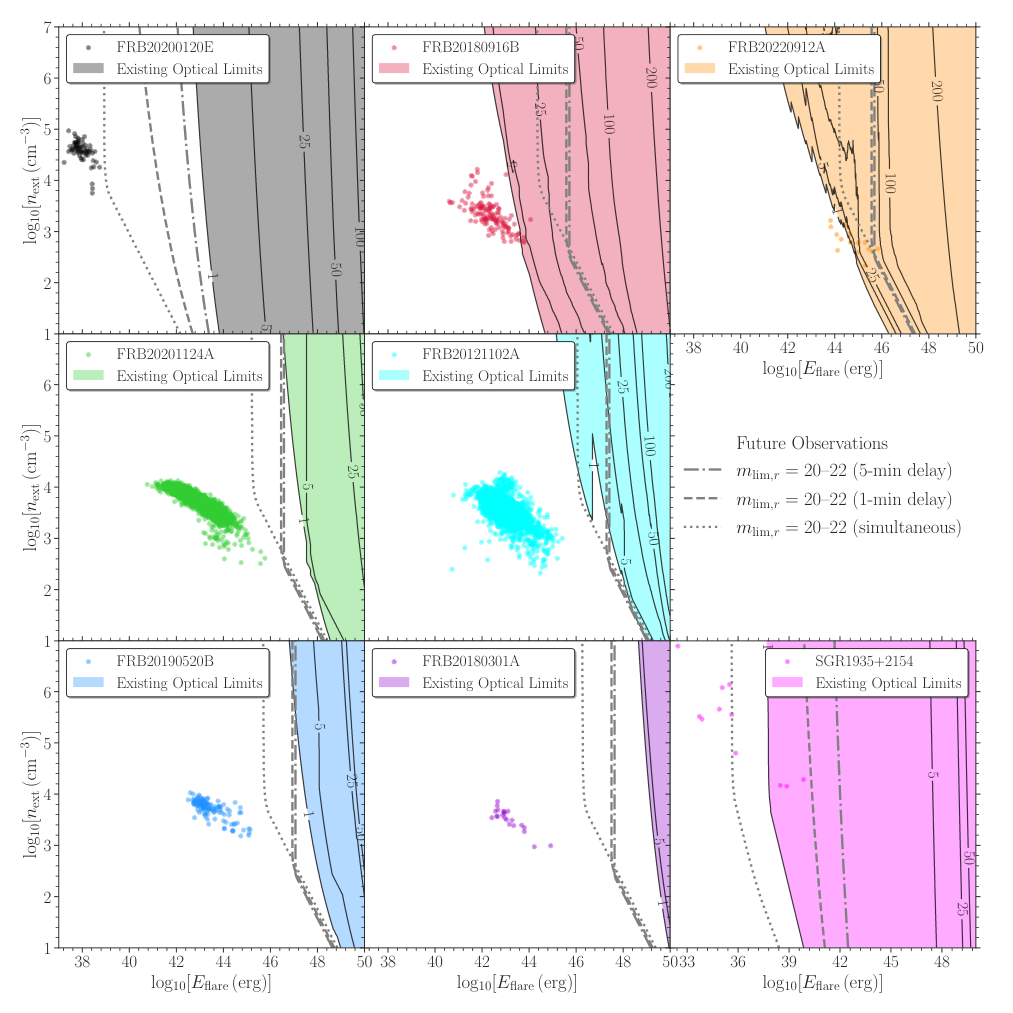
Translating all their optical limits into flare energy constraints, the researchers find that magnetar flares in their sample released no more than 10^43 to 10^49 ergs. The wide range reflects the different distances of each source. For the one Galactic FRB-like event from magnetar SGR 1935+2154, the constraint tightens to under 10^39 ergs. These limits are generally at least an order of magnitude looser than what the radio bursts themselves imply, so the optical data alone don’t yet rule the model out in most cases.
FRB 20220912A is the exception. Here, the simultaneous observations come close enough to the theoretically predicted optical brightness to carve away parts of the allowed parameter space, specifically restricting combinations of high flare energy and dense surrounding plasma. It’s the first time simultaneous multiwavelength observations have squeezed an FRB model this hard.
The parallel to gamma-ray bursts (GRBs) is deliberate. GRBs were mysteries for years until rapid optical follow-up cracked them open. FRBs are at a similar turning point. The next generation of large optical telescopes, combined with real-time radio alert systems, could push sensitivity down by orders of magnitude, into the territory where theoretical models make firm predictions.
Bottom Line: No one has ever caught a fast radio burst glowing in visible light. This study sets the strictest limits yet, and the deep non-detections from FRB 20220912A already strain the synchrotron maser model. Future telescope campaigns could finally reveal what powers the universe’s most powerful radio flashes.
IAIFI Research Highlights

This work required real-time coordination between radio (CHIME) and optical telescopes alongside large-scale archival data mining, combining observational astrophysics with the kind of multi-instrument, data-intensive science central to IAIFI's mission.

The pipeline for real-time burst detection, cross-instrument triggering, and multi-survey archival matching is ripe for machine learning, from automated alert classification to rapid follow-up scheduling.

By placing the deepest simultaneous optical limits ever achieved for an extragalactic FRB, this study constrains the physical mechanisms behind the universe's most energetic radio transients, narrowing the viable parameter space of magnetar flare and synchrotron maser models.
Future campaigns with 30-meter class telescopes and sub-second optical response could reach theoretically critical brightness thresholds; full results are available at [arXiv:2211.03974](https://arxiv.org/abs/2211.03974).
Original Paper Details
Limits on Simultaneous and Delayed Optical Emission from Well-localized Fast Radio Bursts
2211.03974
["Daichi Hiramatsu", "Edo Berger", "Brian D. Metzger", "Sebastian Gomez", "Allyson Bieryla", "Iair Arcavi", "D. Andrew Howell", "Ryan Mckinven", "Nozomu Tominaga"]
We present the largest compilation to date of optical observations during and following fast radio bursts (FRBs). The data set includes our dedicated simultaneous and follow-up observations, as well as serendipitous archival survey observations, for a sample of 15 well-localized FRBs: eight repeating and seven one-off sources. Our simultaneous (and nearly simultaneous with a $0.4$ s delay) optical observations of 13 (1) bursts from the repeating FRB 20220912A provide the deepest such limits to date for any extragalactic FRB, reaching a luminosity limit of $νL_ν\lesssim 10^{42}$ erg s$^{-1}$ ($\lesssim 2\times10^{41}$ erg s$^{-1}$) with $15-400$ s exposures; an optical-flux-to-radio-fluence ratio of $f_{\rm opt}/F_{\rm radio}\lesssim 10^{-7}$ ms$^{-1}$ ($\lesssim 10^{-8}$ ms$^{-1}$); and flux ratio of $f_{\rm opt}/f_{\rm radio}\lesssim 0.02-\lesssim 2\times 10^{-5}$ ($\lesssim 10^{-6}$) on millisecond to second timescales. These simultaneous limits provide useful constraints in the context of FRB emission models, such as the pulsar magnetosphere and pulsar nebula models. Interpreting all available optical limits in the context of the synchrotron maser model, we find that they constrain the flare energies to $\lesssim 10^{43}-10^{49}$ erg (depending on the distances of the various repeating FRBs, with $\lesssim 10^{39}$ erg for the Galactic SGR 1935+2154). These limits are generally at least an order of magnitude larger than those inferred from the FRBs themselves, although in the case of FRB 20220912A our simultaneous and rapid follow-up observations severely restrict the model parameter space. We conclude by exploring the potential of future simultaneous and rapid-response observations with large optical telescopes.