

Level Crossings, Attractor Points and Complex Multiplication
Authors
Hamza Ahmed, Fabian Ruehle
Abstract
We study the complex structure moduli dependence of the scalar Laplacian eigenmodes for one-parameter families of Calabi-Yau $n$-folds in P^{n+1}. It was previously observed that some eigenmodes get lighter while others get heavier as a function of these moduli, which leads to eigenvalue crossing. We identify the cause for this behavior for the torus. We then show that at points in a sublocus of complex structure moduli space where Laplacian eigenmodes cross, the torus has complex multiplication. We speculate that the generalization to arbitrary Calabi-Yau manifolds could be that level crossing is related to rank one attractor points. To test this, we compute the eigenmodes numerically for the quartic K3 and the quintic threefold, and match crossings to CM and attractor points in these varieties. To quantify the error of our numerical methods, we also study the dependence of the numerical spectrum on the quality of the Calabi-Yau metric approximation, the number of points sampled from the Calabi-Yau variety, the truncation of the eigenbasis, and the the distance from degeneration points in complex structure moduli space.
Concepts
The Big Picture
Imagine tuning a guitar, but as you tighten one string, another seemingly unrelated one shifts pitch in response. Now scale that up: the strings are vibrational patterns on a six-dimensional geometric space curled up at every point in the universe, and the tuning knob controls the shape of reality itself.
In string theory, the extra dimensions aren’t empty space. They’re folded into intricate geometric objects called Calabi-Yau manifolds, and the shapes of these spaces determine observable physics: particle masses, symmetries, the forces of nature.
As you vary the shape parameters (called complex structure moduli) of these spaces, the spectrum of vibrational frequencies changes. Sometimes two frequencies gradually approach each other and, at a precise moment, swap. This phenomenon, known as level crossing, had been observed numerically, but nobody knew why it happened or what made the crossing points special.
Ahmed and Ruehle set out to answer exactly that question. What they found connects abstract number theory to black hole physics in a way nobody had anticipated.
Key Insight: Level crossings in Calabi-Yau Laplacian spectra occur at points in moduli space with a number-theoretic property called complex multiplication, the same special points that govern the behavior of extremal black holes in string theory.
How It Works
The researchers started with the simplest case: a torus (a CY 1-fold, mathematically a cubic curve in projective space P²). Everything about the torus can be computed analytically, no approximations needed. That made it the right place to understand level crossings before moving to harder cases.
A torus’s shape is encoded in a single complex number τ, its complex structure modulus. As τ varies, the eigenmodes of the scalar Laplacian (the differential operator governing wave behavior on the surface) shift their eigenvalues. They tracked how each eigenmode transforms as the torus’s algebraic description changes.
What they found: eigenmodes divide into symmetry classes called irreducible representations, distinct families of vibrations that don’t normally mix. As τ changes, eigenvalues from different families can approach each other, and at specific values of τ, they cross.
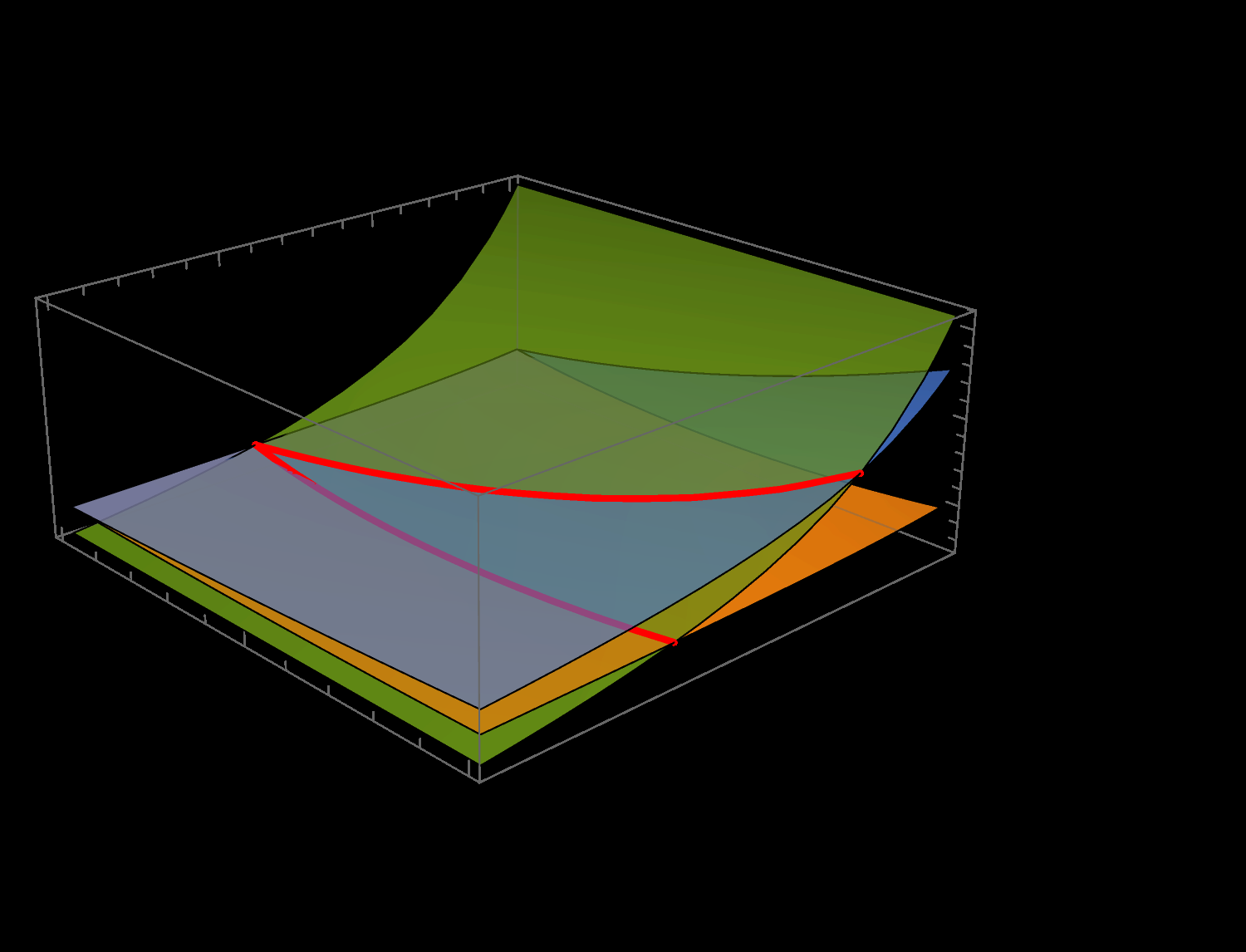
Those crossing points aren’t random. They correspond to values of τ where the torus has complex multiplication (CM), a special algebraic property where the endomorphism ring contains more than just the integers. The torus at such points carries an extra symmetry visible only through number theory. Familiar examples include τ = i (the square torus) and τ = e^(2πi/3) (the hexagonal torus).
The team then moved to higher dimensions, where numerical computation becomes essential:
- Quartic K3 surface (CY 2-fold): A complex 2-dimensional surface where the Picard rank, a count of algebraic cycles, jumps from 19 to 20 at special CM points.
- Quintic threefold (CY 3-fold): A complex 3-dimensional manifold with 101 complex structure parameters. The paper studies the one-parameter subfamily with enhanced symmetry.
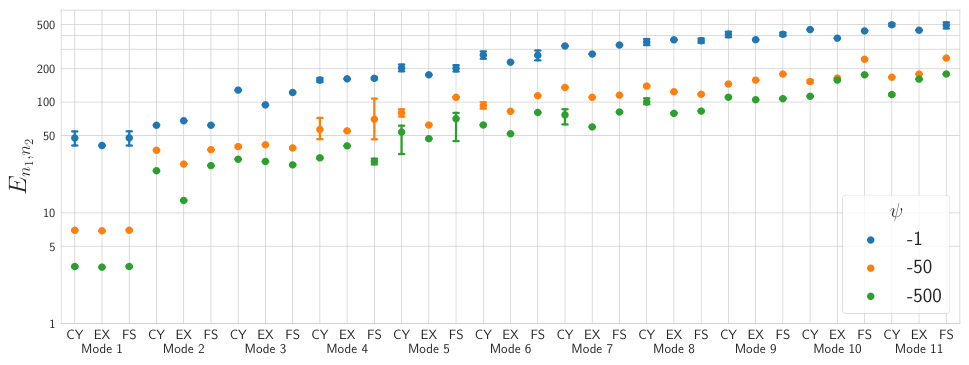
Analytic metrics don’t exist for these cases. The team used neural network-approximated Ricci-flat metrics to numerically compute the Laplacian eigenspectrum. They characterized numerical errors carefully, varying metric approximation quality, sampling density, eigenbasis truncation, and proximity to degeneration points.
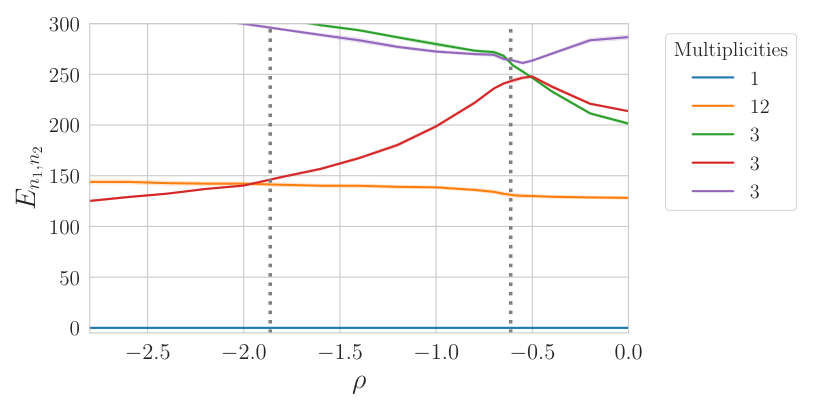
For the K3, crossings matched known CM points where the Picard rank jumps. The quintic told a more dramatic story: crossings matched rank one attractor points, special moduli values where BPS black hole flows in string theory converge. The same points governing the thermodynamics of extremal black holes in 4D supergravity also mark where vibrational modes on the compactification manifold exchange identity.
Why It Matters
Why should we care? Attractor points in Calabi-Yau moduli space are tied to BPS black hole stability and the structure of the string landscape, the vast collection of possible string theory vacua. A direct spectral signature of these points opens a different route to finding them: instead of hunting through algebraic geometry, you could detect attractor points through numerical spectroscopy of the Laplacian.
This work also advances the use of machine learning for precise calculations in string theory. The careful error analysis across multiple approximation schemes shows that neural network-based metric approximations are accurate enough to pick up subtle spectral phenomena.
Several open questions remain. Does the crossing-to-attractor connection hold for arbitrary multi-parameter Calabi-Yau families? Can spectral methods become a systematic tool for mapping out string vacua? The conjectured link to rank one attractor points, rather than CM points directly, still awaits a proof.
Bottom Line: Level crossings in Calabi-Yau spectra are a spectral fingerprint of attractor points, extraordinary geometric locations at the intersection of black hole physics and number theory. Ahmed and Ruehle turn a puzzling numerical observation into a precise conjecture, backed by analytic proof for the torus and strong numerical evidence for K3 and quintic geometries.
IAIFI Research Highlights

This work sits at the crossroads of algebraic geometry, number theory, black hole physics, and machine learning, the kind of cross-disciplinary combination that IAIFI was built for.

The paper rigorously benchmarks neural network-approximated Ricci-flat metrics as a tool for detecting subtle spectral phenomena in curved geometry, showing that ML methods are reliable enough for serious mathematical physics.

Connecting Laplacian level crossings to rank one attractor points and complex multiplication in Calabi-Yau manifolds, the paper offers a new spectral probe of the string landscape and the geometry underlying 4D supergravity.
Future work may extend this conjecture to multi-parameter Calabi-Yau families and provide a computational shortcut for locating attractor points; the full paper is available at [arXiv:2304.00027](https://arxiv.org/abs/2304.00027).
Original Paper Details
Level Crossings, Attractor Points and Complex Multiplication
2304.00027
["Hamza Ahmed", "Fabian Ruehle"]
We study the complex structure moduli dependence of the scalar Laplacian eigenmodes for one-parameter families of Calabi-Yau $n$-folds in P^{n+1}. It was previously observed that some eigenmodes get lighter while others get heavier as a function of these moduli, which leads to eigenvalue crossing. We identify the cause for this behavior for the torus. We then show that at points in a sublocus of complex structure moduli space where Laplacian eigenmodes cross, the torus has complex multiplication. We speculate that the generalization to arbitrary Calabi-Yau manifolds could be that level crossing is related to rank one attractor points. To test this, we compute the eigenmodes numerically for the quartic K3 and the quintic threefold, and match crossings to CM and attractor points in these varieties. To quantify the error of our numerical methods, we also study the dependence of the numerical spectrum on the quality of the Calabi-Yau metric approximation, the number of points sampled from the Calabi-Yau variety, the truncation of the eigenbasis, and the the distance from degeneration points in complex structure moduli space.