

Full-shape analysis with simulation-based priors: constraints on single field inflation from BOSS
Authors
Mikhail M. Ivanov, Carolina Cuesta-Lazaro, Siddharth Mishra-Sharma, Andrej Obuljen, Michael W. Toomey
Abstract
Perturbative, or effective field theory (EFT)-based, full-shape analyses of galaxy clustering data involve ``nuisance parameters'' to capture various observational effects such as the galaxy-dark matter connection (galaxy bias). We present an efficient approach to set informative physically motivated priors on these parameters. We extract these priors from simulated galaxy catalogs based on halo occupation distribution (HOD) models. First, we build a joint distribution between EFT galaxy bias and HOD parameters from a set of 10,500 HOD mock catalogs. We use the field level EFT technique that allows for cosmic variance cancellation, enabling a precision calibration of EFT parameters from computationally inexpensive small-volume simulations. Second, we use neural density estimators -- normalizing flows -- to model the marginal probability density of the EFT parameters, which can be used as a prior distribution in full shape analyses. As a first application, we use our HOD-based priors in a new analysis of galaxy power spectra and bispectra from the BOSS survey in the context of single field primordial non-Gaussianity. We find that our priors lead to a reduction of the posterior volume of bias parameters by an order of magnitude. We also find $f_{\rm NL}^{\rm equil} = 320\pm 300$ and $f_{\rm NL}^{\rm ortho} = 100\pm 130$ (at 68\% CL) in a combined two-template analysis, representing a $\approx 40\%$ improvement in constraints on single field primordial non-Gaussianity, equivalent to doubling the survey volume.
Concepts
The Big Picture
Imagine trying to weigh something on a scale that vibrates. You can still get a reading, but the wobble limits your precision. Now imagine you had a blueprint for exactly how that scale vibrates under different conditions, so you could subtract the noise. Your measurement suddenly gets much sharper.
A team from MIT, Harvard, and the University of Zurich has done something like this for one of the most ambitious measurements in modern cosmology: probing the physics of the Big Bang using the largest maps of galaxies ever built.
The problem: galaxies don’t trace the underlying structure of matter in the universe perfectly. They form in preferred locations, dense knots of invisible dark matter, and the relationship between where galaxies sit and where matter actually is turns out to be messy and complicated. That messiness injects a “wobble” into any attempt to use galaxy maps to measure fundamental cosmic physics.
By training a neural network on 10,500 simulated galaxy catalogs, the researchers built a precise map of that wobble and used it as a correction, cutting measurement uncertainty by 40%.
Key Insight: By replacing vague assumptions about galaxy bias with AI-learned priors from galaxy simulations, this team achieved the equivalent of doubling the volume of one of the world’s premier galaxy surveys, without collecting a single new data point.
How It Works
To extract cosmological signals from galaxy surveys like BOSS (the Baryon Oscillation Spectroscopic Survey), analysts use the Effective Field Theory of Large-Scale Structure (EFT-LSS). This mathematical framework describes how galaxies cluster on large scales, building up from simpler, well-understood components. EFT is fast (templates compute in under a second) and systematically improvable. But it comes with a price.
EFT requires galaxy bias parameters, numbers like b₁, b₂, and bG₂ that encode how galaxies trace the dark matter distribution. These capture messy small-scale physics: how galaxies form inside dark matter halos (the invisible gravitational scaffolding around which galaxies assemble) and how they respond to their surroundings.
Traditionally, analysts treat these as free parameters and marginalize over them using broad, uninformative priors, averaging over all plausible values. The result: significant dilution of the cosmological signals you’re trying to measure. You’re leaving the scale vibrating when you don’t have to.
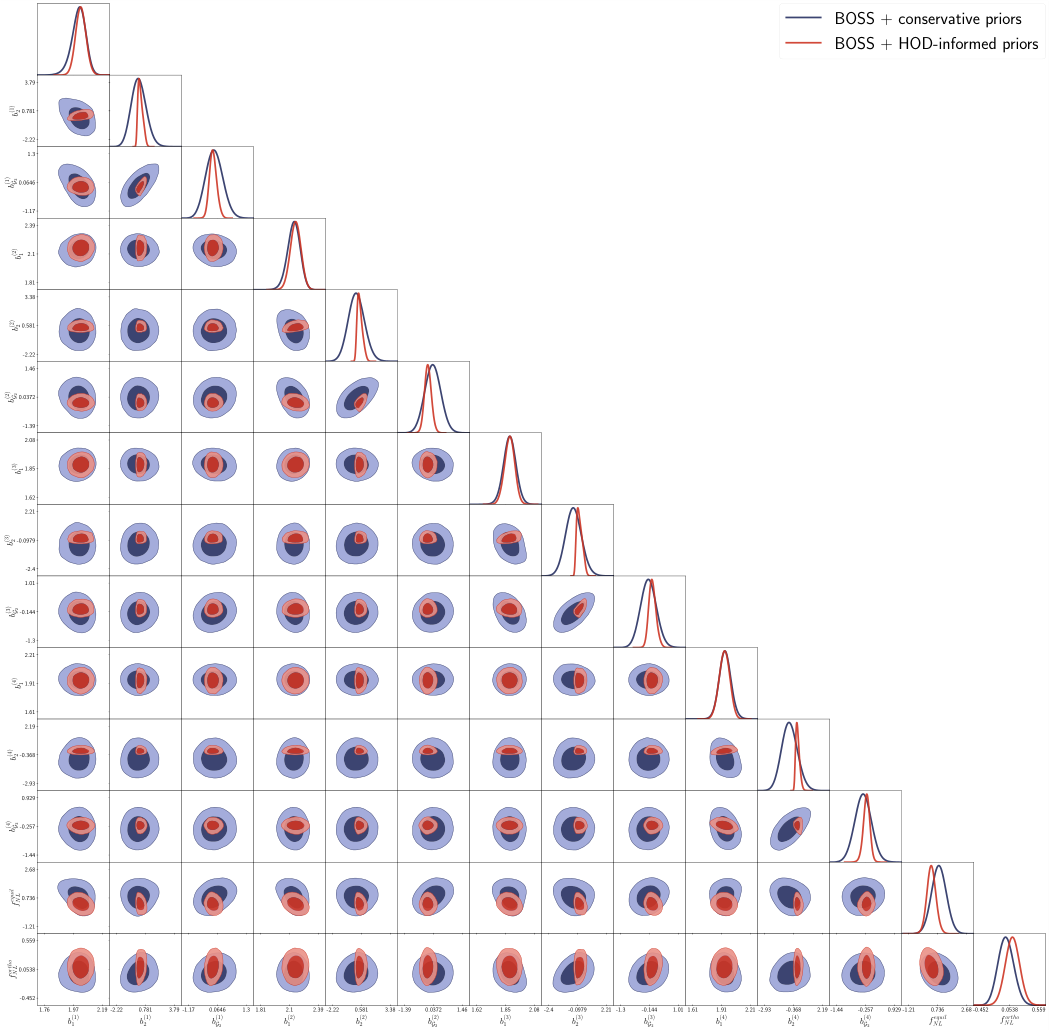
The approach has two steps:
-
Build the bias-from-simulations map. The team ran 10,500 mock galaxy catalogs using the Halo Occupation Distribution (HOD) model, a statistical recipe that populates dark matter halos with galaxies according to rules rooted in real observations. From these mocks, they extracted EFT bias parameters using field-level EFT, a technique that exploits cosmic variance cancellation: because the simulated and reference universes share the same large-scale structure, statistical noise cancels out, so you can precisely calibrate EFT parameters from computationally cheap small-volume simulations.
-
Learn the distribution with normalizing flows. The 10,500 samples span a 14-dimensional parameter space (HOD parameters plus EFT bias parameters). Rather than fitting simple Gaussian approximations, the team used normalizing flows, a type of neural network that learns complex probability distributions by gradually transforming a simple shape (like a bell curve) into whatever shape the data requires.
The learned marginal distribution over EFT parameters then becomes the prior in the actual data analysis. It isn’t a vague Gaussian guess. It knows, from thousands of simulations, which combinations of bias parameters are physically plausible for BOSS-like galaxies. It rules out the vast swaths of parameter space that no realistic galaxy population would ever occupy.
Why It Matters
The immediate target is primordial non-Gaussianity (PNG): subtle statistical patterns in the universe’s earliest moments that reveal whether the initial density fluctuations were perfectly random or showed signs of more exotic physics. The team focuses on equilateral and orthogonal PNG templates, which probe how the inflaton field (the energy field thought to have driven the universe’s rapid early expansion) interacted with itself. If inflation wasn’t the simplest possible single-field model, PNG is where the fingerprints show up.
Using HOD-based priors on BOSS power spectra and bispectra (statistical summaries of how strongly galaxies cluster at different scales and in different geometric configurations), the team finds f_NL^equil = 320 ± 300 and f_NL^ortho = 100 ± 130 (68% confidence), with uncertainties roughly 40% smaller than conventional analyses. The posterior volume for galaxy bias parameters in each BOSS chunk shrank by an order of magnitude. That’s not a marginal tweak; it’s a real gain in constraining inflation physics from galaxy surveys.
This matters well beyond BOSS. Surveys like DESI, Euclid, and the Roman Space Telescope will map hundreds of millions of galaxies over the coming decade. The galaxy bias problem won’t go away; it gets worse as statistical power improves. Simulation-based priors transfer directly to these next-generation surveys.
The framework is also modular: as HOD models improve and hydrodynamical simulations get more realistic, the priors sharpen for free.
It’s worth being clear about what machine learning actually did here. It didn’t replace physical modeling. The normalizing flow didn’t invent knowledge about galaxy bias. It compressed and organized knowledge already embedded in thousands of physically motivated simulations, then packaged it in a form that slots into a rigorous Bayesian analysis.
Bottom Line: By combining 10,500 galaxy simulations with neural density estimators, this work turned galaxy bias from a constraint-killing nuisance into a well-characterized prior, delivering a 40% improvement in inflation constraints equivalent to doubling the BOSS survey volume, and pointing toward the same approach for next-generation large-scale structure cosmology.
IAIFI Research Highlights

Normalizing flows trained on galaxy simulations produce a physically grounded Bayesian prior, tightening cosmological constraints on inflationary physics without any new observational data.

The neural density estimators learned the full joint distribution across a 14-dimensional, 10,500-sample parameter space, capturing structure that simplified Gaussian approximations would miss entirely.

The improved constraints on equilateral and orthogonal primordial non-Gaussianity push closer to the theoretical thresholds that distinguish standard single-field inflation from models with exotic inflaton self-interactions or modified propagation speeds.
Applying this framework to DESI, Euclid, and Roman data, combined with improved HOD and hydrodynamical simulation models, could tighten these constraints further. See [arXiv:2402.13310](https://arxiv.org/abs/2402.13310) for full details.