

First demonstration of neural sensing and control in a kilometer-scale gravitational wave observatory
Authors
Nikhil Mukund, James Lough, Aparna Bisht, Holger Wittel, Séverin Landry Nadji, Christoph Affeldt, Fabio Bergamin, Marc Brinkmann, Volker Kringel, Harald Lück, Michael Weinert, Karsten Danzmann
Abstract
Suspended optics in gravitational wave (GW) observatories are susceptible to alignment perturbations, particularly slow drifts over time, due to variations in temperature and seismic levels. Such misalignments affect the coupling of the incident laser beam into the optical cavities, degrade both circulating power and optomechanical photon squeezing and thus decrease the astrophysical sensitivity to merging binaries. Traditional alignment techniques involve differential wavefront sensing using multiple quadrant photodiodes but are often restricted in bandwidth and are limited by the sensing noise. We present the first-ever successful implementation of neural network-based sensing and control at a gravitational wave observatory and demonstrate low-frequency control of the signal recycling mirror at the GEO 600 detector. Alignment information for three critical optics is simultaneously extracted from the interferometric dark port camera images via a CNN-LSTM network architecture and is then used for MIMO control using soft actor-critic-based deep reinforcement learning. Overall sensitivity improvement achieved using our scheme demonstrates deep learning's capabilities as a viable tool for real-time sensing and control for current and next-generation GW interferometers.
Concepts
The Big Picture
Imagine trying to detect a ripple in spacetime so faint it would stretch a kilometer-long laser beam by less than one-thousandth the width of a proton. Now imagine that the mirror guiding your laser keeps drifting out of position because the ground is trembling and the temperature won’t hold still. That’s the daily reality inside a gravitational wave observatory.
GEO 600 is a 600-meter precision laser detector near Hannover, Germany. Like LIGO and Virgo, it splits a laser beam, bounces it down two long arms, and recombines it to detect microscopic distortions caused by passing gravitational waves.
The mirrors doing the bouncing hang from pendulums, and they drift. Ground vibrations and temperature changes nudge them out of alignment, slowly and relentlessly. Traditional correction systems analyze tiny differences in the laser beam’s shape to figure out where each mirror is pointing. The results are impressive, but the systems can only respond to slow changes, are prone to sensor noise, and need human intervention about once a week.
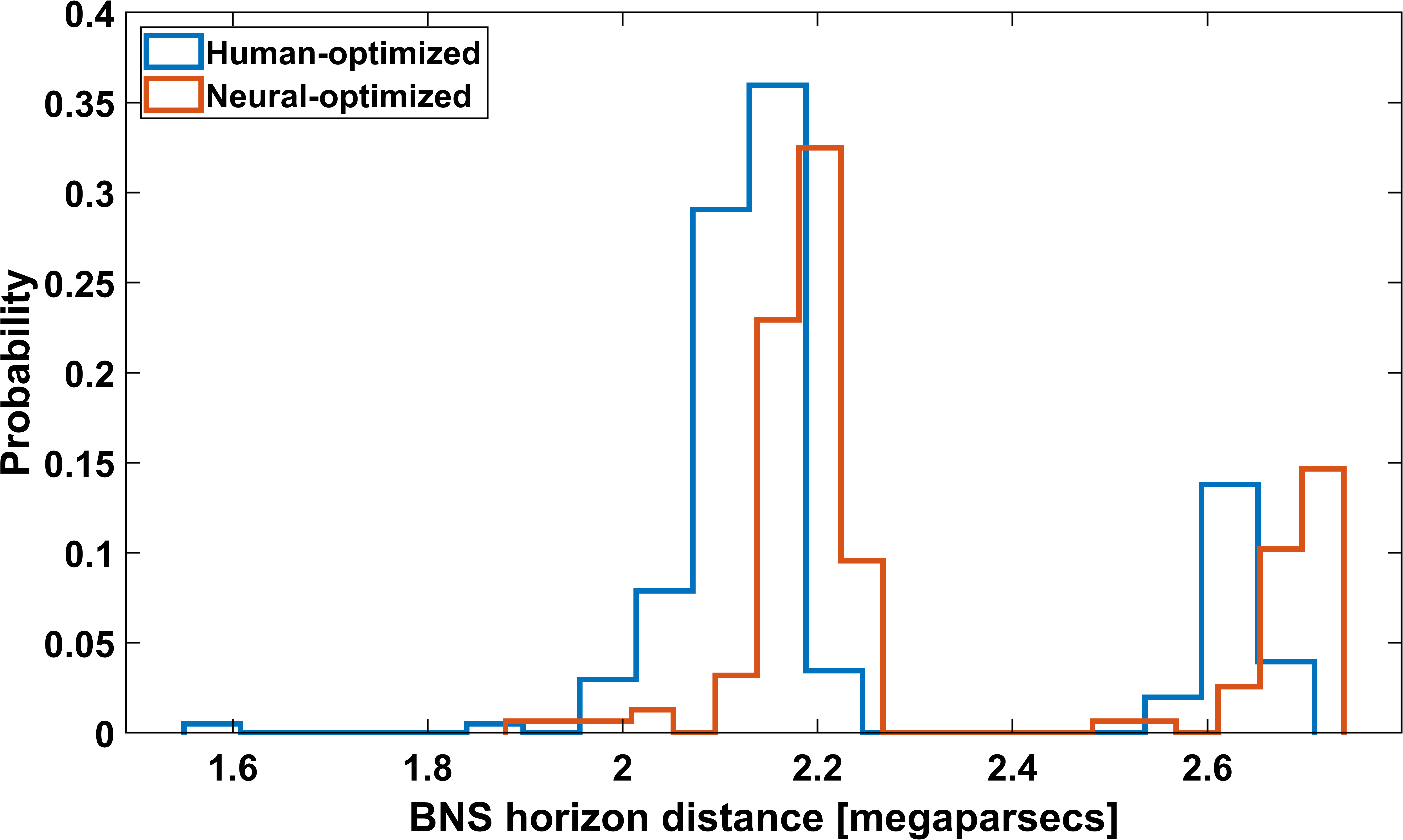
A team from the Max Planck Institute for Gravitational Physics and MIT has now pulled off a first: deploying a neural network-based sensing and control system inside a real, kilometer-scale gravitational wave observatory.
Key Insight: Replacing classical photodiode-based alignment sensors with a deep learning system trained on camera images, paired with reinforcement learning control, gave researchers real-time mirror alignment at GEO 600 and improved the detector’s astrophysical sensitivity.
How It Works
Classical alignment modulates the laser beam’s brightness in a known pattern, then reads the result with quadrant photodiodes (QPDs): sensors split into four sections that detect where the beam lands. It works, but it’s noisy, only responds to slow changes, and breaks down when beams drift off-center by even one beam radius. At that point, 86% of the sensing signal is lost.
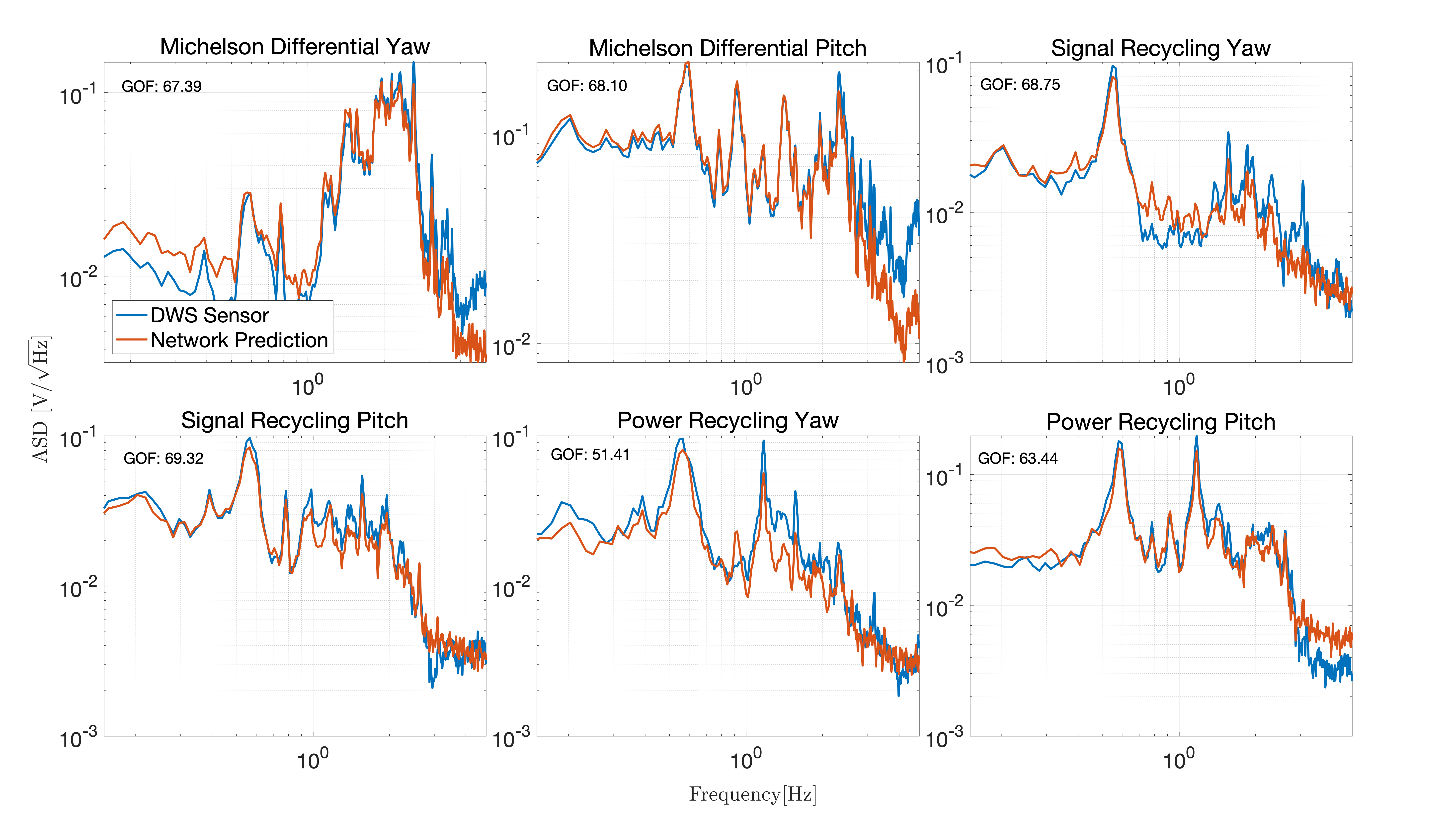
The new system takes a different tack. Instead of dedicated photodiodes, it watches the dark port camera already installed at GEO 600, which images light leaking out of the interferometer’s output. This image encodes alignment information for multiple mirrors at once, written in subtle spatial patterns.
To decode that information, the team trained a CNN-LSTM network. The convolutional layers extract spatial features from each image; the long short-term memory layers track how those features change over time. From a single image stream, the network pulls alignment information for three critical optical components: the signal recycling mirror, the Michelson mirror, and a third key optic.
Good sensor data is only half the problem. You also need to decide what to do with it. Here the team deployed a soft actor-critic (SAC) reinforcement learning controller. SAC learns a control policy by maximizing both a reward signal and entropy, which keeps it exploring rather than locking onto a single strategy. The SAC agent handles multiple-input, multiple-output (MIMO) control, simultaneously nudging multiple mirrors based on the CNN-LSTM’s alignment estimates.
Training ran in four stages:
- Collect real interferometer data to train the CNN-LSTM sensing network
- Use the trained sensor to estimate alignment states from dark port images
- Train the SAC agent in simulation to learn a control policy
- Deploy the full system in real time at GEO 600, controlling the SR mirror at low frequencies
The main target was low-frequency control of the signal recycling mirror, since gradual drifts are what classical systems handle most poorly. The signal recycling (SR) mirror sits at the interferometer’s output port and amplifies gravitational wave signals. Keeping it aligned maintains circulating power, preserves the quantum squeezing of light that boosts sensitivity, and prevents noise from contaminating the strain readout.

Why It Matters
The performance numbers matter, but the real point is where this ran: a live kilometer-scale detector hunting for signals from merging neutron stars, not a simulation or a tabletop setup.
Classical alignment needed manual recalibration roughly once a week because environmental disturbances (seismic events, thermal drifts) would knock beam spots off their photodiodes. The neural system reads directly from camera images and tolerates these perturbations far better. It sees the detector’s state from the light itself, with no dedicated auxiliary sensors required.
Next-generation observatories will need this even more. Einstein Telescope and Cosmic Explorer, planned detectors with arms stretching 10 to 40 kilometers, will face alignment challenges far beyond what today’s instruments deal with. More independently moving optical components, more intricate interactions between them, higher sensitivity stakes. A system that tracks multiple optics from one camera feed and corrects for their interactions in real time is a natural fit.
Open questions remain: how well the approach generalizes to more complex configurations, how it handles rapid transient disturbances, and how it integrates with existing classical control loops. But those are engineering questions for a maturing technology, not doubts about whether the core idea works.
Bottom Line: For the first time, a neural network watching a camera and guided by reinforcement learning has kept a gravitational wave detector’s mirrors aligned better than the system it supplements. It’s a proof of concept for AI-assisted control in the next generation of observatories. Full details are in arXiv:2301.06221.
IAIFI Research Highlights

Deep learning meets precision experimental physics, with CNN-LSTM sensing and soft actor-critic reinforcement learning running as a real-time control system inside one of the world's most sensitive scientific instruments.

A MIMO soft actor-critic controller running in real time, in a high-stakes physical environment, takes reinforcement learning well past the simulation stage. Control quality directly affects measurement sensitivity, making this a demanding test of the algorithm's reliability.

Better alignment control of the signal recycling mirror at GEO 600 improves detector sensitivity, sharpening observations of compact binary mergers and other astrophysical sources.
Future work targets higher-bandwidth control, integration with next-generation detectors like Einstein Telescope, and extension to additional optical degrees of freedom. Full details appear in [arXiv:2301.06221](https://arxiv.org/abs/2301.06221).
Original Paper Details
First demonstration of neural sensing and control in a kilometer-scale gravitational wave observatory
2301.06221
Nikhil Mukund, James Lough, Aparna Bisht, Holger Wittel, Séverin Landry Nadji, Christoph Affeldt, Fabio Bergamin, Marc Brinkmann, Volker Kringel, Harald Lück, Michael Weinert, Karsten Danzmann
Suspended optics in gravitational wave (GW) observatories are susceptible to alignment perturbations, particularly slow drifts over time, due to variations in temperature and seismic levels. Such misalignments affect the coupling of the incident laser beam into the optical cavities, degrade both circulating power and optomechanical photon squeezing and thus decrease the astrophysical sensitivity to merging binaries. Traditional alignment techniques involve differential wavefront sensing using multiple quadrant photodiodes but are often restricted in bandwidth and are limited by the sensing noise. We present the first-ever successful implementation of neural network-based sensing and control at a gravitational wave observatory and demonstrate low-frequency control of the signal recycling mirror at the GEO 600 detector. Alignment information for three critical optics is simultaneously extracted from the interferometric dark port camera images via a CNN-LSTM network architecture and is then used for MIMO control using soft actor-critic-based deep reinforcement learning. Overall sensitivity improvement achieved using our scheme demonstrates deep learning's capabilities as a viable tool for real-time sensing and control for current and next-generation GW interferometers.