

Finite-Volume Pionless Effective Field Theory for Few-Nucleon Systems with Differentiable Programming
Authors
Xiangkai Sun, William Detmold, Di Luo, Phiala E. Shanahan
Abstract
Finite-volume pionless effective field theory provides an efficient framework for the extrapolation of nuclear spectra and matrix elements calculated at finite volume in lattice QCD to infinite volume, and to nuclei with larger atomic number. In this work, it is demonstrated how this framework may be implemented via a set of correlated Gaussian wavefunctions optimised using differentiable programming and via solution of a generalised eigenvalue problem. This approach is shown to be significantly more efficient than a stochastic implementation of the variational method based on the same form of correlated Gaussian wavefunctions, yielding comparably accurate representations of the ground-state wavefunctions with an order of magnitude fewer terms. The efficiency of representation allows such calculations to be extended to larger systems than in previous work. The method is demonstrated through calculations of the binding energies of nuclei with atomic number $A\in\{2,3,4\}$ in finite volume, matched to lattice QCD calculations at quark masses corresponding to $m_π=806$ MeV, and infinite-volume effective field theory calculations of $A\in\{2,3,4,5,6\}$ systems based on this matching.
Concepts
The Big Picture
Computing how protons and neutrons bind together from first principles is, to put it mildly, a mess. Quantum Chromodynamics gives you the exact rules for quarks and gluons, but those rules become intractable at the energy scales where nuclei form.
The standard workaround is to discretize space and time into a grid (a “lattice”) and simulate physics on supercomputers. Lattice calculations are confined to tiny artificial boxes, though, and computational cost explodes as you add more nucleons.
A new paper from MIT’s Center for Theoretical Physics and IAIFI takes a different tack. Instead of brute-forcing larger lattice calculations, the researchers use a bridge theory called pionless effective field theory, a simplified description that captures essential nuclear forces without tracking every quark and gluon, to translate small lattice results into predictions for bigger nuclei. They made that bridge dramatically more efficient by replacing a slow random search with differentiable programming.
The payoff: the same accuracy as previous methods with roughly ten times fewer terms, and nuclear predictions extended to systems that were previously out of reach.
Differentiable programming, the mathematical engine behind neural network training, can optimize nuclear wavefunctions too. Applied here, it squeezes an order-of-magnitude efficiency gain from the same underlying physics framework.
How It Works
The strategy has two stages. First, run a lattice QCD calculation of a small nucleus inside an artificial box. Those results carry finite-volume artifacts, distortions introduced because particles in a box don’t behave the same as particles in infinite space. Second, use finite-volume pionless effective field theory (FVEFT) to model those same box calculations, pin down the theory’s free parameters (the low-energy constants, or LECs, controlling how strongly nucleons attract each other), then extrapolate to infinite volume and larger nuclei.
The tricky part is step two. FVEFT requires finding the wavefunction that gives the lowest possible energy. The standard approach, the stochastic variational method (SVM), builds a trial wavefunction by randomly proposing Gaussian “blobs” one at a time, keeping each only if it improves the energy estimate. It works, but can require hundreds or thousands of terms to converge.
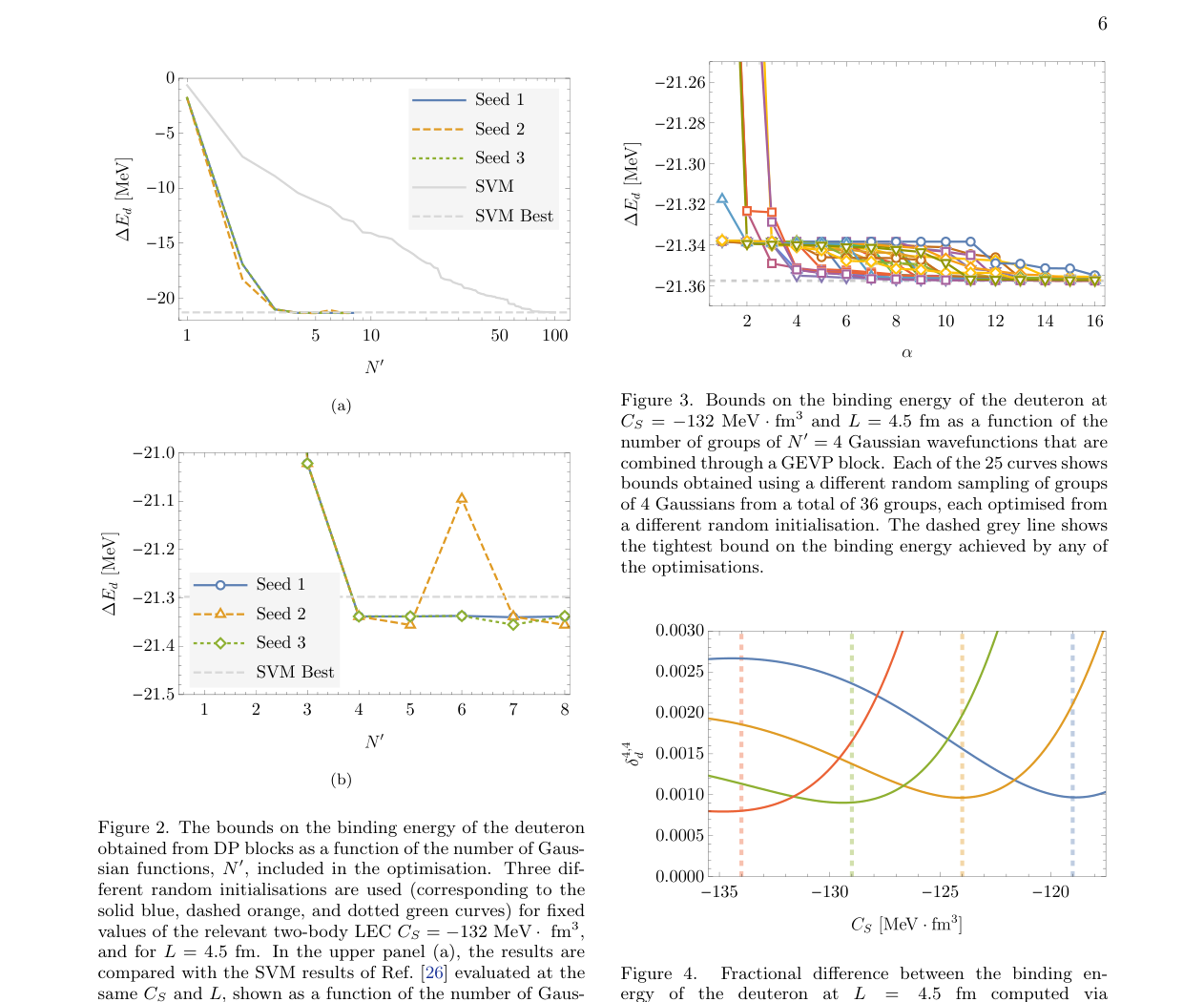
The authors flip this around. They write down a compact wavefunction using a fixed number of correlated Gaussian terms (multi-dimensional bell curves encoding how particles influence each other’s positions), then compute how the energy changes with respect to every parameter. Gradient descent optimizes all parameters simultaneously, steering the wavefunction toward the true ground state. Same math that trains a neural network, different target.
The key steps:
- Parameterize the trial wavefunction as a sum of correlated Gaussians with adjustable widths, centers, and correlations.
- Compute the energy as a differentiable function of those parameters using quantum mechanical expectation values.
- Backpropagate: calculate how each parameter nudges the energy, and update all parameters simultaneously via gradient descent.
- Stack multiple optimized states and solve a generalized eigenvalue problem (GEVP) to extract the most accurate energy levels from overlapping approximate solutions.
Where SVM needs hundreds of Gaussian terms to represent the helium-4 (⁴He) ground state, differentiable programming hits comparable accuracy with roughly ten times fewer. That compactness matters. Memory and compute scale badly with term count, so a 10× reduction opens up calculations that were previously impractical.
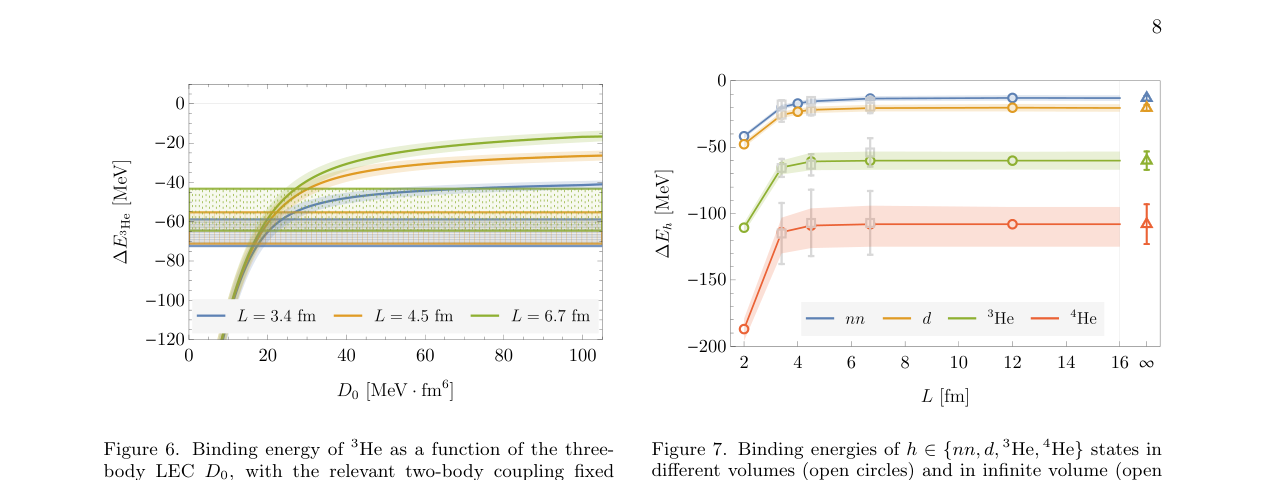
The team validated the method by computing binding energies for nuclei with A∈{2,3,4} inside finite-volume boxes, matching them to existing lattice QCD results at an artificially heavy pion mass of m_π = 806 MeV. With LECs pinned down, they extrapolated to infinite volume and pushed up to A=5 and A=6, systems not previously reached with this framework.
Why It Matters
First-principles nuclear physics is hard. So is figuring out where gradient-based optimization can outperform older numerical methods. This paper tackles both.
PyTorch and JAX have already changed how people do computer vision, language modeling, and protein structure prediction. The differentiable programming machinery underneath those frameworks turns out to work just as well in quantum few-body physics.
With FVEFT matching now extended to A=5 and A=6, physicists have a longer bridge from lattice QCD toward the nuclear chart. As lattice QCD approaches physical quark masses and its systematic uncertainties shrink, this matching framework can absorb those improvements and propagate them to larger nuclei. The same differentiable variational approach could also go after nuclear matrix elements relevant to neutrinoless double-beta decay searches, or other few-body quantum systems where compact wavefunctions are at a premium.
Replacing random sampling with gradient-based optimization cuts nuclear wavefunction costs by an order of magnitude. That efficiency gain enables first-principles-anchored predictions for A=5 and A=6 nuclei, pushing the reach of lattice QCD further into nuclear physics.
IAIFI Research Highlights

Differentiable programming meets pionless nuclear effective field theory. Gradient-based optimization directly accelerates quantum many-body calculations that previously relied on stochastic methods.

Differentiable programming turns out to be more than a neural network training trick. Applied to a demanding physics problem, it delivers order-of-magnitude efficiency gains over stochastic variational methods, demonstrating its reach as a general-purpose scientific optimization tool.

Extending finite-volume EFT calculations to A=5 and A=6 nuclei matched to lattice QCD tightens the connection between the Standard Model's quark-gluon dynamics and actual nuclear properties.
Future work will target physical pion masses and larger nuclei as lattice QCD matures; the full methodology is detailed in [arXiv:2202.03530](https://arxiv.org/abs/2202.03530).
Original Paper Details
Finite-Volume Pionless Effective Field Theory for Few-Nucleon Systems with Differentiable Programming
[2202.03530](https://arxiv.org/abs/2202.03530)
Xiangkai Sun, William Detmold, Di Luo, Phiala E. Shanahan
Finite-volume pionless effective field theory provides an efficient framework for the extrapolation of nuclear spectra and matrix elements calculated at finite volume in lattice QCD to infinite volume, and to nuclei with larger atomic number. In this work, it is demonstrated how this framework may be implemented via a set of correlated Gaussian wavefunctions optimised using differentiable programming and via solution of a generalised eigenvalue problem. This approach is shown to be significantly more efficient than a stochastic implementation of the variational method based on the same form of correlated Gaussian wavefunctions, yielding comparably accurate representations of the ground-state wavefunctions with an order of magnitude fewer terms. The efficiency of representation allows such calculations to be extended to larger systems than in previous work. The method is demonstrated through calculations of the binding energies of nuclei with atomic number $A\in\{2,3,4\}$ in finite volume, matched to lattice QCD calculations at quark masses corresponding to $m_π=806$ MeV, and infinite-volume effective field theory calculations of $A\in\{2,3,4,5,6\}$ systems based on this matching.