

Field of Junctions: Extracting Boundary Structure at Low SNR
Authors
Dor Verbin, Todd Zickler
Abstract
We introduce a bottom-up model for simultaneously finding many boundary elements in an image, including contours, corners and junctions. The model explains boundary shape in each small patch using a 'generalized M-junction' comprising M angles and a freely-moving vertex. Images are analyzed using non-convex optimization to cooperatively find M+2 junction values at every location, with spatial consistency being enforced by a novel regularizer that reduces curvature while preserving corners and junctions. The resulting 'field of junctions' is simultaneously a contour detector, corner/junction detector, and boundary-aware smoothing of regional appearance. Notably, its unified analysis of contours, corners, junctions and uniform regions allows it to succeed at high noise levels, where other methods for segmentation and boundary detection fail.
Concepts
The Big Picture
Imagine trying to sketch a map of a city in thick fog. You can barely make out the streets, but you know they form corners at intersections, smooth curves as they bend, and T-junctions where side streets meet main roads. A skilled cartographer wouldn’t squint at one intersection at a time. They’d use their knowledge of how streets connect to fill in what the fog obscures. That’s roughly how a computer vision model from Harvard finds image edges and boundaries in conditions where virtually every other approach goes blind.
Vision researchers have chased the boundary detection problem for decades, and for good reason: finding where one region ends and another begins is a prerequisite for almost everything a visual system needs to do. Detect an object, understand a scene, navigate a room. But images taken at short exposures, in low light, or from challenging sensors are riddled with noise. Most boundary detection methods, even deep learning systems trained on millions of images, fall apart as that noise climbs.
Dor Verbin and Todd Zickler at Harvard’s SEAS developed the field of junctions, a framework that simultaneously finds three types of image boundaries: smooth edges (contours), sharp corners, and junctions where multiple edges converge at a point. Rather than treating these as separate tasks, the model handles them together so each type of boundary reinforces the others during analysis.
Key Insight: Every small image patch is represented as a “generalized junction,” a wedge-shaped primitive that can smoothly deform into a contour, corner, or multi-way intersection. Because all boundary types share a single representation, they reinforce each other, enabling detection even when signal-to-noise ratios drop to levels that defeat other methods.
How It Works
The central building block is deceptively compact. The researchers define a generalized M-junction: a model for a small image patch consisting of M angular wedges radiating from a center point, each wedge assigned a distinct color. With the right parameters, this single shape can represent:
- A uniform region (no edges at all)
- A contour (two wedges, one boundary line passing through)
- A corner (two wedges meeting at an acute angle)
- A junction of degree M (M wedges, M boundary rays meeting at a point)
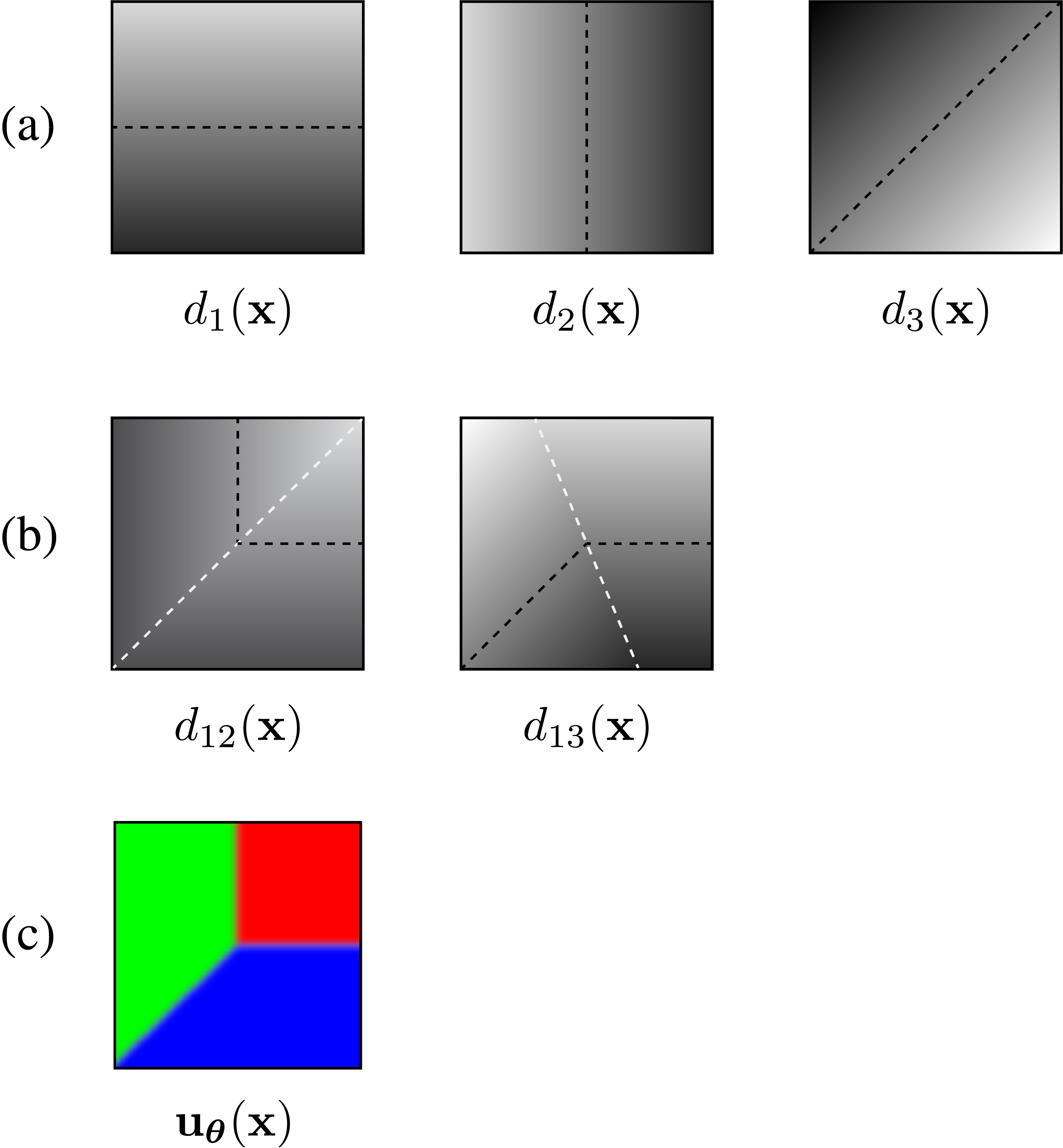
To analyze a full image, the model fits M+2 parameters to dense, overlapping patches at every pixel: the M angles, the vertex position, and the regional colors. This requires solving a non-convex optimization problem (a mathematical search with many local valleys, where it’s easy to get stuck before finding the best answer) across the full image at once. Patches share information with their neighbors, so a noisy patch with ambiguous boundary evidence gets help from surrounding patches where the signal is clearer.
Two innovations make the optimization tractable. First, a greedy initialization algorithm builds up the junction configuration one wedge at a time, giving the global search a good starting point. Second, a spatial regularizer (a penalty term that steers the solution toward smooth, physically plausible boundaries) reduces boundary curvature while simultaneously preserving sharp corners and multi-way junctions. Previous curvature-minimization methods couldn’t do this because they only handled two-region boundaries.
Traditional curvature penalties round off corners because the math doesn’t distinguish between a corner that should be sharp and curvature that should be smoothed away. The field of junctions sidesteps this by encoding the distinction structurally: corners and junctions are zero-dimensional events that the model explicitly represents. The regularizer smooths contours between them without blurring the junctions themselves.
Why It Matters
The most immediate payoff is noise resilience. The paper shows the field of junctions operating on extremely short-exposure images where competing methods produce nothing useful, even when those competitors are preceded by state-of-the-art denoising. This has obvious relevance for astronomy, medical imaging, and autonomous systems in low light, anywhere increasing exposure time isn’t an option.
There’s a deeper point, though. The field of junctions is model-based, not learned. It carries no trained weights, requires no labeled boundary data, and applies equally well to single-channel or multi-channel images regardless of imaging modality.
Encoder-decoder networks (neural networks that compress an image down and then expand it back up to locate boundaries) can internalize statistical patterns from large datasets, but they struggle with spatial precision because internal downsampling blurs boundaries. They also have trouble generalizing to radically different imaging conditions. The field of junctions trades dataset-specific performance for principled generality, and that trade-off pays off in scientific and low-data domains.
The framework also produces an interpretable intermediate representation. It doesn’t just label “there’s a boundary here.” It specifies “here’s a contour, here’s a corner, here’s a three-way junction, and here are the regional colors on each side.” Can the optimization be sped up for real-time use? Could the junction representation serve as a structural prior inside deep networks? How far does the noise tolerance extend to 3D volumes, temporal sequences, or imaging modalities far from natural photographs? These are the open questions the work leaves behind.
Bottom Line: The field of junctions reframes boundary detection as a cooperative, unified problem and achieves noise tolerance that outperforms specialized methods, pointing toward a new class of interpretable, model-based vision primitives.
IAIFI Research Highlights

The approach draws on optimization theory, signal processing, and computational geometry, producing a vision model that works more like a physicist's structured inference problem than a conventional machine learning pipeline.

The field of junctions shows that carefully designed model-based representations can outperform deep neural networks in high-noise regimes, offering a principled alternative when large labeled datasets are unavailable or imaging conditions are extreme.

Boundary extraction from noisy images is directly relevant to scientific imaging in physics, from detecting particle tracks in detectors to identifying structure in astronomical observations where signal-to-noise constraints are severe.
Future directions include integrating the field of junctions as a structural prior within neural architectures and extending the framework to 3D or temporal data; the paper is available at [arXiv:2011.13866](https://arxiv.org/abs/2011.13866).