

Feature Learning and Generalization in Deep Networks with Orthogonal Weights
Authors
Hannah Day, Yonatan Kahn, Daniel A. Roberts
Abstract
Fully-connected deep neural networks with weights initialized from independent Gaussian distributions can be tuned to criticality, which prevents the exponential growth or decay of signals propagating through the network. However, such networks still exhibit fluctuations that grow linearly with the depth of the network, which may impair the training of networks with width comparable to depth. We show analytically that rectangular networks with tanh activations and weights initialized from the ensemble of orthogonal matrices have corresponding preactivation fluctuations which are independent of depth, to leading order in inverse width. Moreover, we demonstrate numerically that, at initialization, all correlators involving the neural tangent kernel (NTK) and its descendants at leading order in inverse width -- which govern the evolution of observables during training -- saturate at a depth of $\sim 20$, rather than growing without bound as in the case of Gaussian initializations. We speculate that this structure preserves finite-width feature learning while reducing overall noise, thus improving both generalization and training speed in deep networks with depth comparable to width. We provide some experimental justification by relating empirical measurements of the NTK to the superior performance of deep nonlinear orthogonal networks trained under full-batch gradient descent on the MNIST and CIFAR-10 classification tasks.
Concepts
The Big Picture
Imagine playing telephone across a hundred people. Each person adds a little noise, a mumble here, a misheard word there. By the end, the original message is unrecognizable. Now imagine each person taught to keep the volume and clarity exactly right, passing along only meaningful content. The final message arrives crisp and intact, no matter how long the chain.
That’s what physicists and machine learning researchers at the University of Illinois and MIT have pulled off for deep neural networks, by swapping out one mathematical ingredient at the very start of training. Instead of setting a network’s starting connection strengths using numbers drawn from a standard bell-curve distribution, they initialize them as orthogonal matrices: arrays of numbers that, by construction, preserve the size of any signal passing through. The result is a network that behaves consistently whether it’s ten layers deep or a hundred.
The underlying problem is the exploding and vanishing gradient problem. The error signals used to teach the network either balloon out of control or shrink to nothing as they travel back through many layers. Even after decades of clever engineering workarounds, a basic question persisted: can we design initializations that keep these signals under control as depth grows? Hannah Day, Yonatan Kahn, and Daniel A. Roberts show mathematically, and confirm through experiments, that orthogonal initialization does exactly this.
Key Insight: Initializing neural network weights from orthogonal matrices, rather than standard Gaussian distributions, makes the statistical fluctuations governing training behavior independent of network depth, allowing stable, efficient training in very deep networks.
How It Works
The standard recipe for initializing a deep network draws each weight from a Gaussian (bell-curve) distribution, then tunes the variance to criticality, a mathematical sweet spot that prevents signals from exploding or collapsing as they travel forward through layers.
This works reasonably well, but there’s a catch. Even at criticality, Gaussian networks suffer from preactivation fluctuations (statistical noise in layer signals) that grow linearly with depth. These scale as L/n, where L is depth and n is width. When depth rivals width (L/n ~ 1), the fluctuations grow large enough to interfere with training.
Orthogonal matrices offer a cleaner starting point. A square orthogonal matrix O satisfies O^T O = I: it’s a pure rotation or reflection that reorients without ever stretching or compressing. The authors prove analytically that for networks using tanh activations (a smooth S-shaped function that belongs to a particular universality class of mathematically similar functions), orthogonal initialization makes preactivation fluctuations independent of depth to leading order in 1/n. The telephone chain no longer degrades with length.
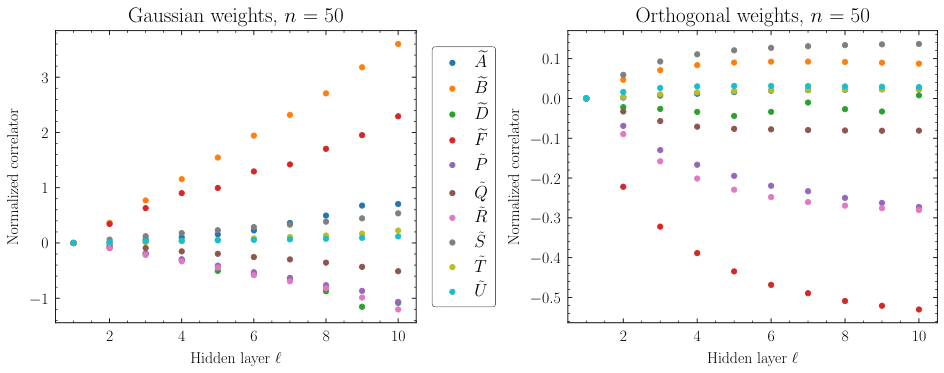
The analysis centers on the connected 4-point correlator, a statistical quantity measuring how much four neurons’ outputs co-vary. Think of it as a proxy for the overall noisiness of a network’s internal representations. For Gaussian initializations, this quantity grows without bound as depth increases. For orthogonal initializations with tanh, it stays flat.
This holds in the finite-width regime, the realistic setting where networks have a limited number of neurons per layer. The authors use a systematic expansion in powers of 1/n to track corrections that arise in real networks.
They also examine the neural tangent kernel (NTK), the central object governing how a network’s outputs change during gradient descent. The NTK and its statistical relatives encode how features evolve as the network learns. For Gaussian networks, NTK correlators scale with L/n, growing indefinitely. For orthogonal networks, the numerics tell a different story:
- At initialization, NTK correlators saturate around depth L ~ 20
- Beyond that depth, adding more layers doesn’t increase the noise
- This saturation appears across all NTK correlators studied, not just one
That saturation is the paper’s main experimental signature. Very deep orthogonal networks don’t accumulate progressively chaotic training dynamics. They hit a stable regime early and stay there.
Why It Matters
The practical payoff shows up in classification experiments. The team trained fully-connected networks on MNIST (handwritten digits) and CIFAR-10 (small color images) using full-batch gradient descent, a controlled setting that strips away the complexity of modern optimizers and regularization tricks.
In shallow networks (L/n << 1), Gaussian and orthogonal initializations perform comparably. Push into the deep regime (L/n ~ 1), and orthogonal networks pull ahead: better generalization, faster training. NTK fluctuations stay suppressed throughout the training run, confirming that the initial stability carries over into learning dynamics.
The tools behind this result come straight from physics. Perturbative expansions in 1/n, universality classes from statistical field theory, the geometry of matrix ensembles: these are the bread and butter of theoretical physics, repurposed here to say something precise about neural networks. The authors identify which activation functions belong to the right universality class (tanh yes, ReLU no), and that classification determines whether orthogonal initialization delivers its depth-independence benefits. This is structural insight from analytical theory, not empirical trial and error.
Plenty of open questions remain. The analysis covers fully-connected networks with tanh activations and full-batch gradient descent. Modern architectures use attention mechanisms, residual connections, and stochastic optimizers. Extending this framework to transformers and convolutional networks is the obvious next step. The authors also note that combining orthogonal initialization with techniques like LayerNorm might prove fruitful.
Bottom Line: Orthogonal weight initialization tames the noise that plagues deep Gaussian networks, keeping training dynamics stable regardless of depth. For anyone designing or scaling very deep networks, the choice of weight distribution at initialization may matter more than previously appreciated.
IAIFI Research Highlights

This work applies techniques from theoretical physics (perturbative expansions, universality classes, and random matrix theory) to derive rigorous analytical results about neural network training dynamics, in the tradition of physics-informed AI research at IAIFI.

The paper provides the first analytical and numerical evidence that orthogonal initialization suppresses NTK fluctuations independently of depth. The authors speculate that this explains why deep orthogonal networks generalize better than their Gaussian counterparts in practice, and their experiments on MNIST and CIFAR-10 support the hypothesis.

Universality, a concept central to statistical mechanics and quantum field theory, carries over directly into the theory of neural networks here. Certain classes of activation functions inherit depth-independent fluctuations, and the classification follows from the same mathematical structure physicists use in other domains.
Future directions include extending the orthogonal initialization framework to convolutional and attention-based architectures and deriving optimal hyperparameter prescriptions for the *L/n ~ 1* regime; the paper is available at [arXiv:2310.07765](https://arxiv.org/abs/2310.07765).
Original Paper Details
Feature Learning and Generalization in Deep Networks with Orthogonal Weights
[2310.07765](https://arxiv.org/abs/2310.07765)
Hannah Day, Yonatan Kahn, Daniel A. Roberts
Fully-connected deep neural networks with weights initialized from independent Gaussian distributions can be tuned to criticality, which prevents the exponential growth or decay of signals propagating through the network. However, such networks still exhibit fluctuations that grow linearly with the depth of the network, which may impair the training of networks with width comparable to depth. We show analytically that rectangular networks with tanh activations and weights initialized from the ensemble of orthogonal matrices have corresponding preactivation fluctuations which are independent of depth, to leading order in inverse width. Moreover, we demonstrate numerically that, at initialization, all correlators involving the neural tangent kernel (NTK) and its descendants at leading order in inverse width -- which govern the evolution of observables during training -- saturate at a depth of ~20, rather than growing without bound as in the case of Gaussian initializations. We speculate that this structure preserves finite-width feature learning while reducing overall noise, thus improving both generalization and training speed in deep networks with depth comparable to width. We provide some experimental justification by relating empirical measurements of the NTK to the superior performance of deep nonlinear orthogonal networks trained under full-batch gradient descent on the MNIST and CIFAR-10 classification tasks.