

Demonstration of neutron identification in neutrino interactions in the MicroBooNE liquid argon time projection chamber
Authors
MicroBooNE collaboration, P. Abratenko, O. Alterkait, D. Andrade Aldana, L. Arellano, J. Asaadi, A. Ashkenazi, S. Balasubramanian, B. Baller, A. Barnard, G. Barr, D. Barrow, J. Barrow, V. Basque, J. Bateman, O. Benevides Rodrigues, S. Berkman, A. Bhanderi, A. Bhat, M. Bhattacharya, M. Bishai, A. Blake, B. Bogart, T. Bolton, J. Y. Book, M. B. Brunetti, L. Camilleri, Y. Cao, D. Caratelli, F. Cavanna, G. Cerati, A. Chappell, Y. Chen, J. M. Conrad, M. Convery, L. Cooper-Troendle, J. I. Crespo-Anadon, R. Cross, M. Del Tutto, S. R. Dennis, P. Detje, R. Diurba, Z. Djurcic, R. Dorrill, K. Duffy, S. Dytman, B. Eberly, P. Englezos, A. Ereditato, J. J. Evans, R. Fine, B. T. Fleming, W. Foreman, D. Franco, A. P. Furmanski, F. Gao, D. Garcia-Gamez, S. Gardiner, G. Ge, S. Gollapinni, E. Gramellini, P. Green, H. Greenlee, L. Gu, W. Gu, R. Guenette, P. Guzowski, L. Hagaman, M. D. Handley, O. Hen, C. Hilgenberg, G. A. Horton-Smith, Z. Imani, B. Irwin, M. S. Ismail, C. James, X. Ji, J. H. Jo, R. A. Johnson, Y. J. Jwa, D. Kalra, N. Kamp, G. Karagiorgi, W. Ketchum, M. Kirby, T. Kobilarcik, I. Kreslo, N. Lane, J. -Y. Li, Y. Li, K. Lin, B. R. Littlejohn, H. Liu, W. C. Louis, X. Luo, C. Mariani, D. Marsden, J. Marshall, N. Martinez, D. A. Martinez Caicedo, S. Martynenko, A. Mastbaum, I. Mawby, N. McConkey, V. Meddage, J. Mendez, J. Micallef, K. Miller, K. Mistry, T. Mohayai, A. Mogan, M. Mooney, A. F. Moor, C. D. Moore, L. Mora Lepin, M. M. Moudgalya, S. Mulleria Babu, D. Naples, A. Navrer-Agasson, N. Nayak, M. Nebot-Guinot, C. Nguyen, J. Nowak, N. Oza, O. Palamara, N. Pallat, V. Paolone, A. Papadopoulou, V. Papavassiliou, H. Parkinson, S. F. Pate, N. Patel, Z. Pavlovic, E. Piasetzky, K. Pletcher, I. Pophale, X. Qian, J. L. Raaf, V. Radeka, A. Rafique, M. Reggiani-Guzzo, L. Ren, L. Rochester, J. Rodriguez Rondon, M. Rosenberg, M. Ross-Lonergan, I. Safa, D. W. Schmitz, A. Schukraft, W. Seligman, M. H. Shaevitz, R. Sharankova, J. Shi, E. L. Snider, M. Soderberg, S. Soldner-Rembold, J. Spitz, M. Stancari, J. St. John, T. Strauss, A. M. Szelc, W. Tang, N. Taniuchi, K. Terao, C. Thorpe, D. Torbunov, D. Totani, M. Toups, A. Trettin, Y. -T. Tsai, J. Tyler, M. A. Uchida, T. Usher, B. Viren, J. Wang, M. Weber, H. Wei, A. J. White, S. Wolbers, T. Wongjirad, M. Wospakrik, K. Wresilo, W. Wu, E. Yandel, T. Yang, L. E. Yates, H. W. Yu, G. P. Zeller, J. Zennamo, C. Zhang
Abstract
A significant challenge in measurements of neutrino oscillations is reconstructing the incoming neutrino energies. While modern fully-active tracking calorimeters such as liquid argon time projection chambers in principle allow the measurement of all final state particles above some detection threshold, undetected neutrons remain a considerable source of missing energy with little to no data constraining their production rates and kinematics. We present the first demonstration of tagging neutrino-induced neutrons in liquid argon time projection chambers using secondary protons emitted from neutron-argon interactions in the MicroBooNE detector. We describe the method developed to identify neutrino-induced neutrons and demonstrate its performance using neutrons produced in muon-neutrino charged current interactions. The method is validated using a small subset of MicroBooNE's total dataset. The selection yields a sample with $60\%$ of selected tracks corresponding to neutron-induced secondary protons.
Concepts
The Big Picture
Imagine trying to reconstruct a crime scene when some of the key evidence is invisible. You can see the aftermath, marks on the floor, disturbed furniture, but the perpetrator left no fingerprints and no photograph. Now scale that problem down to subatomic particles, compress the timeline to a fraction of a nanosecond, and raise the stakes: your entire understanding of why the universe is made of matter rather than nothing depends on catching the culprit.
That’s the situation with neutrons in neutrino detectors.
Neutrinos are absurdly hard to detect, but they do occasionally interact with matter and produce a shower of secondary particles. Measuring the energy of those secondaries tells us the energy of the original neutrino, and that measurement matters for experiments probing whether neutrinos and antineutrinos behave differently. That asymmetry could explain why the universe is made of matter at all.
The snag: neutrons carry no electric charge. They leave no track in a detector the way charged particles do. They carry away energy in silence, systematically skewing every neutrino energy measurement.
The MicroBooNE collaboration has now pulled off a first: demonstrating that neutrino-induced neutrons can be tagged inside a liquid argon time projection chamber. The trick is hunting for secondary protons kicked out when those invisible neutrons slam into argon nuclei.
Key Insight: For the first time, physicists have identified neutrons produced in neutrino interactions inside a liquid argon detector, the same technology powering the next generation of neutrino experiments. Their selected sample achieves 60% purity, meaning 60% of tagged tracks correspond to genuine neutron-induced secondary protons.
How It Works
The MicroBooNE detector is a 170-tonne tank of ultra-pure liquid argon threaded with thousands of sensing wires. When a charged particle passes through, it strips electrons from argon atoms. Those freed electrons drift toward the wires, creating a detailed three-dimensional image of the interaction.
This technology, the liquid argon time projection chamber (LArTPC), is excellent at tracking charged particles. It has a blind spot, though: neutral particles like neutrons don’t ionize argon and leave no trace.
The workaround is indirect. A neutron speeding through liquid argon will eventually collide with an argon nucleus and knock out a proton. That proton is charged and leaves a clean track. By searching for these neutron-induced secondary protons (NISPs), the team can infer a neutron’s presence even though the neutron itself was invisible.
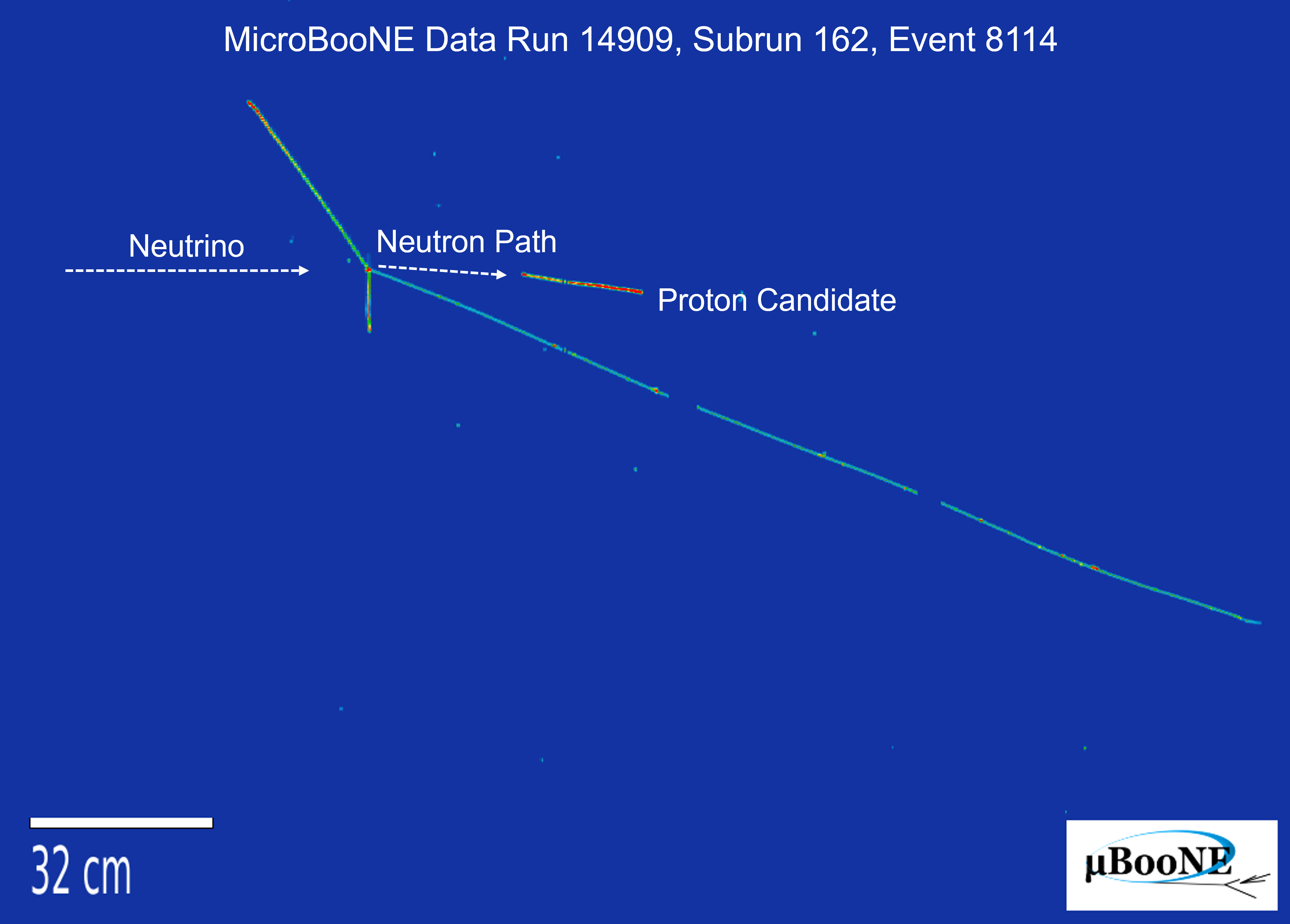
The detection proceeds in three steps:
- Identify the neutrino interaction vertex, the point where the original muon-neutrino hit an argon nucleus and produced a muon along with other particles.
- Search for displaced proton tracks: short tracks starting away from the interaction vertex. These are the signature of a neutron that traveled some distance before scattering.
- Apply selection cuts. Tracks must be spatially separated from the main vertex, have length and energy deposition consistent with a slow-moving proton, and point back toward the interaction region.
Plenty of short proton-like tracks arise from other sources. Pions bouncing off nuclei, misidentified muon segments, or ordinary protons from the primary collision placed at the wrong location can all mimic the signal. Separating genuine NISPs from this background required careful study of the neutron interaction length in argon (roughly 40 cm, the average distance a neutron travels before hitting a nucleus) and the characteristic energy-loss pattern of stopping protons.
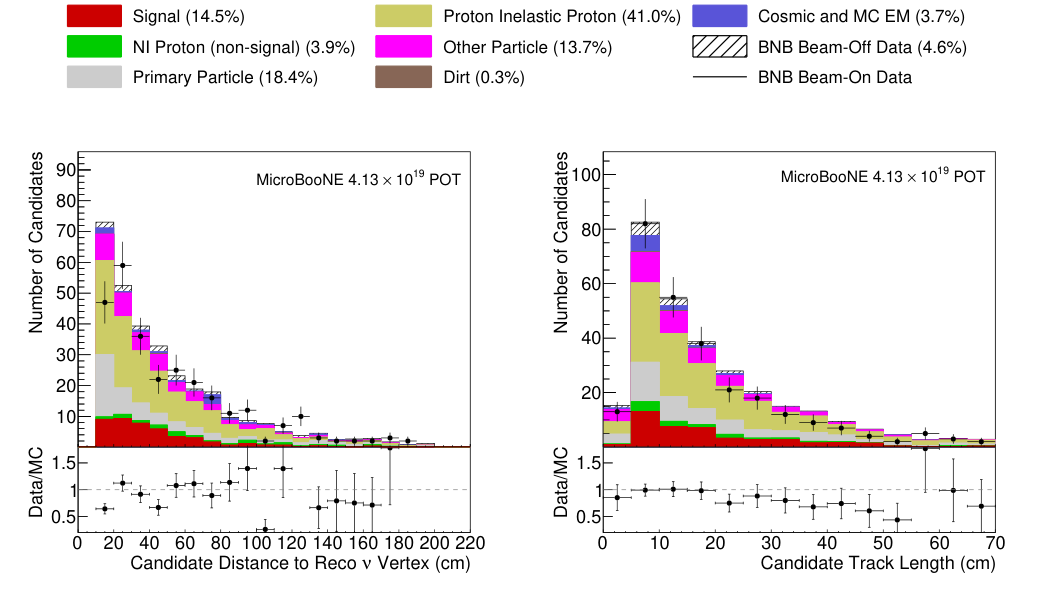
The team validated their method using muon-neutrino charged current interactions, where an incoming muon-neutrino produces a muon plus other particles. These are the best-understood neutrino collisions, making them a natural testing ground. Simulations using GENIE (for neutrino-nucleus interactions) and GEANT4 (for particle propagation through detector material) predicted the neutron production and scattering rates. The data agreed well with those predictions.
Why It Matters
The timing of this result is no accident. Two enormous experiments are under construction: the Deep Underground Neutrino Experiment (DUNE) in South Dakota and Hyper-Kamiokande in Japan. They represent the best shot at measuring the CP-violating phase, the asymmetry between neutrinos and antineutrinos that could explain why the universe contains matter rather than antimatter.
Both experiments demand extreme precision in neutrino energy reconstruction. DUNE uses LArTPC technology identical in principle to MicroBooNE, so it is especially affected. Neutrons represent a systematic error in energy estimates that, until now, has been impossible to constrain directly from data.
This result cracks that problem open. Future analyses can use neutron tagging to measure how many neutrons different neutrino interactions produce, what energies they carry, and how those rates compare to theory. Every improvement in neutron modeling translates into a sharper measurement of neutrino flavor oscillations and, ultimately, a clearer picture of the matter-antimatter asymmetry.
Bottom Line: MicroBooNE has demonstrated the first data-driven technique to identify neutrons in a liquid argon neutrino detector, achieving 60% purity in a neutron-tagged sample. This is a concrete step toward solving the “missing energy” problem that limits neutrino oscillation measurements at DUNE and other next-generation experiments.
IAIFI Research Highlights
The work sits at the intersection of nuclear physics, particle physics, and detector science, combining LArTPC reconstruction with detailed simulation to pick out signals that were previously invisible.

The simulation-driven reconstruction approach here (picking out rare indirect signatures buried in noisy detector data) is conceptually similar to the machine-learning-based event reconstruction techniques now being developed for future LArTPC experiments.

Tagging neutrons in a LArTPC for the first time constrains a major systematic uncertainty in neutrino energy reconstruction, with real consequences for DUNE's sensitivity to CP violation.
Future work will extend this technique to larger datasets and additional interaction channels to pin down neutron production cross-sections. The full analysis is available at [arXiv:2406.10583](https://arxiv.org/abs/2406.10583).