

Conversations and Deliberations: Non-Standard Cosmological Epochs and Expansion Histories
Authors
Brian Batell, Keith R. Dienes, Brooks Thomas, Scott Watson, Rouzbeh Allahverdi, Mustafa Amin, Kimberly K. Boddy, M. Sten Delos, Adrienne L. Erickcek, Akshay Ghalsasi, John T. Giblin, James Halverson, Fei Huang, Andrew J. Long, Lauren Pearce, Barmak Shams Es Haghi, Jessie Shelton, Gary Shiu, Kuver Sinha, Tristan L. Smith
Abstract
This document summarizes the discussions which took place during the PITT-PACC Workshop entitled "Non-Standard Cosmological Epochs and Expansion Histories," held in Pittsburgh, Pennsylvania, Sept. 5-7, 2024. Much like the non-standard cosmological epochs that were the subject of these discussions, the format of this workshop was also non-standard. Rather than consisting of a series of talks from participants, with each person presenting their own work, this workshop was instead organized around free-form discussion blocks, with each centered on a different overall theme and guided by a different set of Discussion Leaders. This document is not intended to serve as a comprehensive review of these topics, but rather as an informal record of the discussions that took place during the workshop, in the hope that the content and free-flowing spirit of these discussions may inspire new ideas and research directions.
Concepts
The Big Picture
Imagine reading a biography where everything before chapter three is blank. You know roughly how the story ends, but the formative years remain a mystery. That’s the situation cosmologists face with the universe itself. We have a detailed picture of cosmic history stretching back to about one second after the Big Bang, when Big Bang Nucleosynthesis (BBN) forged the light atomic nuclei that set the ratios of hydrogen, helium, and lithium we observe today. Before that? Essentially nothing.
What filled that cosmic chapter? Was the early universe dominated by fast-moving radiation, as the simplest models assume? Or did some exotic ingredient alter the expansion rate of space: a slowly decaying energy field, a swarm of tiny black holes, a peculiar frozen state called “stasis”?
These questions aren’t merely academic. The expansion history of the universe shapes everything from the clumping of dark matter into the structures that seeded galaxies, to the faint ripples in spacetime that next-generation detectors might soon pick up.
In September 2024, twenty physicists gathered in Pittsburgh for a workshop built not around polished talks but around open, free-flowing conversation. Their output is a document that maps the current frontier of non-standard cosmological epochs: where the field stands, what remains uncertain, and where the best observational handles lie.
Key Insight: The universe’s expansion history before Big Bang Nucleosynthesis remains almost entirely unconstrained, and the range of possibilities is enormous. But we may be close to probing it observationally.
How It Works
The workshop ran as a series of thematic discussion blocks, each opened with a brief framing presentation before stepping back to let conversation take over. Topics ranged from concrete observational signatures to abstract formal theory.
First up: what could we actually see if the early universe deviated from standard radiation domination? The group worked through several possible signals:
- Modifications to the matter power spectrum, the statistical fingerprint of how matter clusters on different scales
- Changes to the abundances of light elements produced during BBN
- Shifts in the stochastic gravitational-wave background, a faint hiss of gravitational waves from the early universe that space-based detectors like LISA may one day hear
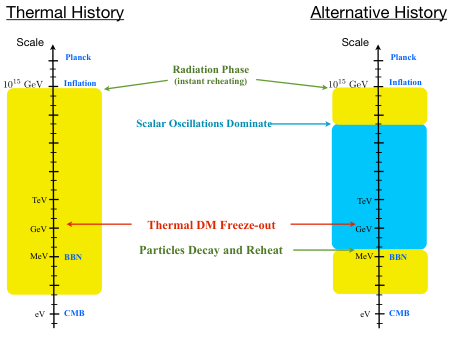
Much of the time went to Early Matter-Dominated Eras (EMDEs), periods when some heavy, slowly-decaying particle or field dominated the universe’s energy budget before eventually decaying into radiation. During an EMDE, the universe expands more slowly than in standard radiation domination. The consequences for dark matter are significant: particles that would otherwise have been diluted away survive, and small-scale structure forms differently. Those imprints could show up in dwarf galaxies or dark matter streams detectable through gravitational lensing.
The group also spent time on scalar fields, fundamental quantum fields that can drive unusual expansion phases. Depending on how a scalar field rolls down its potential energy landscape, it can mimic matter, radiation, or something in between. A few questions kept surfacing: How do you distinguish between different scalar field scenarios observationally? What theoretical constraints does string theory impose? Do top-down motivations from moduli fields (the parameters that set the shape of hidden extra dimensions in string theory) favor particular expansion histories?
Cosmological stasis drew some of the most spirited back-and-forth. This recently proposed phenomenon involves multiple particle species conspiring to hold the universe at a fixed expansion rate for an extended period, even as individual species decay and replenish each other. The concept grew out of thinking about “tower states,” a cascade of increasingly massive particles predicted by string theory. Whether stasis is a generic outcome of certain theoretical frameworks or a fine-tuned curiosity remained unresolved.
The final major thread concerned primordial black holes (PBHs): tiny black holes formed from density fluctuations in the very early universe. PBHs could have briefly dominated the universe’s energy density before evaporating via Hawking radiation, the slow leak of energy that causes black holes to gradually shrink and vanish. A PBH-dominated epoch would leave its own gravitational wave signature and could affect dark matter production in ways distinct from other non-standard scenarios.
Why It Matters
The conversational format gives this document a quality that formal publications rarely have: candor. Participants voiced genuine uncertainty, disagreement, and speculation. The result reads less like a review article and more like a window into how the field actually thinks about these problems.
The open questions are real. How do we tell apart different non-standard scenarios that produce similar observational signals? What new computational tools do we need to simulate structure formation through exotic cosmological epochs? Can machine learning help search for subtle signatures in gravitational wave data or the cosmic microwave background?
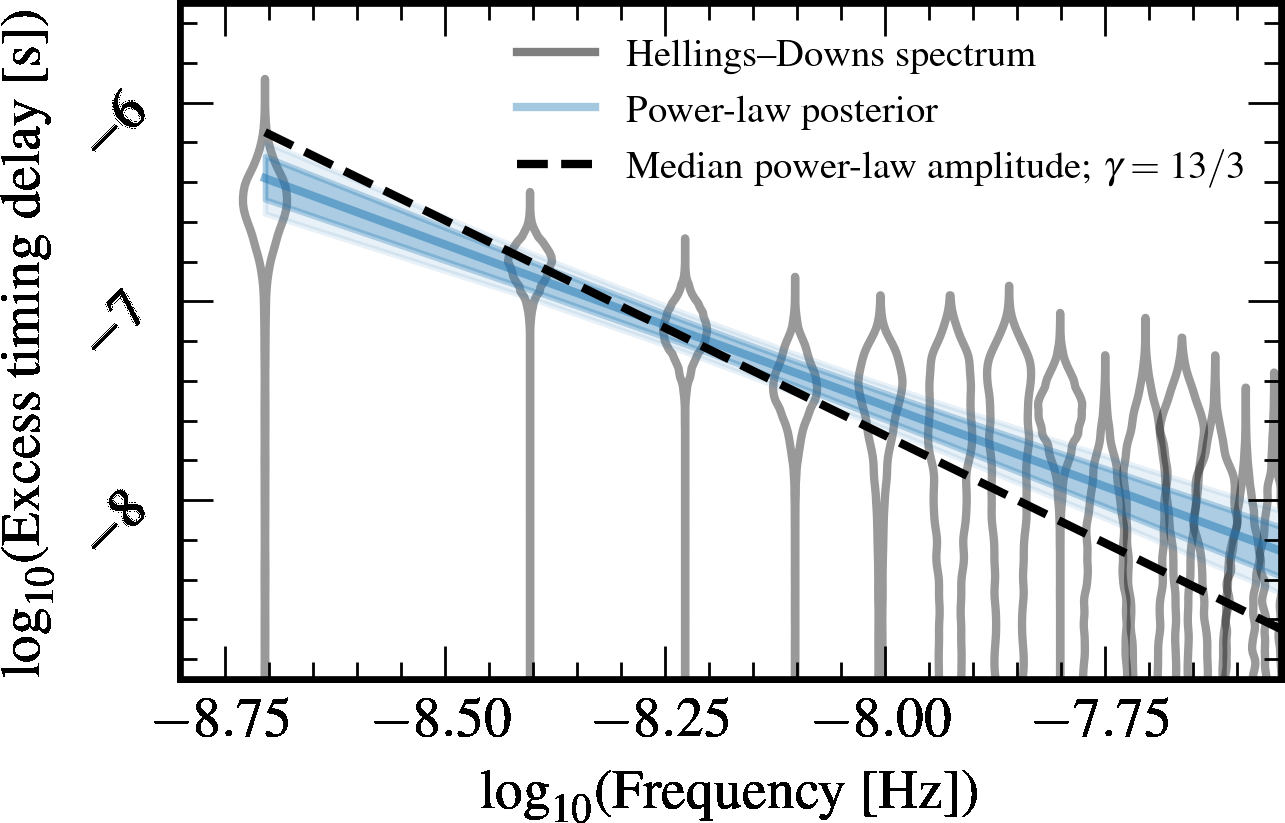
The timing matters too. Pulsar timing arrays, networks of ultra-precise cosmic clocks that detect passing gravitational waves, are already hinting at a gravitational wave background. LISA and the Einstein Telescope are on the horizon. Galaxy surveys like the Rubin Observatory’s LSST will map cosmic structure with unprecedented precision. The theoretical frameworks debated in Pittsburgh will face real tests within the next decade.
Getting ready for those tests (knowing which signatures are unique to which scenario, building reliable analysis pipelines) is urgent work. This workshop lays out the map.
Bottom Line: The universe’s first second remains cosmology’s greatest mystery, but a new generation of gravitational wave detectors and structure surveys is about to crack it open. The theoretical territory mapped at this Pittsburgh workshop defines exactly what signatures to look for.
IAIFI Research Highlights

This workshop, with IAIFI-affiliated physicist James Halverson (Northeastern) among its Discussion Leaders, connects string theory and formal high-energy physics with observational cosmology, using insights from both formal theory and astrophysical data to constrain the pre-BBN universe.

Participants identified machine learning as a needed tool for extracting subtle non-standard-epoch signatures from gravitational wave backgrounds and large-scale structure surveys, pointing toward AI-driven analysis pipelines as a near-term priority.

By mapping the full range of non-standard cosmological epochs, from EMDEs to stasis to PBH domination, the workshop establishes a theoretical framework for connecting string-motivated physics (moduli fields, tower states) to observable cosmological signatures.
Future work will focus on building observational probes that can discriminate between competing non-standard scenarios; the full workshop record is available at [arXiv:2411.04780](https://arxiv.org/abs/2411.04780).